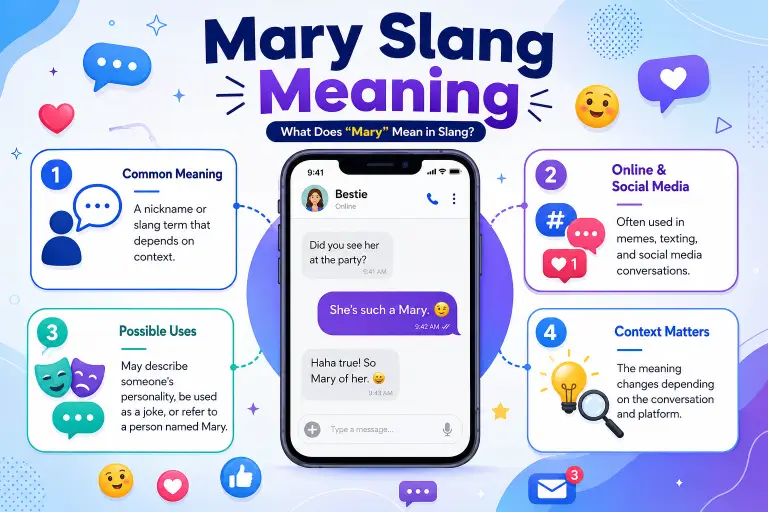
Mary slang does not have one single meaning. In most cases, Mary is simply a common first name. However, in slang, internet culture, and some communities, Mary can be used as a playful nickname, a humorous way to address someone, or a cultural expression. The exact meaning depends on the conversation and who is using it.
Many people search for mary slang after seeing it in a text message, TikTok video, meme, Instagram comment, or online discussion. Because the word has more than one meaning, it can be confusing.
This guide explains what mary slang means, where it comes from, how people use it on social media, and if it is appropriate in different situations. You’ll also find real-life examples, common misunderstandings, and answers to frequently asked questions so you can understand the term with confidence.
Quick Answer: What Does Mary Slang Mean?
Mary slang is an informal use of the name Mary rather than a fixed internet abbreviation. Depending on the situation, it may refer to a playful nickname, a humorous way to tease someone, or an expression used in drag culture and LGBTQ+ communities. Since there is no single universal definition, you should always consider the context before deciding what it means.
What Does Mary Slang Mean?
The meaning of mary slang changes depending on where and how it is used. Unlike abbreviations such as LOL, BRB, or SMH, Mary is not an acronym with one official definition.
Instead, people use the word in several different ways.
Some common meanings include:
- A playful nickname between friends
- A humorous way to call someone dramatic or overly cautious
- A friendly expression in drag culture
- A fictional or example name used in stories and jokes
- Simply someone’s real first name
The conversation usually makes the intended meaning clear.
For example:
Friend 1: “You checked the door lock five times.”
Friend 2: “Okay, Mary, relax!”
Here, Mary is being used jokingly to tease someone for being extra careful.
In another conversation:
“Hey Mary, are you coming to dinner?”
In this case, Mary is simply the person’s name and has nothing to do with slang.
This is why context is the most important part of understanding the word.
Is “Mary” a Slang Word?
Sometimes but not always.
Most of the time, Mary is simply a traditional given name. However, names often become informal expressions over time, especially in online communities, comedy, entertainment, and popular culture.
When people use Mary as slang, they are usually not talking about someone actually named Mary. Instead, they use it to add humor, tease a friend, or make a conversation feel more playful.
Unlike many internet slang terms, there is no official dictionary definition that covers every use of Mary as slang. Different communities have developed their own meanings over time.
Because of this, you should avoid assuming that every use of Mary has the same meaning.
Does Mary Have a Full Form?
No.
Mary is not an abbreviation, so it does not have a full form.
Some people search for:
- Mary full form
- What does Mary stand for?
- Mary abbreviation
The answer is simple:
Mary does not stand for anything. It is a personal name that sometimes takes on a slang meaning depending on the context.
This makes it different from abbreviations like:
| Term | Full Form |
| LOL | Laughing Out Loud |
| BRB | Be Right Back |
| IMO | In My Opinion |
| IDK | I Don’t Know |
| Mary | No full form (personal name used as slang in some contexts) |
If someone asks, “What does Mary stand for?”, the correct answer is that it is a name, not an acronym.
Why Do People Search for “Mary Slang”?
People often search for mary slang because they have seen the word used in a way that doesn’t seem like someone’s actual name.
Common places where people encounter it include:
- TikTok
- X (formerly Twitter)
- Discord
- Text messages
- Online memes
- Group chats
In many of these situations, Mary is used jokingly or playfully, making people curious about its meaning.
Someone might comment:
- “Mary, please stop 😂”
- “Go off, Mary!”
- “Okay, Mary…”
- “That’s so Mary of you.”
Without understanding the context, these comments can seem confusing. That’s why learning the different meanings is important before using the term yourself.
At a Glance: Mary Slang Meaning
| Feature | Details |
| Word | Mary |
| Type | Slang term / Personal name |
| Full Form | None |
| Common Tone | Playful, humorous, casual |
| Used In | Texting, social media, memes, conversations |
| Can Have Multiple Meanings? | Yes |
| Professional Use? | Usually not recommended |
| Needs Context? | Yes context determines the meaning |
Different Meanings of Mary Slang
One reason mary slang can be confusing is that it does not have one fixed definition. The meaning changes depending on the speaker, the community, and the situation. Below are the most common ways people use Mary in casual conversations and online.
1. Mary as a Playful Nickname
One of the most common slang uses of Mary is as a humorous nickname. Friends may call someone Mary when they are acting overly dramatic, extra cautious, overly organized, or making a big deal out of a small situation.
This use is usually meant as light-hearted teasing, not as an insult.
Examples
Friend 1: “I cleaned my desk three times today.”
Friend 2: “Alright, Mary, I think it’s clean enough.”
Alex: “I brought hand sanitizer, wipes, and gloves.”
Jordan: “Okay, Mary, you’re prepared for everything!”
In these examples, Mary adds humor to the conversation rather than expressing anger or disrespect.
2. Mary in Drag Culture
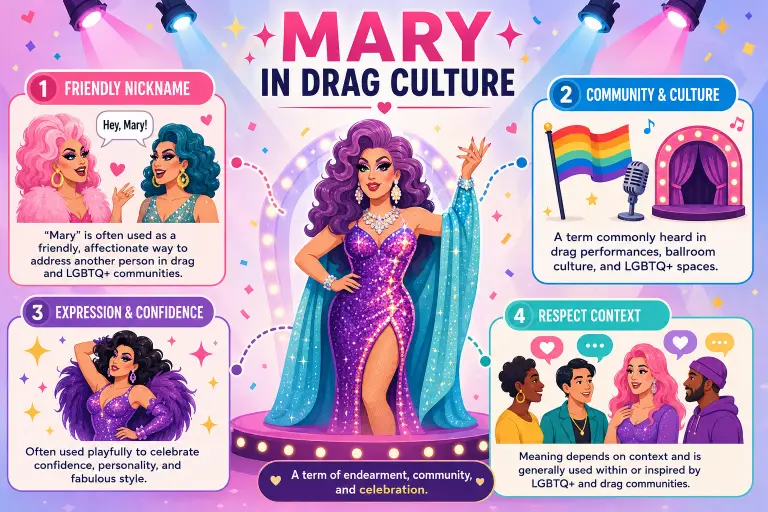
Another important meaning comes from drag culture and parts of the LGBTQ+ community.
Here, Mary is often used as a friendly way to address another person, similar to saying:
- Girl
- Honey
- Sis
- Darling
You might hear expressions like:
- “Come on, Mary!”
- “Work, Mary!”
- “Yes, Mary!”
In these situations, the word usually shows:
- Excitement
- Encouragement
- Friendship
- Celebration
This usage became more widely recognized through drag performances, LGBTQ+ entertainment, and online videos. However, it is still more common within those communities than in everyday conversations.
3. Mary as a Generic Example Name
Sometimes Mary isn’t slang at all.
People often use Mary as a placeholder name when telling stories or explaining examples.
For instance:
“If Mary forgets her homework, she’ll lose points.”
Or:
“Imagine Mary wins the lottery.”
Here, Mary simply represents an imaginary person.
4. Mary in Memes and Internet Humor
On social media, people sometimes turn ordinary names into funny expressions.
Comments like:
- “Not Mary doing that again!”
- “Classic Mary behavior.”
- “Mary, please!”
are usually part of a joke rather than referring to someone named Mary.
These posts rely on humor, exaggeration, or the personality shown in a video or meme.
Where Is Mary Slang Commonly Used?
The meaning of Mary slang often depends on the platform where you see it.
| Platform | How It’s Commonly Used |
| Text Messages | Friendly teasing between friends |
| TikTok | Memes, comedy videos, reactions |
| Funny comments and captions | |
| Discord | Casual conversations in some communities |
| Storytelling, jokes, discussions | |
| X (Twitter) | Pop culture jokes and viral posts |
Unlike abbreviations such as OMG or LOL, Mary is not equally common on every platform.
Mary in Text Messages
In texting, Mary usually appears as playful teasing.
Example
Emma: “I checked my alarm six times.”
Noah: “Okay, Mary 😂”
The message suggests that Emma is being extra careful.
Mary on TikTok
TikTok creators often use names for comedy.
You may hear:
- “Don’t be a Mary.”
- “Go off, Mary!”
- “Mary really thought she could…”
These phrases depend on the video’s context rather than having one fixed definition.
Mary on Instagram
Instagram comments often include Mary as part of playful reactions.
For example:
- “Mary, you’re too funny.”
- “Stop it, Mary 😂”
- “Not Mary again!”
Most comments are intended to be humorous.
Mary on Discord
Discord communities sometimes use Mary casually among friends.
However, it is much less common than gaming slang such as:
- GG
- AFK
- NPC
- OP
- W
- L
Because Discord servers have their own culture, the meaning may vary from one community to another.
Mary on Reddit
Reddit users occasionally use Mary in fictional stories, jokes, or discussions.
Unlike fixed internet slang, there is no single Reddit meaning. Always read the surrounding comments to understand the intended use.
Is Mary Slang Rude, Offensive, or Harmless?
For most people, Mary slang is harmless.
It is generally used as a joke, playful nickname, or friendly expression.
However, tone always matters.
Usually Harmless
- Talking with close friends
- Funny online comments
- Casual group chats
- Social media memes
Could Be Considered Rude
It may sound disrespectful if it is used to:
- Mock someone repeatedly
- Embarrass another person
- Make fun of someone’s personality
- Ignore someone’s request to stop
Even harmless slang can become hurtful if used in a negative way.
Can You Use Mary at Work or School?
It depends on the situation.
| Situation | Recommended? |
| Friends | ✅ Yes |
| Family | ✅ Usually |
| Social Media | ✅ Yes |
| School Friends | ✅ Yes, if everyone understands the joke |
| Teachers | ⚠ Better to avoid |
| Workplace | ⚠ Usually not appropriate |
| Professional Emails | ❌ No |
In formal settings, using someone’s actual name is usually the better choice.
Key Takeaways
- Mary is not a fixed internet abbreviation.
- It has multiple meanings depending on context.
- It is commonly used as a playful nickname or humorous expression.
- In drag culture, it can be a friendly form of address.
- The word is generally harmless but should be used respectfully.
- Context always determines the correct meaning.
Real Life Examples of Mary Slang
The easiest way to understand mary slang is by seeing how people use it in everyday conversations. Since Mary has more than one meaning, these examples show different situations where the word may appear.
Friendly Conversation
Emma: “I packed snacks, water, sunscreen, and a first-aid kit.”
Lily: “Okay, Mary, we’re only going to the park!”
Meaning: Lily is joking that Emma is being extra prepared.
Jake: “I checked my homework four times.”
Ryan: “Relax, Mary. You’ll be fine.”
Meaning: Ryan is playfully teasing Jake for being overly careful.
Text Message Example
Friend 1: “I refreshed the tracking page every five minutes.”
Friend 2: “You’re such a Mary today 😂”
Meaning: The speaker is joking that their friend is worrying too much.
TikTok Comment
“Mary really thought that dance was easy 😂”
Meaning: The comment is part of a humorous reaction and not aimed at someone actually named Mary.
Instagram Comment
“Go off, Mary! 🔥”
Meaning: This is an encouraging and playful way of cheering someone on.
Discord Chat
Player 1: “I organized every item in my inventory.”
Player 2: “Classic Mary behavior.”
Meaning: The speaker jokes that their friend is being extremely organized.
Reddit Discussion
“Not Mary solving everyone’s problems again.”
Meaning: A humorous way of referring to someone who always takes charge.
Origin and History of Mary Slang
Unlike many internet abbreviations, Mary did not begin as a slang acronym. It started as a traditional personal name that has been used for centuries in many cultures.
Over time, people began using names in humorous and informal ways. Just as names like Karen, Chad, or Debbie Downer developed meanings beyond being personal names, Mary also gained slang uses in certain communities.
Influence of Drag Culture
One of the best-known modern slang uses of Mary comes from drag culture.
Within some drag and LGBTQ+ communities, Mary became a friendly and expressive way to address another person.
Examples include:
- “Hey, Mary!”
- “Work, Mary!”
- “Come through, Mary!”
This use became more visible through drag performances, live shows, television, and social media. Even so, it is still not a universal slang term, and many people may never use it this way.
Internet and Meme Culture
As memes became more popular, internet users started turning ordinary names into jokes.
Instead of using someone’s real name, people sometimes write:
- “Okay, Mary.”
- “Not Mary again.”
- “That’s so Mary.”
These phrases often exaggerate someone’s behavior for comedic effect.
Because memes change quickly, the exact meaning can vary from one online community to another.
Why Do People Use Mary as Slang?
People use Mary slang because it adds personality and humor to conversations.
Common reasons include:
- To joke with friends
- To make conversations feel more casual
- To exaggerate someone’s behavior in a funny way
- To reference internet memes
- To copy expressions used in drag culture or online communities
Using a familiar name can make a joke sound more natural than using a formal description.
For example, saying:
“Okay, Mary.”
often feels shorter and funnier than saying:
“You’re being overly dramatic.”
Similar Slang and Related Terms
Although Mary has its own unique uses, several other slang terms serve a similar purpose.
| Slang Term | Meaning | Tone |
| Karen | Someone acting demanding or entitled | Negative |
| Chad | A confident or stereotypically attractive man | Humorous |
| Sis | Friendly way to address someone | Casual |
| Girl | Friendly expression, regardless of gender in some communities | Playful |
| Bestie | Close friend | Positive |
| Queen | Praise or admiration | Positive |
Unlike Karen, which has a widely recognized meaning, Mary is much more context-dependent and usually less negative.
Why Context Matters
The biggest mistake people make is assuming that Mary always means the same thing.
Consider these examples:
Example 1
“Mary is coming over tonight.”
Here, Mary is simply someone’s name.
Example 2
“Okay, Mary, calm down.”
Here, Mary is a playful nickname.
Example 3
“Work, Mary!”
Here, the word is being used as an encouraging expression in drag culture.
The surrounding conversation tells you which meaning is intended.
Is Mary Slang Still Popular?
Mary is not one of today’s most common internet slang terms like Rizz, NPC, Delulu, or Mid.
Instead, it appears occasionally in:
- Memes
- Comedy videos
- Drag culture
- Casual conversations
- Social media comments
Because slang changes over time, its popularity may vary between different communities and generations.
Many younger internet users may recognize it from memes, while others may only know Mary as a personal name.
When Should You Avoid Using Mary Slang?
Although mary slang is usually lighthearted, it is not appropriate in every situation. Because the meaning depends on context, using it with the wrong audience can cause confusion or make someone feel uncomfortable.
It’s generally best to avoid using Mary as slang in formal or professional settings.
Avoid using Mary slang when:
- Writing professional emails
- Talking to teachers or supervisors
- Speaking with clients or customers
- Addressing someone you don’t know well
- Joking about someone who may find it disrespectful
If you’re unsure if the other person understands the joke, it’s safer to use clear and respectful language instead.
Polite Alternatives
If you want to keep your conversation friendly without using Mary as slang, try these alternatives:
| Instead of “Mary” | You Can Say |
| Okay, Mary! | Relax! |
| Calm down, Mary. | Don’t worry so much. |
| Go off, Mary! | You did great! |
| Not Mary again! | Here we go again! |
| Classic Mary. | That’s so you! |
These alternatives are easier for everyone to understand, especially in mixed age groups or formal conversations.
Common Misunderstandings About Mary Slang
Because Mary has several meanings, people often misunderstand it. Here are a few common myths.
Myth 1: Mary is an abbreviation.
Fact: No. Mary is a personal name, not an acronym, so it has no full form.
Myth 2: Mary always means the same thing.
Fact: The meaning changes depending on the conversation, tone, and community using it.
Myth 3: Mary is always offensive.
Fact: In most situations, it is harmless and playful. However, repeated teasing or mocking someone with the term can become rude.
Myth 4: Everyone uses Mary as slang.
Fact: No. Many people only know Mary as a common first name. Others may recognize it from drag culture, memes, or social media.
Frequently Asked Questions
What does Mary slang mean?
Mary slang is an informal use of the name Mary. It may be used as a playful nickname, a humorous expression, or a friendly term in certain communities. The exact meaning depends on the context.
Does Mary have a full form?
No. Mary is not an abbreviation or acronym, so it does not have a full form.
Is Mary slang rude?
Usually, no. It is generally playful and harmless among friends. However, if it is used to mock or embarrass someone, it can be considered rude.
Is Mary slang used on TikTok?
Yes. You may see Mary in TikTok videos, memes, or comments, often as part of a joke or humorous reaction.
Can I use Mary in professional conversations?
It is not recommended. Since many people may not understand the slang meaning, it’s better to use clear and professional language at work or in school.
Is Mary slang popular today?
It appears occasionally in memes, drag culture, and social media, but it is not as common as modern internet slang like Rizz, NPC, Mid, or Delulu.
Conclusion
Mary slang does not have one fixed definition, which is why it can be confusing at first. While Mary is most commonly known as a traditional first name, it is also used in some online communities and casual conversations as a playful nickname or humorous expression. In drag culture, it can even be a friendly way to address someone.
The key to understanding mary slang is context. Always pay attention to the conversation, the speaker’s tone, and where the word is being used. In most cases, it is meant to be lighthearted rather than offensive.
If you’re unsure what someone means by Mary, read the surrounding messages or ask for clarification. Understanding the context will help you interpret the term correctly and avoid misunderstandings.
Descover more!
SFS Slang Meaning: What Does SFS Mean
Roast Beef Slang Meaning: Text & Chat Explained

I enjoy writing about English vocabulary and making difficult words easier to understand. I create simple guides on synonyms, word meanings, example sentences, quizzes, and everyday English to help students, ESL learners, and writers improve their vocabulary. Before publishing any article, I research trusted dictionaries and language resources to keep the information clear and accurate. My goal is to make learning English simple, practical, and enjoyable for everyone.