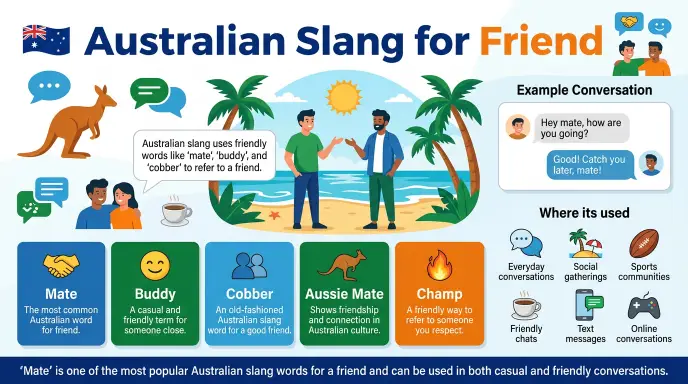
Australian slang for friend refers to the informal words and expressions Australians use to describe a friend, close companion, or trusted person in everyday conversation.
The most common term is mate, but words like cobber, buddy, and pal are also used in different situations. These expressions reflect Australia’s friendly, relaxed, and welcoming culture.
If you’re learning English, planning to visit Australia, or simply curious about Aussie slang, understanding these words can help you communicate more naturally.
In this guide, you’ll discover the most popular Australian slang for friend, what each term means, when to use it, and real-life examples to help you speak with confidence.
Quick Answer: Australian Slang for Friend
Australian slang for friend commonly includes words like “mate,” “cobber,” “buddy,” “pal,” and “legend.” The most popular and widely used Australian slang for friend is “mate,” which means a close friend, companion, or someone you share a friendly connection with.
What Does Australian Slang for Friend Mean?
Australian slang for friend refers to informal words Australians use to talk about friends, close companions, or friendly people. These expressions are a big part of everyday Australian communication and are often used to show friendliness, respect, and connection.
The word “mate” is the most common example. Australians use it with friends, coworkers, teammates, and even strangers in casual situations. It does not always mean a best friend. Sometimes it simply shows a warm and friendly attitude.
For example:
“Hey mate, how’s it going?”
This can mean:
“Hello friend, how are you?”
Australian slang for friend can change depending on the region, age group, and situation. Some words are common today, while others sound old-fashioned or are used less often.
Most Common Australian Slang Words for Friend
1. Mate
Mate is the most famous Australian slang word for friend. It means a friend, companion, or someone you have a friendly relationship with.
Australians use “mate” in many situations:
- Talking with close friends
- Greeting coworkers
- Speaking casually with strangers
- Showing support or kindness
Examples:
“Thanks for helping me, mate.”
“Hey mate, are you coming to the game tonight?”
Mate can also show emotion. Depending on the voice, it can express happiness, appreciation, surprise, or even frustration.
Example:
“Mate, you won’t believe what happened!”
Here, “mate” adds a friendly feeling to the sentence.
2. Cobber
Cobber is an older Australian slang word for friend. It was especially popular in the early and middle parts of the 20th century.
Today, “cobber” is less common and may sound traditional or humorous. Many younger Australians do not use it in normal daily conversations.
Example:
“My old cobber from school came to visit me.”
The word often appears in Australian books, movies, or conversations about older Australian culture.
3. Buddy
Buddy is another informal word for friend. Although it is not only Australian, it is commonly understood and used in Australia.
It means a friend, companion, or someone you know well.
Examples:
“I’m meeting my buddy after work.”
“My buddy helped me fix my bike.”
Buddy sounds friendly and casual but is not as strongly connected to Australian identity as “mate.”
4. Pal
Pal means friend or companion. It is used in many English speaking countries, including Australia.
It can sound friendly, but in some situations, the tone matters.
Friendly example:
“Thanks, pal. I really appreciate it.”
Negative example:
“Listen, pal, you need to calm down.”
The second example can sound slightly aggressive because of the tone.
Why Do Australians Say “Mate” So Often?
The word “mate” is strongly connected with Australian culture because it represents friendliness, equality, and teamwork.
Many Australians use “mate” even with people they do not know personally. It can create a relaxed and welcoming feeling.
Examples:
A customer talking to a worker:
“Thanks, mate.”
Two people meeting casually:
“Good to see you, mate.”
A sports teammate:
“Great job, mate.”
However, the meaning depends on the situation. Calling someone “mate” does not always mean you are close friends. It can simply be a polite and casual way to address someone.
Where Is Australian Slang for Friend Commonly Used?
Australian friendship slang appears in many everyday situations, including:
Text Messages
Australians often use “mate” in casual texts.
Example:
“Hey mate, are we still meeting later?”
Social Media
On platforms like TikTok, Instagram, Facebook, and Reddit, Australians may use “mate” in comments and conversations.
Example:
“Great video, mate!”
Gaming Communities
Australian gamers often use friendly slang while playing online games.
Example:
“Nice move, mate!”
Workplace Chat
In relaxed workplaces, coworkers may use “mate” with each other.
Example:
“Can you send me that file, mate?”
However, it may not fit every professional environment. Formal emails and business communication usually avoid slang.
Australian Slang for Friend by Context
| Slang Word | Meaning | Common Use | Tone |
| Mate | Friend, companion, friendly person | Everyday conversations | Friendly and casual |
| Cobber | Old-fashioned friend | Traditional Australian speech | Warm but dated |
| Buddy | Friend or companion | Casual conversations | Friendly |
| Pal | Friend | General English use | Friendly or sometimes sarcastic |
Is “Mate” Only Used for Close Friends?
No, “mate” is not only used for close friends. Australians often use it with acquaintances, coworkers, teammates, and strangers.
The meaning changes with context.
For example:
“Thanks, mate.”
This usually means:
“Thank you, friend.”
But:
“Mate, that’s not okay.”
This may show disappointment or disagreement.
The word itself is usually harmless. The tone of voice and situation decide the meaning.
Origin and History of Australian Slang for Friend
Australian slang for friend developed from Australia’s unique culture, history, and everyday communication style. Many Australian expressions came from a mix of British English, local communities, workers, soldiers, and rural life.
The word “mate” has a long history in English and was not created only in Australia. It originally meant a companion, partner, or fellow person. Over time, Australians adopted “mate” as a common way to address friends and other people in casual situations.
The idea of “mateship” became an important part of Australian culture. Mateship refers to loyalty, helping others, and standing together, especially during difficult times. The word became strongly connected with ideas of friendship and support.
Other terms, like “cobber,” became popular during earlier generations but are now less common. Modern Australians are much more likely to say “mate” than “cobber” in daily conversations.
Different Meanings of “Mate” in Australian English
The word “mate” can have several meanings depending on context.
Friend or Close Companion
The most common meaning of mate is a friend.
Example:
“My mate is coming over this weekend.”
Meaning:
“My friend is coming over this weekend.”
Friendly Way to Address Someone
Australians often use mate when speaking to someone they do not know well.
Example:
“Excuse me, mate, is this seat free?”
Here, mate is simply a friendly greeting.
Romantic Partner or Life Partner
In some English contexts, “mate” can mean a partner or spouse. This meaning is less common in casual Australian slang conversations.
Example:
“They have been mates for years.”
This usually means friends, not romantic partners.
Animal Partner Meaning
In biology, “mate” can also refer to an animal’s breeding partner. This is a completely different meaning from Australian friendship slang.
Example:
“The bird found a mate.”
This meaning is not related to Australian casual speech.
Is Australian Slang for Friend Rude or Offensive?
Australian slang for friend is generally harmless and friendly. Words like “mate” and “buddy” are usually considered polite in casual conversations.
However, tone matters.
The word “mate” can sound unfriendly if someone says it with anger or frustration.
Example:
“Listen, mate, you need to stop.”
This could sound like a warning depending on the speaker’s tone.
The word itself is not offensive. The situation and emotion behind it create the meaning.
Can You Use Australian Friend Slang at Work?
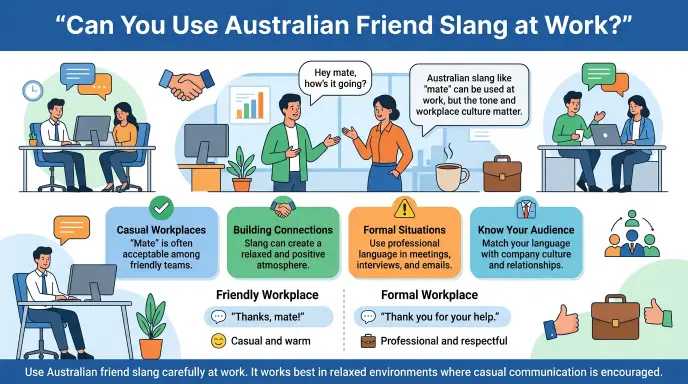
Australian slang for friend can be used in some workplaces, but it depends on the environment.
Suitable situations:
- Friendly team conversations
- Casual workplaces
- Conversations with coworkers you know well
- Informal messages
Example:
“Thanks for your help, mate.”
Avoid using it in:
- Formal business emails
- Job interviews
- Official reports
- Communication with senior professionals you do not know
Instead, use:
“Thank you for your help.”
or:
“I appreciate your assistance.”
Understanding the workplace culture is important. Some Australian workplaces are very casual, while others prefer more formal communication.
Australian Slang for Friend on Social Media and Online Platforms
Australian friendship slang appears frequently online because social media encourages casual communication.
TikTok
On TikTok, Australians may use “mate” in comments to show support or friendliness.
Example:
“Great content, mate!”
Users may use friend slang when commenting on photos or videos.
Example:
“Looking good, mate!”
Discord and Gaming
In gaming communities, “mate” is common because teamwork and communication are important.
Example:
“Good game, mate!”
Australian users may use “mate” during discussions to create a relaxed tone.
Example:
“I agree with you, mate.”
Online, the word usually creates a friendly feeling, but users should still consider the conversation topic and audience.
Australian Slang for Friend Compared to Other Countries
Friend slang changes across English-speaking countries.
| Country | Common Friend Slang | Meaning |
| Australia | Mate | Friend or friendly person |
| United States | Buddy, pal, bro | Friend or companion |
| United Kingdom | Mate, lad, pal | Friend or person you know |
| Canada | Buddy, pal | Friend or casual address |
| New Zealand | Mate, bro | Friend or companion |
The word “mate” is especially associated with Australia, although it is also used in other countries.
Similar Australian Slang Words Related to Friendship
Bloke
A bloke means a man or guy. It does not directly mean friend, but Australians may use it when talking about a person casually.
Example:
“He’s a good bloke.”
Meaning:
“He’s a good guy.”
Fella
Fella means a person or guy. It can sometimes be used in a friendly way.
Example:
“He’s a nice fella.”
Champ
Champ means someone respected or admired. It can be friendly, but it can also sound sarcastic depending on tone.
Friendly example:
“Thanks, champ!”
Negative example:
“Okay, champ, whatever you say.”
Legend
Legend is often used to describe someone who is helpful, kind, or impressive.
Example:
“Thanks for fixing my computer, you’re a legend!”
It does not literally mean a famous historical person in this context. It means someone great or appreciated.
Common Misunderstandings About Australian Friend Slang
“Mate” Always Means Best Friend
This is incorrect.
Mate can mean a close friend, but it can also simply mean a friendly person.
Example:
A stranger helping you:
“Thanks, mate.”
The person is not your close friend. It is just a friendly expression.
Only Australians Use “Mate”
This is also incorrect.
People in countries like the United Kingdom, New Zealand, and other English speaking regions also use mate.
However, Australians are especially known for using it frequently.
“Cobber” Is Still Common Today
Cobber is recognized as Australian slang, but many younger Australians rarely use it in normal conversations.
It may sound old-fashioned or connected to older Australian speech.
When Should You Avoid Using Australian Friend Slang?
Australian slang for friend is casual, so it is not suitable for every situation.
Avoid using words like “mate” when:
- Writing formal documents
- Speaking in a serious professional meeting
- Applying for a job
- Communicating with someone who prefers formal language
- Writing academic work
Use more neutral words instead:
- Friend
- Colleague
- Customer
- Team member
- Classmate
The safest choice depends on the relationship and situation.
Polite Alternatives to Australian Slang for Friend
If you are speaking in a formal situation or with someone who may not understand Australian slang, you can use clearer and more neutral words.
Common alternatives include:
Friend
“Friend” is the safest and most universal word.
Example:
“She is my friend from university.”
Companion
“Companion” means someone who spends time with you or supports you.
Example:
“He was a great companion during the trip.”
Colleague
“Colleague” is used for someone you work with.
Example:
“My colleague helped me complete the project.”
Classmate
“Classmate” refers to someone who studies with you.
Example:
“My classmate explained the homework.”
Teammate
“Teammate” is used for someone in your sports team, gaming team, or work team.
Example:
“My teammate helped us win the match.”
These words are better choices for formal writing, professional conversations, and academic situations.
Real Life Examples of Australian Friend Slang
Understanding slang becomes easier when you see how people actually use it.
Friendly Conversation
Example:
Person 1: “Hey mate, how have you been?”
Person 2: “I’m good, mate. Just busy with work.”
Meaning:
Two friends are having a casual conversation.
Asking for Help
Example:
“Can you help me carry this box, mate?”
Meaning:
The speaker is politely asking someone for help in a friendly way.
Showing Appreciation
Example:
“Thanks for helping me move house, mate. I really appreciate it.”
Meaning:
The speaker is showing gratitude.
Gaming Conversation
Example:
“Nice strategy, mate. That was a great move.”
Meaning:
A player is complimenting another player.
Social Media Comment
Example:
“Awesome photo, mate!”
Meaning:
A friendly compliment on social media.
Workplace Conversation
Example:
“Thanks for finishing that task, mate.”
Meaning:
A coworker is showing appreciation.
Note:
This is more suitable for casual workplaces. It may not fit every professional environment.
Australian Friend Slang for Different Age Groups
The use of Australian slang can vary by generation.
Older Generations
Older Australians may recognize words like:
- Cobber
- Fella
- Mate
Some older expressions may sound traditional today.
Younger Generations
Younger Australians commonly use:
- Mate
- Buddy
- Legend
- Bro
They may also use internet slang from platforms like TikTok, Discord, and Instagram.
Online Communities
Young users often mix Australian slang with global internet expressions.
For example:
“Thanks mate, that was sick!”
Here, “mate” is Australian-style friendship slang, while “sick” is modern informal slang meaning impressive or cool.
Is Australian Slang for Friend Used in Texting?
Yes, Australian friend slang is commonly used in text messages.
People often use short, casual messages with words like “mate.”
Examples:
“Hey mate, are we still meeting today?”
“Good job mate!”
“See you later, mate.”
Texting makes slang more common because people usually write the way they speak.
However, formal messages such as emails to a company or official requests should usually avoid slang.
Frequently Asked Questions About Australian Slang for Friend
Q1: What is the most common Australian slang for friend?
The most common Australian slang for friend is “mate.” It is widely used by Australians in everyday conversations, texts, workplaces, and social situations.
Q2: Does “mate” mean best friend in Australia?
No. “Mate” can mean a close friend, but Australians also use it for acquaintances, coworkers, teammates, and even strangers in friendly situations.
Q3: Is “mate” only Australian slang?
No. The word “mate” is also used in countries such as the United Kingdom and New Zealand. However, it is strongly associated with Australian speech and culture.
Q4: Is calling someone “mate” rude?
Usually, no. “Mate” is normally friendly and casual. It can only sound rude if the speaker uses an angry tone or uses it during an argument.
Q5: Can I use “mate” with Australians?
Yes, you can use “mate” in casual conversations. It is generally understood and accepted, especially in friendly situations.
Q6: Is “cobber” still used in Australia?
“Cobber” is understood as Australian slang for friend, but it is less common today. Many younger Australians may see it as old fashioned.
Q7. What is Buddy in Australian slang?
In Australian slang, buddy is a friendly and informal way to refer to a friend or companion. However, Australians more commonly use the word mate instead of buddy in everyday conversations.
Q8. What is a Cobba?
A cobber (sometimes spelled cobba in pronunciation) is an old Australian slang term that means a close friend or trusted mate. It is less common today but is still recognized as a classic Aussie expression.
Q9. How do you say friend in slang?
The most common Australian slang word for a friend is mate. Other informal terms include cobber, buddy, pal, and champ, depending on the situation.
Q10. What are 5 Aussie slang phrases?
Five popular Aussie slang phrases are G’day (hello), No worries (it’s okay), Arvo (afternoon), Brekkie (breakfast), and Mate (friend). These expressions are widely used in everyday Australian English.
Conclusion
Australian slang for friend is mainly built around the word “mate,” which represents friendship, friendliness, and connection. Australians use it in everyday conversations, online chats, workplaces, and casual situations.
Other words like “cobber,” “buddy,” “pal,” and “legend” can also describe friendship or friendly relationships, but their popularity and meaning can change depending on age, region, and context.
The key thing to remember is that Australian slang depends on the situation. “Mate” is usually friendly and harmless, but tone and setting always matter. It works well in casual conversations but should be replaced with more formal words in professional or academic communication.