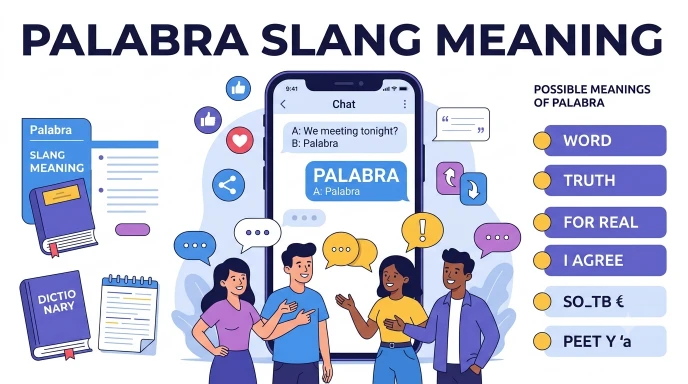
Palabra slang is a phrase many people search when they come across the Spanish word “palabra” in text messages, social media posts, or casual conversations.
While palabra literally means “word” in Spanish, it can also be used informally to express honesty, a promise, or strong agreement. The exact meaning depends on the context and the speaker’s tone.
You may notice palabra being used on TikTok, Instagram, Reddit, Discord, Snapchat, WhatsApp, and in conversations between Spanish speakers or bilingual communities. Learning its meaning helps you understand online discussions and communicate more naturally with native speakers.
Unlike internet abbreviations such as LOL or BRB, palabra is a real Spanish word that has gained additional meaning in everyday informal communication.
Quick Answer: Palabra Slang Meaning
Palabra slang usually means “I promise,” “my word,” or “I’m telling the truth.” It is a friendly and respectful way to assure someone that you are being honest.
What Does Palabra Mean in Text?
In texting and online conversations, palabra is commonly used to reassure someone or emphasize that what you’re saying is true.
For example:
Friend: “Are you really coming tonight?”
You: “Palabra.”
Here, palabra means:
- I promise.
- You have my word.
- I’m serious.
- Trust me.
Rather than typing a full sentence, many Spanish speakers simply write “palabra” because it quickly communicates sincerity.
Palabra Full Form / Definition
Unlike abbreviations, palabra does not have a full form.
It is a complete Spanish word that literally translates to:
Palabra = Word
When used as slang, it often means:
| Meaning | Explanation |
| I promise | Giving someone your word |
| Trust me | Asking someone to believe you |
| I’m serious | Showing honesty |
| My word | A sincere promise |
| Honestly | Stressing truthfulness |
The intended meaning depends on the conversation.
Is Palabra Rude, Offensive, or Neutral?
Palabra is considered a neutral and polite expression.
It is:
- ✅ Friendly
- ✅ Respectful
- ✅ Safe for conversations
- ✅ Appropriate in most casual situations
It is not a rude or offensive slang term.
Many Spanish speakers use it naturally among family members, friends, classmates, and coworkers.
Where Is Palabra Commonly Used?
Although it comes from spoken Spanish, palabra also appears frequently online.
1. Text Messages
People use it to promise something.
Example:
“Palabra, I’ll call you after work.”
2. Social Media
You’ll often see it on:
- TikTok
- Snapchat
Example:
“Palabra, this recipe actually works.”
3. Reddit and Discord
Spanish speaking communities sometimes use palabra without translating it because everyone understands its meaning.
4. Everyday Conversation

Native speakers often replace longer expressions like:
- I promise.
- Believe me.
- Trust me.
with simply:
Palabra.
This makes conversations sound more natural.
Different Meanings of Palabra Slang
Depending on the situation, palabra can communicate several related ideas.
1. I Promise
This is the most common meaning.
Example:
“Palabra, I didn’t tell anyone.”
The speaker is making a sincere promise.
2. I’m Serious
Sometimes it emphasizes that someone isn’t joking.
Example:
“Palabra, that’s exactly what happened.”
3. Trust Me
It can also encourage another person to believe what you’re saying.
Example:
“Palabra, you’ll enjoy this movie.”
4. You Have My Word
This meaning is common when making commitments.
Example:
“You have my palabra.”
This is similar to saying:
“You have my word.”
Origin and Background of Palabra
The word palabra has existed in Spanish for centuries.
Its literal meaning is “word.”
A traditional Spanish expression is:
“Dar mi palabra.”
This translates to:
“To give my word.”
Over time, many speakers shortened the phrase in everyday conversation.
Instead of saying:
“Te doy mi palabra.”
They simply say:
“Palabra.”
This shorter version eventually became common in texting and social media conversations as well.
Is Palabra Used as Internet Slang?
Yes, but not in the same way as abbreviations like LOL, OMG, or BRB.
Palabra is an actual Spanish word that people naturally use in conversations. As texting and social media became more popular, the word also became common online. Today, many Spanish speakers use it to express honesty, make a promise, or reassure someone in a quick and natural way.
Unlike many internet slang terms that were created online, palabra comes from everyday spoken language.
Comparison with Similar Slang
Several slang terms express honesty or agreement, but they are not exactly the same as palabra.
| Slang | Meaning | Common Use | Tone |
| Palabra | I promise | Texting, conversations | Honest |
| FR | For real | Social media, texting | Casual |
| No Cap | I’m telling the truth | TikTok, Instagram | Informal |
| ONG | On God | Texting, gaming | Strong emphasis |
| Facts | That’s true | Social media | Agreement |
| Bet | Okay, agreed | Chat, gaming | Friendly |
The biggest difference is that palabra sounds more like giving someone your personal promise, while terms like no cap or FR simply emphasize that something is true.
Real Life Examples of Palabra Slang
Here are different examples showing how palabra is used in everyday conversations.
Friendly Examples
Example 1
“Palabra, I’ll help you with your homework tomorrow.”
Example 2
“Your secret is safe with me. Palabra.”
Example 3
“Palabra, I’ll bring your book back next week.”
Casual Conversation
Example 1
“Palabra, that pizza place is amazing.”
Example 2
“Palabra, this game is worth buying.”
Example 3
“You should watch that movie. Palabra.”
Argumentative Tone
Sometimes people use palabra when defending themselves or insisting they are telling the truth.
Example 1
“Palabra, I never touched your phone.”
Example 2
“I’m serious palabra I wasn’t there.”
Example 3
“Palabra, you’re blaming the wrong person.”
Gaming Examples
Players sometimes use the word while chatting with teammates.
Example 1
“Palabra, my internet disconnected.”
Example 2
“I’ll join the next match. Palabra.”
Example 3
“Palabra, I wasn’t AFK on purpose.”
Social Media Examples
TikTok
“Palabra 😂 That’s exactly how my family acts.”
“Palabra, this sunset looks even better in real life.”
Snapchat
“Palabra, I’ll reply after class.”
“Palabra, I’m almost there.”
When Should You Avoid Using Palabra?
Although palabra is safe and polite, there are situations where it may not be the best choice.
Avoid using it in:
- Formal business emails
- School assignments
- Academic papers
- Legal documents
- Professional reports
- Conversations with people who don’t understand Spanish
In these situations, clear English expressions are usually better.
For example, instead of writing:
“Palabra.”
You could write:
“I promise.”
or
“I assure you.”
These alternatives are easier for everyone to understand.
Polite Alternatives to Palabra
If you’re speaking English, these phrases communicate the same idea:
- I promise
- Honestly
- Believe me
- Trust me
- You have my word
- I assure you
- Seriously
- I’m being honest
Each alternative works well depending on the situation.
For example:
Instead of:
“Palabra, I’ll be there.”
You can say:
“I promise I’ll be there.”
Both sentences express the same commitment.
Why Context Matters
One reason people become confused about palabra slang is that the word has both a literal and an informal meaning.
Literal Meaning
“La palabra correcta.”
Translation:
“The correct word.”
Here, palabra simply means word.
Slang Meaning
“Palabra, I’ll help you.”
Here, it means:
- I promise.
- Trust me.
- I’m serious.
Always pay attention to the sentence rather than translating the word by itself.
Why People Use Palabra Slang
People use palabra slang because it sounds more personal and sincere than simply saying “okay” or “yes.” It adds emotion to a conversation and shows that the speaker genuinely means what they are saying.
Some common reasons people use palabra include:
- To make a promise
- To show honesty
- To reassure someone
- To build trust
- To emphasize that they are serious
- To sound natural in Spanish conversations
Instead of writing:
“I really promise I’ll come.”
Many people simply write:
“Palabra.”
It is short, natural, and easy to understand for Spanish speakers.
Impact of Using Slang in Communication
Slang plays an important role in modern communication. Words like palabra help conversations feel more relaxed and personal.
Positive Effects
- Makes conversations sound friendly.
- Creates stronger connections between friends.
- Adds emotion and personality.
- Makes texting faster and more natural.
Possible Drawbacks
- Some people may not understand the meaning.
- It can confuse those who don’t speak Spanish.
- It isn’t suitable for formal communication.
The key is knowing when your audience will understand the expression.
Is Palabra Safe for Social Media?

Yes. Palabra is considered a safe and respectful word on all major social media platforms.
You can use it on:
- TikTok
- Snapchat
- Discord
- X (Twitter)
- Messenger
Because it is neither offensive nor inappropriate, it does not violate community guidelines.
Common Mistakes People Make
Many people misunderstand palabra slang when they first see it online.
Here are some common mistakes to avoid.
1. Thinking It’s an Acronym
Unlike terms such as LOL or BRB, palabra is not an abbreviation.
It is a complete Spanish word.
2. Believing It Always Means “Word”
Although the literal translation is “word,” its conversational meaning often changes.
For example:
“Palabra.”
usually means:
- I promise.
- Trust me.
- I’m serious.
3. Using It in Professional Writing
Business emails, reports, and academic papers should avoid casual slang.
Instead, write:
- I assure you.
- I promise.
- I guarantee.
These phrases sound more professional.
4. Ignoring Context
The same word can have different meanings depending on the conversation.
Always read the entire sentence before deciding what palabra means.
Tips for Using Palabra Correctly
If you’re learning Spanish or chatting with bilingual friends, these tips will help.
✔ Use it casually
It works best in relaxed conversations with friends or family.
✔ Know your audience
Only use palabra if the people you’re speaking with understand Spanish.
✔ Keep it sincere
Since it often means “I promise,” don’t use it for things you don’t intend to do.
✔ Avoid overusing it
Repeating palabra too often can make your promises sound less meaningful.
Palabra vs. English Expressions
The closest English expressions include:
| Spanish | English Equivalent | Meaning |
| Palabra | I promise | Making a promise |
| Palabra | Trust me | Asking someone to believe you |
| Palabra | Honestly | Stressing honesty |
| Palabra | You have my word | Giving reassurance |
| Palabra | Seriously | Showing sincerity |
These expressions all communicate honesty, but palabra carries a uniquely Spanish cultural tone.
When Is Palabra Most Appropriate?
The word fits naturally in situations such as:
- Talking with friends
- Family conversations
- Text messaging
- Social media comments
- Online gaming chats
- Casual group discussions
It is less suitable for:
- Job interviews
- Business meetings
- Official documents
- Academic writing
- Formal presentations
Choosing the right setting helps your communication sound natural and appropriate.
Can Non Spanish Speakers Use Palabra?
Yes, but it’s best to use it only when you’re speaking with people who understand Spanish or bilingual expressions.
For example, if your friend often mixes English and Spanish in conversation, saying “Palabra!” may sound completely natural.
However, if you’re speaking with someone who doesn’t know Spanish, using “I promise” or “You have my word” will avoid confusion.
Frequently Asked Questions
1. What does palabra mean in slang?
In slang, palabra usually means “I promise,” “trust me,” “I’m serious,” or “you have my word.” It is used to reassure someone that what you’re saying is honest.
2. What does palabra stand for?
Palabra does not stand for anything because it is not an acronym. It is a Spanish word that literally means “word.”
3. Is palabra a bad or offensive word?
No. Palabra is a neutral, respectful, and polite expression. It is safe to use in casual conversations and is not considered offensive.
4. Is palabra commonly used in text messages?
Yes. Many Spanish speakers use palabra in text messages, WhatsApp chats, and social media conversations to express honesty or make a promise.
Example:
“Palabra, I’ll send you the photos tonight.”
5. Is palabra the same as “no cap”?
Not exactly.
Both expressions relate to telling the truth, but they have different meanings.
- Palabra = “I promise” or “You have my word.”
- No cap = “I’m not lying” or “This is true.”
Palabra focuses more on making a sincere promise.
6. Can English speakers use palabra?
Yes. If you’re chatting with Spanish speaking or bilingual friends, using palabra can sound natural. However, in conversations where people don’t know Spanish, it’s better to use English phrases like “I promise” or “trust me.”
Key Takeaways
Here are the most important things to remember about palabra slang:
- Palabra literally means “word” in Spanish.
- As slang, it often means “I promise,” “trust me,” or “you have my word.”
- It is not an abbreviation or acronym.
- The expression is polite and respectful.
- It is commonly used in texting, social media, and everyday conversations.
- Context determines if it has its literal or slang meaning.
- It is best suited for casual communication rather than formal writing.
Conclusion:
Palabra slang is a simple yet meaningful expression that reflects honesty, trust, and sincerity. Although its literal translation is “word,” its everyday slang meaning often becomes “I promise,” “trust me,” or “you have my word.” This makes it a popular expression in conversations among Spanish speakers, if they’re chatting face to face or online.
You’ll often encounter palabra in text messages, WhatsApp chats, TikTok comments, Instagram captions, Reddit discussions, and other social media platforms. Because it is friendly and respectful, it’s a useful phrase for expressing genuine commitment or reassurance.
The most important thing to remember is that context matters. Sometimes palabra simply refers to a “word” in Spanish, while other times it acts as a slang expression that emphasizes honesty. Understanding the conversation and the speaker’s intent will help you interpret it correctly.
if you’re learning Spanish, exploring internet slang, or simply curious about modern online language, knowing the meaning of palabra slang will help you communicate more confidently and understand real-world conversations with greater ease.

I’m Emily Carter, and I enjoy writing about slang, internet language, and modern English expressions. My goal is to explain word meanings in a simple, clear, and easy-to-understand way so anyone can learn with confidence.