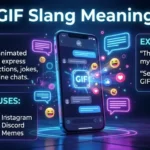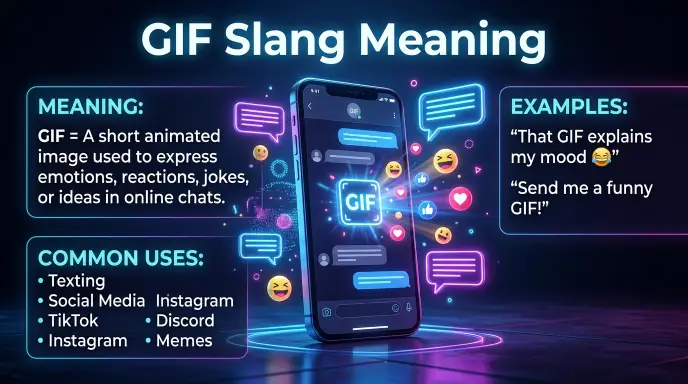
GIF slang meaning refers to the use of a GIF (Graphics Interchange Format) to express emotions, reactions, jokes, or messages in online conversations.
Instead of typing a response, people often send a GIF to show how they feel in a fun and visual way.
Many people search for “GIF slang meaning” because they see someone reply with a GIF on social media, in text messages, or on apps like Discord, Reddit, TikTok, Instagram, or Snapchat.
While GIF is not a slang word itself, it has become an important part of internet slang and online communication. In this guide, you’ll learn what GIF means, its full form, how it’s used in texting and social media, where it became popular, and when using a GIF is the best way to communicate.
Quick Answer: GIF Slang Meaning
A GIF in slang and online communication is a short, looping animated image used to express emotions, reactions, humor, or opinions without typing a full message. People use GIFs to make conversations more engaging, funny, and expressive.
What Does GIF Slang Mean?
GIF slang meaning is the use of an animated image as a reaction or response in digital conversations. Instead of writing words like “I’m laughing” or “That’s amazing,” someone may simply send a GIF that shows laughter, applause, surprise, or another emotion.
Unlike many internet slang terms, GIF is not an abbreviation created for texting. It is a digital image format that has become part of online culture because people use it to communicate quickly and visually.
For example:
Person A: “I finally passed my driving test!”
Person B: Sends a cheering GIF.
The GIF communicates excitement without needing a written reply.
Today, using GIFs is common across messaging apps, forums, gaming communities, and social media platforms.
Full Form of GIF
GIF stands for:
Graphics Interchange Format
It is a digital image format introduced in 1987 by CompuServe. The format supports short animations made from multiple image frames that play repeatedly in a loop.
Although the full form is technical, most internet users simply know GIF as a moving image that expresses a reaction or emotion.
Examples include:
- A celebrity clapping
- Someone laughing loudly
- A surprised facial expression
- A dancing character
- A funny movie scene
These animated images help people communicate more naturally online.
Is GIF Actually Slang?
No. GIF itself is not a slang word.
However, GIFs have become a major part of internet slang and online communication because they often replace written responses.
For example, instead of saying:
“That joke was hilarious.”
Someone may send a laughing GIF.
Instead of typing:
“I agree.”
They may send a GIF showing someone nodding.
This is why many people search for “GIF slang meaning.” They want to understand how GIFs communicate emotions and reactions during conversations.
Different Meanings of GIF in Online Conversations
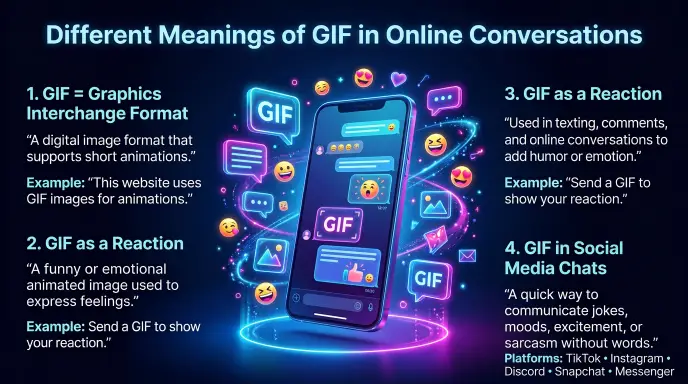
The meaning of a GIF depends entirely on the image being used. One GIF can express happiness, while another may show disappointment or sarcasm.
GIF as a Happy Reaction
Many people send GIFs to celebrate good news.
Example:
“You got the job!”
Celebration GIF
Meaning:
“Congratulations! That’s fantastic.”
GIF as a Funny Response
Funny GIFs are one of the most popular reaction types online.
Example:
Friend:
“I accidentally wore two different shoes.”
Reply:
A laughing GIF.
Meaning:
“That’s really funny.”
GIF as a Surprise Reaction
A shocked face or dramatic movie scene can express surprise.
Example:
“I met my favorite singer today.”
Reply:
A surprised GIF.
Meaning:
“I can’t believe it!”
GIF as an Expression of Agreement
Instead of typing “I agree,” users often send a GIF showing someone giving a thumbs up or nodding.
Example:
“Pizza is the best comfort food.”
Reply:
A nodding GIF.
Meaning:
“I completely agree.”
GIF as a Sarcastic Response
Some GIFs communicate sarcasm or playful teasing.
Example:
“I’m definitely going to wake up at 5 AM tomorrow.”
Reply:
A character rolling their eyes.
Meaning:
“I don’t think that’s going to happen.”
Because tone matters, sarcastic GIFs work best with friends who understand your sense of humor.
Where Is GIF Commonly Used?
GIFs are used almost everywhere people communicate online.
Text Messages
Friends often send GIFs instead of writing long replies.
Example:
“I’m so excited for the concert!”
Reply:
A dancing GIF.
Discord
Gaming communities frequently use GIFs to celebrate victories, react to funny moments, or tease teammates.
Example:
“We finally won the match!”
Reply:
A victory celebration GIF.
Many Reddit users share reaction GIFs in discussions, memes, and community conversations.
Example:
“That plot twist was unexpected.”
Reply:
A shocked reaction GIF.
TikTok
Although TikTok focuses on short videos, users often share GIF reactions in comments and private messages.
Example:
“That ending was wild!”
Reply:
A mind-blown GIF.
People use GIFs in Stories, direct messages, and comment replies to make conversations more engaging.
Example:
“Happy Birthday!”
Reply:
A confetti celebration GIF.
Snapchat
Snapchat users often send GIF stickers to react quickly without typing a message.
Example:
“I’m on my way!”
Reply:
A running character GIF.
Common Types of GIF Reactions
| GIF Type | What It Means | Typical Situation |
| Laughing GIF | Something is funny | Jokes and memes |
| Clapping GIF | Approval or congratulations | Achievements |
| Crying GIF | Sadness or emotional reaction | Emotional conversations |
| Dancing GIF | Excitement or celebration | Good news |
| Facepalm GIF | Embarrassment or frustration | Silly mistakes |
| Eye-roll GIF | Sarcasm or disbelief | Playful teasing |
| Thumbs-up GIF | Agreement or approval | Casual discussions |
Why Are GIFs So Popular?
GIFs help people communicate emotions faster than words.
Instead of writing a long explanation, a single GIF can instantly show happiness, surprise, excitement, disappointment, or humor.
People also enjoy GIFs because they:
- Make conversations more entertaining.
- Add personality to messages.
- Show emotions clearly.
- Create quick visual reactions.
- Help express feelings that are difficult to describe with words.
As a result, GIFs have become a common part of internet culture and modern digital communication.
Origin and History of GIF
The GIF (Graphics Interchange Format) was introduced by CompuServe in 1987 as a way to display digital images efficiently. While it started as a simple image format, it became famous because it supports short, looping animations.
During the late 1990s and early 2000s, GIFs became popular on websites and internet forums. As social media platforms and messaging apps grew, people began using GIFs as reaction images instead of typing messages.
Today, GIFs are a key part of internet culture. Platforms like Discord, Reddit, X (formerly Twitter), Facebook, Instagram, WhatsApp, and Slack include built in GIF search tools, making them easy to use in everyday conversations.
Unlike many internet slang terms, the meaning of GIF has stayed consistent. What has changed is how people use GIFs to communicate emotions and reactions.
Is GIF Rude, Offensive, or Harmless?
GIFs are generally harmless and are used to make conversations more fun and expressive.
However, the meaning of a GIF depends on the animation, context, and relationship between the people chatting.
Friendly GIFs
Most GIFs are positive and suitable for everyday conversations.
Examples include:
- Smiling
- Laughing
- Clapping
- Waving
- Celebrating
These GIFs help create a friendly and relaxed conversation.
Sarcastic GIFs
Some GIFs are meant to be sarcastic.
For example:
Someone says:
“I never make mistakes.”
Reply:
A person rolling their eyes.
The GIF jokingly suggests that the statement is not believable.
Sarcastic GIFs are best used with friends who understand your sense of humor.
Offensive GIFs
Some GIFs contain rude language, insulting gestures, or inappropriate scenes.
These should be avoided when talking to:
- Teachers
- Parents
- Clients
- Coworkers
- People you do not know well
Always think about your audience before sending a reaction GIF.
Where Is GIF Most Commonly Used?
GIFs are popular on almost every major online platform.
Text Messages
People use GIFs to replace written reactions.
Example:
“I’m finally on vacation!”
Reply:
A happy dancing GIF.
Friends and family often send GIFs for birthdays, celebrations, congratulations, and jokes.
Example:
“Happy Birthday!”
Reply:
A birthday celebration GIF.
Discord
Discord users frequently use GIFs while chatting during games or community discussions.
Examples include:
- Celebrating a win
- Laughing at a funny moment
- Reacting to announcements
Reddit communities often share GIFs to express opinions or reactions during discussions.
Example:
“A shocking movie ending.”
Reply:
A surprised reaction GIF.
People use GIFs in direct messages and Stories to make conversations more engaging.
GIFs are commonly shared in comments and Messenger chats.
Slack and Workplace Chats
Some workplaces allow friendly GIFs in team chats.
Example:
A clapping GIF after a successful project.
However, professional environments usually expect respectful and appropriate GIFs.
Can You Use GIFs at Work?
Yes, but only in the right situations.
GIFs work well in:
- Team celebrations
- Casual workplace chats
- Internal messaging
- Friendly conversations with coworkers
Example:
“Great job on today’s presentation!”
Reply:
A clapping GIF.
Avoid using GIFs in:
- Job applications
- Formal emails
- Customer complaints
- Business proposals
- Official reports
When communicating professionally, written responses are usually more appropriate.
Similar Internet Expressions
GIFs are only one way people express emotions online. Other visual communication tools are also popular.
Emoji
Emojis are small digital icons that show emotions or objects.
Example:
😂 ❤️ 👍 🎉
Unlike GIFs, emojis are static images.
Meme
A meme is a funny image, video, or joke shared across the internet.
Many memes also become GIFs.
Sticker
Stickers are larger digital images used in messaging apps like WhatsApp and Telegram.
They often include cartoon characters or text.
Reaction Image
A reaction image is a still picture used to express feelings.
Unlike GIFs, it does not move.
GIF vs Emoji vs Meme
| Expression | Moving Image | Purpose | Common Use |
| GIF | Yes | Show reactions and emotions | Texting, social media, gaming |
| Emoji | No | Express simple emotions | Everyday messaging |
| Meme | Sometimes | Humor and entertainment | Social media and forums |
| Sticker | Usually No | Fun conversations | Messaging apps |
Why Do People Use GIFs?
GIFs make conversations feel more natural and expressive.
People use them because they:
- Show emotions instantly.
- Make chats more entertaining.
- Replace long written replies.
- Add humor to conversations.
- Help express reactions more clearly than text alone.
A single GIF can often communicate more emotion than several sentences.
Common Misunderstandings About GIFs
GIF Is a Text Abbreviation
This is incorrect.
GIF is an image format, not a texting abbreviation like LOL or BRB.
Every GIF Means the Same Thing
Not true.
The meaning depends entirely on the animation, facial expression, and conversation.
The same GIF may be funny in one chat but sarcastic in another.
GIFs Are Only for Teenagers
Incorrect.
People of all ages use GIFs on messaging apps, workplaces, and social media.
Businesses, brands, and professionals also use appropriate GIFs to make communication more engaging.
Real Life Examples of GIF Slang Meaning
Seeing GIFs in real conversations makes it easier to understand how people use them.
Friendly Conversation
Person A: “I finally passed my exam!”
Person B: Sends a cheering GIF.
Meaning:
The GIF expresses excitement and congratulations without using words.
Text Message
Friend: “Our trip is booked!”
Reply: A dancing GIF.
Meaning:
The sender is excited about the upcoming trip.
Discord Chat
Player 1: “We won the final round!”
Player 2: A victory celebration GIF.
Meaning:
The GIF celebrates the team’s success.
Reddit Discussion
User: “That movie ending shocked me.”
Reply: A surprised reaction GIF.
Meaning:
The GIF shows the same feeling of surprise.
Instagram Direct Message
Friend: “Happy Birthday!”
Reply: A confetti celebration GIF.
Meaning:
The GIF adds a fun and festive touch to the greeting.
Workplace Chat
Manager: “Great work on today’s presentation.”
Employee: A thankful GIF.
Meaning:
The employee expresses appreciation in a friendly but respectful way.
Can GIFs Replace Words?
Sometimes, yes.
A GIF can replace short replies such as:
- “That’s funny.”
- “Congratulations!”
- “I agree.”
- “I’m surprised.”
- “Well done.”
- “Thank you.”
However, GIFs should not replace clear communication in important or professional conversations.
Are GIFs Still Popular?
Yes. GIFs remain popular across messaging apps and social media, although short videos, stickers, and reaction emojis have become more common on some platforms.
People continue to use GIFs because they are quick, expressive, and easy to understand.
Their popularity varies by platform. For example, GIFs are heavily used on Discord, Reddit, and messaging apps, while younger users on TikTok may rely more on videos and emojis in public posts.
Frequently Asked Questions
Q1: What is the GIF slang meaning?
GIF slang meaning refers to using an animated image to express emotions, reactions, jokes, or opinions during online conversations instead of typing a message.
Q2: What does GIF stand for?
GIF stands for Graphics Interchange Format. It is an image format that supports short looping animations.
Q3: Is GIF a slang word?
No. GIF is not a slang word. It is a digital image format that has become an important part of internet slang and online communication.
Q4: Where are GIFs commonly used?
GIFs are commonly used in text messages, Discord, Reddit, Instagram, Snapchat, Facebook, WhatsApp, Slack, and other social media platforms.
Q5: Are GIFs appropriate at work?
Yes, but only in casual workplace chats or team conversations. Avoid using GIFs in formal emails, business proposals, or professional documents.
Q6: Are GIFs rude?
Most GIFs are friendly and harmless. However, some animated images can appear sarcastic or offensive depending on the content and context.
Q7. What is GIF on social media?
On social media, a GIF is a short animated image that loops continuously without sound. People use GIFs to express emotions, reactions, jokes, or messages in a fun and visual way.
Q8. What is the meaning of GIF from a girl?
When a girl sends a GIF, it usually helps express her feelings, humor, or reaction more clearly than plain text. The meaning depends on the specific GIF and the conversation’s context.
Q9. What is the full form of GIF in texting?
The full form of GIF is Graphics Interchange Format. In texting and online chats, it refers to a short animated image used to make conversations more engaging and expressive.
Conclusion
GIF slang meaning is not about a new slang word but about using animated images as part of modern online communication. A GIF helps people express emotions, reactions, humor, and opinions in a quick and visual way.
If you’re chatting with friends, replying on Reddit, celebrating a win on Discord, or sending a funny reaction in a text message, GIFs make conversations more expressive and enjoyable.
The key is to use the right GIF for the right situation. Friendly and appropriate GIFs work well in casual conversations, while formal or sensitive situations are usually better handled with clear written messages.