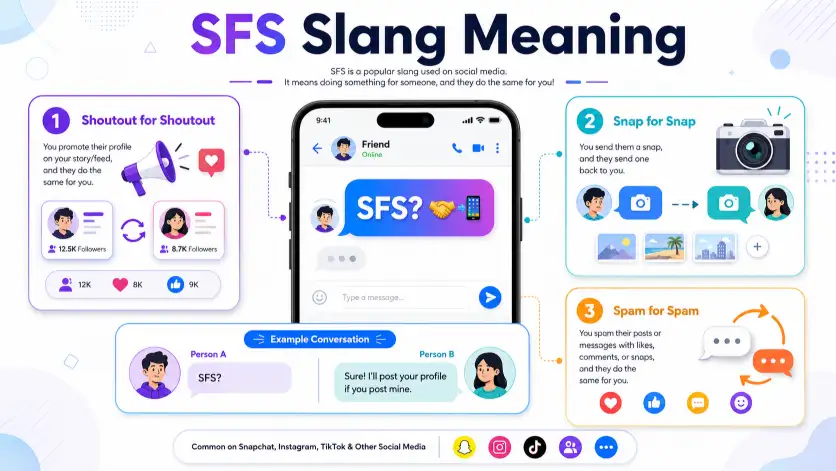
SFS slang usually stands for “Shoutout for Shoutout” on social media. It is a popular internet abbreviation people use when they want to exchange promotions with someone else.
In some situations, SFS can also mean “Snap for Snap” or “Spam for Spam,” depending on the platform and the conversation.
Many people search for SFS slang after seeing it in Instagram stories, Snapchat chats, TikTok comments, or direct messages. Since the abbreviation has more than one meaning, understanding the context is important.
In this guide, you’ll learn what SFS slang means, its different full forms, where it is commonly used, if it is appropriate to use, its origin, real life examples, and the most common misunderstandings. By the end, you’ll know exactly how to understand and use SFS correctly.
Quick Answer: SFS Slang
SFS slang most commonly means “Shoutout for Shoutout.” It is a request between two social media users to promote each other’s accounts. On Snapchat, it may also mean “Snap for Snap,” where users exchange snaps to stay active or build friendships. Less commonly, SFS can mean “Spam for Spam,” referring to exchanging likes or comments on posts.
| Abbreviation | Most Common Meaning | Common Platforms | Tone |
| SFS | Shoutout for Shoutout | Instagram, TikTok | Friendly |
| SFS | Snap for Snap | Snapchat | Casual |
| SFS | Spam for Spam | Informal |
What Does SFS Slang Mean?
The meaning of SFS slang depends on where you see it. While the abbreviation stays the same, users may intend different things based on the platform and conversation.
The three most common meanings are:
- Shoutout for Shoutout
- Snap for Snap
- Spam for Spam
Although these meanings are related to social media interaction, they are used in different ways.
For example:
“Anyone want to do SFS?”
On Instagram, this usually means:
“Let’s promote each other’s accounts.”
On Snapchat, it often means:
“Let’s exchange snaps.”
Looking at the platform and the surrounding conversation usually makes the intended meaning clear.
What Does SFS Stand For?
SFS has several accepted full forms online.
1. Shoutout for Shoutout (Most Common)
This is the meaning most people recognize.
A shoutout is when someone recommends another user’s profile, page, or content to their followers. In an SFS, both people agree to promote each other.
Example:
Alex: “SFS?”
Taylor: “Sure! I’ll post your page if you post mine.”
This type of promotion is common among:
- Content creators
- Small businesses
- Influencers
- Artists
- Photographers
- Meme pages
Its goal is to help both accounts gain more followers and engagement.
2. Snap for Snap
On Snapchat, SFS often stands for Snap for Snap.
Instead of promoting accounts, users agree to send each other snaps regularly.
Example:
“Looking for SFS friends.”
This usually means:
“I’m looking for people to exchange Snapchat photos or messages with.”
People often use this to:
- Keep Snapchat streaks active
- Meet new friends
- Increase interaction
- Stay connected
3. Spam for Spam
A less common meaning is Spam for Spam.
Here, “spam” does not mean unwanted emails. Instead, it means leaving lots of likes, comments, or reactions on someone’s posts.
Example:
“SFS?”
Response:
“Sure! I’ll like your recent posts if you like mine.”
This meaning appears mostly on Instagram among users trying to boost engagement.
Different Meanings of SFS Slang
Because SFS has multiple meanings, context is essential. The table below shows how each version is commonly used.
| Meaning | Where Used | Purpose | Popularity |
| Shoutout for Shoutout | Instagram, TikTok | Mutual promotion | Very High |
| Snap for Snap | Snapchat | Exchange snaps | High |
| Spam for Spam | Increase likes and comments | Moderate |
Which Meaning Is the Most Popular?
Today, Shoutout for Shoutout is the meaning most people associate with SFS slang. It has been widely used by creators, influencers, and businesses for years as a simple way to cross-promote accounts.
However, if you’re chatting on Snapchat, Snap for Snap is often the more likely interpretation.
Where Is SFS Commonly Used?
SFS appears across several social media platforms, but its meaning can change slightly depending on the community.
| Platform | Typical Meaning | Common Usage |
| Shoutout for Shoutout | Story promotions, Reels, DMs | |
| Snapchat | Snap for Snap | Chats, streaks, friend requests |
| TikTok | Shoutout for Shoutout | Creator collaborations |
| Discord | Occasionally used | Community promotions |
| X (formerly Twitter) | Rare | Account promotion |
| Uncommon | Group promotions |
SFS on Instagram
Instagram is where Shoutout for Shoutout became especially popular.
Users often post:
- “SFS anyone?”
- “DM me for SFS.”
- “Story SFS today.”
The goal is to introduce followers to another account while receiving the same promotion in return.
This strategy is commonly used by:
- Influencers
- Small businesses
- Beauty creators
- Fitness coaches
- Photography pages
- Online shops
SFS on Snapchat
On Snapchat, SFS usually means Snap for Snap.
Someone may post:
“Need new SFS friends.”
This means they want people to exchange snaps and stay active together. It is often connected with maintaining Snapchat streaks or making new online friends.
SFS on TikTok
TikTok creators sometimes use SFS when collaborating with others.
For example:
“SFS with creators over 5K followers.”
This invites creators to promote each other’s TikTok profiles through videos, comments, or stories on other platforms.
Is SFS Rude, Offensive, or Harmless?
SFS slang is generally harmless. It is a friendly abbreviation used to ask for mutual support or interaction on social media. Unlike some internet slang, it is not considered rude, offensive, or insulting when used in the right context.
However, repeatedly asking strangers for SFS or sending unsolicited messages can become annoying. if it is welcomed depends on the platform, the community, and how you approach others.
Quick Tone Guide
| Situation | Appropriate? | Notes |
| Asking a friend for SFS | ✅ Yes | Common and friendly |
| Collaborating with another creator | ✅ Yes | Frequently used for cross-promotion |
| Messaging random people repeatedly | ⚠️ Not recommended | May be viewed as spam |
| Using SFS in school or work emails | ❌ No | Too informal for professional communication |
Is SFS Safe for Kids and Teens?
Yes. SFS itself is a harmless abbreviation. Many teenagers use it on Instagram, Snapchat, and TikTok to grow their accounts or make new friends.
That said, parents should know that SFS often encourages interaction with people outside a user’s existing friend group. As with any online activity, it’s wise to avoid sharing personal information with strangers.
Real Life Examples of SFS Slang

Seeing SFS in context makes it much easier to understand.
Example 1: Instagram Story
Emma: “SFS today! DM me.”
Meaning:
Emma wants to exchange story shoutouts with other users.
Example 2: Snapchat Chat
Ryan: “Anyone doing SFS?”
Meaning:
Ryan is looking for people to exchange snaps with.
Example 3: TikTok Creator
Creator A:
“Looking for SFS with gaming creators.”
Meaning:
The creator wants to promote another gaming account while receiving a promotion in return.
Example 4: Small Business
Shop Owner:
“SFS with other handmade businesses.”
Meaning:
Two small businesses promote each other’s products to reach more potential customers.
Example 5: Friend Conversation

Sara: “Want to do SFS later?”
Lily: “Sure! I’ll post your account after dinner.”
Meaning:
They have agreed to exchange Instagram story promotions.
Example 6: Spam for Spam
Chris: “SFS?”
Jordan: “Absolutely! I’ll like your latest posts.”
Meaning:
Here, SFS means Spam for Spam, where both users engage with each other’s content.
Origin and History of SFS
The exact origin of SFS slang is difficult to pinpoint, but its rise is closely tied to the growth of social media in the early 2010s.
As Instagram became more popular, creators looked for free ways to reach larger audiences. One simple method was exchanging shoutouts. Instead of typing “Shoutout for Shoutout” every time, users shortened it to SFS.
Later, Snapchat users adopted the same abbreviation but gave it a different meaning: Snap for Snap.
Today, both meanings are widely recognized, although Shoutout for Shoutout remains the most common.
Timeline
| Time Period | Development |
| Early 2010s | SFS appears on Instagram as “Shoutout for Shoutout.” |
| Mid-2010s | Snapchat users popularize “Snap for Snap.” |
| Late 2010s | TikTok creators begin using SFS for collaborations. |
| Today | Still common, though many creators now prefer authentic collaborations over mass SFS exchanges. |
Is SFS Still Popular?
Yes, but its popularity has changed.
Several years ago, SFS posts were extremely common among influencers trying to grow quickly. Today, many established creators focus on genuine partnerships instead of frequent SFS promotions.
Even so, SFS is still widely used by:
- New content creators
- Small businesses
- Fan pages
- Niche communities
- Personal accounts looking for more engagement
This reflects a broader shift on social platforms toward authentic engagement rather than simply exchanging promotions.
Why Do People Use SFS?
People use SFS slang because it benefits both participants. Instead of paying for advertising, they help each other gain visibility.
Common reasons include:
- Growing followers
- Increasing profile visits
- Building online friendships
- Finding active Snapchat contacts
- Promoting a business or brand
- Boosting likes and comments
- Reaching a new audience
For many creators, SFS is a quick and easy way to connect with users who share similar interests.
Benefits of Using SFS
When used naturally and respectfully, SFS can offer several advantages:
- Helps smaller accounts get noticed
- Encourages community support
- Creates networking opportunities
- Increases engagement on posts
- Introduces followers to relevant creators
- Can lead to future collaborations
The best results usually come when both accounts have similar audiences and genuinely relevant content.
How SFS Is Used Across Different Platforms
Although the abbreviation stays the same, the way people use SFS varies by platform.
| Platform | Common Meaning | Typical Goal |
| Shoutout for Shoutout | Grow followers through story or post promotions | |
| Snapchat | Snap for Snap | Exchange snaps and maintain streaks |
| TikTok | Shoutout for Shoutout | Collaborate with other creators |
| Discord | Community promotion | Share servers or creator pages (less common) |
| Rare | Usually explained rather than actively used | |
| Occasional | Promote pages within groups |
Instagram remains the platform where Shoutout for Shoutout is most recognizable. Users often share temporary Story promotions or mention another creator in a post.
Snapchat
On Snapchat, Snap for Snap focuses more on interaction than promotion. Users exchange snaps to stay active or keep streaks alive.
TikTok
TikTok creators may use SFS when looking for collaboration partners, especially within the same niche. However, algorithm driven discovery has reduced the need for traditional SFS compared with earlier social media trends.
Similar Slang and Related Terms
Many social media abbreviations have a purpose similar to SFS. While they all encourage interaction, each one has a slightly different meaning.
| Term | Full Form | Meaning | Common Platforms |
| SFS | Shoutout for Shoutout / Snap for Snap | Exchange promotions or snaps | Instagram, Snapchat, TikTok |
| L4L | Like for Like | Exchange likes on posts | |
| F4F | Follow for Follow | Follow each other to grow followers | Instagram, TikTok |
| C4C | Comment for Comment | Exchange comments to boost engagement | |
| SB | Snap Back | Reply with a snap | Snapchat |
| DM | Direct Message | Send a private message | Most social platforms |
SFS vs F4F
Although both help users grow their accounts, they work differently.
| SFS | F4F |
| Exchange shoutouts or snaps | Exchange follows |
| Promotes your account to another audience | Increases follower count directly |
| Often shared in Stories | Usually arranged through comments or DMs |
SFS vs L4L
These abbreviations are also easy to confuse.
| SFS | L4L |
| Focuses on promotion or interaction | Focuses only on likes |
| May reach new audiences | Mainly boosts engagement metrics |
| Often involves Stories or snaps | Usually involves recent posts |
Understanding these differences helps you respond correctly when someone uses one of these abbreviations.
When Should You Avoid Using SFS?
Although SFS slang is harmless, there are situations where it is not the best choice.
Avoid SFS When:
- You’re writing a school assignment.
- You’re sending a professional email.
- You’re talking with teachers or clients.
- You’re communicating in a formal workplace.
- The other person has not shown interest in promotions.
- You repeatedly message strangers asking for SFS.
Using SFS too often or sending the same request to many people can make your account look spammy.
Best Practices for Using SFS
If you decide to use SFS, following a few simple guidelines can make the interaction more respectful and effective.
- Ask politely instead of demanding a shoutout.
- Choose creators with similar interests or audiences.
- Keep your promise if someone agrees to an SFS.
- Avoid sending repeated messages if someone doesn’t respond.
- Focus on genuine relationships rather than chasing numbers.
People are more likely to respond positively when your request feels authentic.
Polite Alternatives to SFS
If you don’t want to use internet slang, you can ask for collaboration in plain English.
Instead of saying:
“SFS?”
You could say:
- “Would you like to promote each other’s accounts?”
- “Interested in a collaboration?”
- “Let’s support each other’s pages.”
- “Would you like to exchange story mentions?”
- “We have similar audiences want to work together?”
These alternatives sound clearer, especially when speaking with people who may not know internet abbreviations.
Why Context Matters
One reason people become confused about SFS slang is that the abbreviation has multiple accepted meanings.
For example:
“SFS tonight?”
Usually means:
“Let’s exchange shoutouts.”
Snapchat
“Looking for SFS friends.”
Usually means:
“I’m looking for people to exchange snaps with.”
Creator Community
“SFS with fitness creators.”
Usually means:
“Let’s promote each other’s content.”
The surrounding conversation almost always tells you which meaning is intended.
Common Misunderstandings About SFS
People who are new to social media often misunderstand this abbreviation. Here are some common myths.
Myth 1: SFS Always Means the Same Thing
False.
Its meaning changes depending on the platform and context.
Myth 2: SFS Is Offensive
False.
SFS is generally a neutral and friendly abbreviation.
Myth 3: Everyone Uses SFS
Not exactly.
While many social media users recognize it, some platforms and communities rarely use it. Older users or people outside social media may not know the abbreviation at all.
Myth 4: SFS Guarantees More Followers
False.
An SFS can increase visibility, but it doesn’t guarantee that people will follow your account. Your content still plays the biggest role in attracting and keeping followers.
Myth 5: SFS Is a New Slang Term
Not really.
SFS has been part of online culture for many years. While it’s still recognized, some creators now prefer collaborations based on shared interests instead of frequent SFS exchanges.
Can You Use SFS at Work or School?

In most cases, no.
SFS is designed for informal online conversations. It is not suitable for:
- Business emails
- Professional presentations
- Academic writing
- Job applications
- Formal reports
If you’re speaking with coworkers about social media marketing in a casual setting, you can explain the abbreviation. Otherwise, it’s better to write the full phrase, such as “shoutout for shoutout” or simply “mutual promotion.”
Is SFS Still Popular Today?
Yes, but its usage has evolved.
Years ago, SFS was one of the most common ways to grow an Instagram account. Today, many platforms rely more heavily on recommendation algorithms, making organic content and authentic collaborations more valuable than mass shoutout exchanges.
Even so, SFS remains common among:
- New creators
- Small businesses
- Fan communities
- Hobby pages
- Local brands
- Friends building Snapchat streaks
So while it may not dominate social media as it once did, it is still widely understood and actively used in many online communities.
Frequently Asked Questions
Q1:What does SFS mean in slang?
SFS most commonly means “Shoutout for Shoutout.” It describes an agreement where two users promote each other’s social media accounts. On Snapchat, it often means “Snap for Snap,” where users exchange snaps to stay active.
Q2:What does SFS stand for on Instagram?
On Instagram, SFS almost always stands for “Shoutout for Shoutout.” Users post it in Stories, captions, or direct messages when they want to exchange account promotions.
Example:
“DM me for SFS today!”
This means the person is inviting others to trade story or post shoutouts.
Q3:What does SFS mean on Snapchat?
On Snapchat, SFS usually means “Snap for Snap.” People use it to find active friends, exchange snaps, or maintain Snapchat streaks.
Q4:Is SFS the same as Follow for Follow (F4F)?
No. While both are used to grow social media accounts, they are different.
- SFS = Exchange shoutouts or snaps.
- F4F = Follow each other’s accounts.
SFS focuses on promotion or interaction, while F4F focuses on increasing follower numbers.
Q5:Is SFS rude or offensive?
No. SFS is generally a neutral and friendly abbreviation. It is commonly used among content creators, friends, and social media users.
However, repeatedly sending SFS requests to strangers or spamming messages can be seen as annoying, even though the abbreviation itself is not offensive.
Q6:Is SFS appropriate for work or school?
Usually not.
SFS is informal internet slang and is best suited for casual online conversations. In professional or academic settings, it’s better to use clear phrases like:
- Mutual promotion
- Account collaboration
- Cross promotion
Q7:Do people still use SFS today?
Yes, although its popularity has changed.
SFS is still used on Instagram, Snapchat, and TikTok, especially by:
- New creators
- Small businesses
- Fan pages
- Community groups
- Friends using Snapchat
Many larger creators now prefer long-term collaborations rather than frequent SFS exchanges.
Q8:How can I tell which meaning of SFS someone intends?
Look at the platform and the conversation.
- Instagram: Usually Shoutout for Shoutout
- Snapchat: Usually Snap for Snap
- Engagement-focused conversations: Sometimes Spam for Spam
The surrounding context almost always makes the intended meaning clear.
Conclusion:
SFS slang most commonly means “Shoutout for Shoutout,” making it a popular way for social media users to support each other’s accounts. On Snapchat, it often means “Snap for Snap,” while “Spam for Spam” is a less common meaning used to describe exchanging likes or comments.
Although SFS has more than one definition, the correct interpretation is usually easy to identify by looking at the platform and the surrounding conversation. It is a friendly, informal abbreviation that is widely recognized on Instagram, Snapchat, and TikTok but is generally not appropriate in professional or academic settings.
If you’re ever unsure what someone means by SFS, consider where you saw it and what the discussion is about. Understanding the context will help you interpret the abbreviation accurately and use it naturally in your own online conversations.