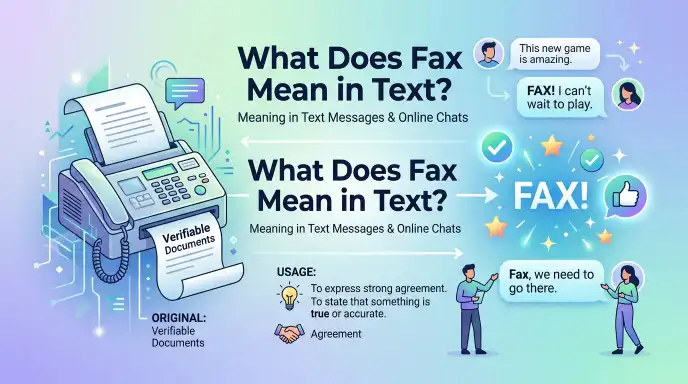
Fax in text usually means “facts” or “that’s true.” People use it to agree with something, especially on TikTok, Snapchat, Instagram, WhatsApp, and in casual texting. It can also literally mean a fax machine, so context matters.
When someone replies “fax” to your message, they are usually saying that what you said is true or that they strongly agree with you. It is similar to saying “facts,” “true,” or “exactly.”
People often search for what fax means in text because the word can look confusing. If you see it in a comment or private message, it may not have anything to do with sending a document.
The meaning is usually easy to understand once you look at the conversation around it. Below, you will see how fax is used, what it means on social media, and how you can reply naturally.
What Does Fax Mean in Text?
In texting and online conversations, fax usually means “facts.” It is a casual way to agree with someone or show that you believe their statement is completely true.
For example:
A: “People who reply late always say they were busy.”
B: “Fax.”
Here, fax does not refer to a machine. B is basically saying, “Facts” or “That is true.”
The word can also be used as a stronger form of agreement:
“FAX!”
Using capital letters can make the response feel more enthusiastic or emphatic.
Is Fax Slang, an Acronym, or an Abbreviation?
In online slang, fax is best understood as a slang spelling of “facts.” It is not normally treated as a traditional acronym where every letter stands for a separate word.
The spelling became popular because fax sounds similar to facts in casual speech. Online users began using the shorter spelling as a playful way to say that something is true.
There is also a completely different meaning of fax. In traditional communication, a fax is a machine or method used to send copies of documents electronically.
So, the context is important.
If someone says:
“Please fax the document to the office.”
They mean the traditional communication method.
But if someone comments:
“You need to stop wasting money on things you don’t use.”
“Fax.”
They are using fax as internet slang for “facts.”
What Does Fax Mean in Everyday Chat?
In everyday online chat, fax can mean:
- Facts
- That is true
- I agree
- Exactly
- You are right
- No lies
- That is completely true
It is usually a short response rather than a full sentence.
For example:
“That movie was way better than I expected.”
“Fax.”
The second person is simply agreeing with the opinion.
Where People Use Fax
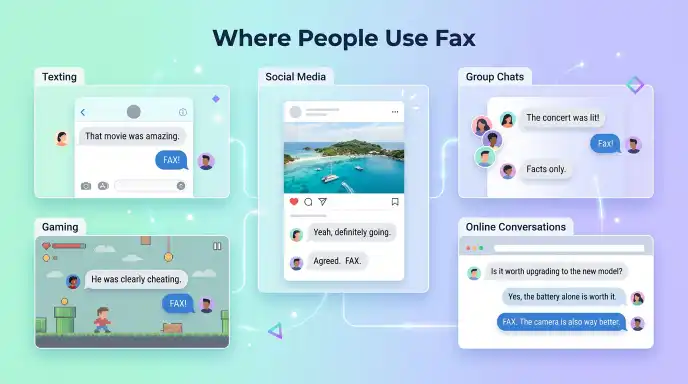
The slang use of fax appears mostly in casual online communication. It can show up in comments, private messages, group chats, and short replies.
The exact frequency can vary by platform, age group, community, and time. It is more natural in informal conversations than in formal writing.
Fax on TikTok
On TikTok, people may use fax in comments when they strongly agree with a video, statement, or opinion.
For example:
“Nobody talks about how tiring online shopping can be.”
“FAX.”
The comment means “That is completely true.”
You may also see forms such as:
“fax no printer”
This is another slang expression used to emphasize that someone is telling the truth.
The tone is usually playful and informal.
Fax on Snapchat
On Snapchat, faxes can appear in direct messages or replies to Stories.
For example:
Friend: “We should stop staying up until 2 a.m. before school.”
You: “Fax 😭”
The response shows agreement while keeping the conversation casual.
Snapchat conversations are usually informal, so slang like this can fit naturally between friends.
Fax on Instagram
On Instagram, you may see fax in comments, Reels discussions, captions, or direct messages.
Someone might post:
“Having a small group of real friends is better than knowing everyone.”
A person may comment:
“Fax.”
They are agreeing with the statement.
The word is especially easy to see in short comments because it communicates agreement without requiring a longer response.
Fax on WhatsApp
On WhatsApp, people can use fax in individual chats or group conversations.
For example:
A: “We should order food instead of cooking tonight.”
B: “Fax 😂”
It simply means “I agree.”
Because WhatsApp is used for both casual and professional conversations, the meaning depends on who you are talking to.
Fax in SMS
You can also see fax in ordinary text messages, especially when friends or younger users are chatting casually.
For example:
“That test was way too long.”
“Fax.”
It is short, easy to type, and usually understood from context.
For formal SMS messages, such as communication with a teacher, manager, customer, or business, a clearer phrase like “I agree” or “That’s true” is usually more appropriate.
Real Chat Examples
Here are some natural examples showing how fax can appear in everyday conversations.
Example 1
A: Everyone needs a vacation after exam week.
B: Fax.
A: I knew you would agree.
Example 2
A: That restaurant is seriously overrated.
B: FAX 😭
A: Finally, someone said it.
Example 3
A: We spend way too much time scrolling before bed.
B: Fax.
A: And then complain that we’re tired.
Example 4
A: Good friends don’t need to talk every day.
B: Fax.
A: Exactly. Real friendships can handle that.
Example 5
A: Monday mornings should start later.
B: FAX 😂
A: We definitely agree on that.
Example 6
A: That new update made the app harder to use.
B: Fax.
A: I thought I was the only one who noticed.
Example 7
A: Saving money is harder when everything looks interesting online.
B: FAX.
A: My shopping cart is proof.
Example 8
A: You don’t have to reply immediately to every message.
B: Fax.
A: Exactly. People have other things to do.
Example 9
A: The book was better than the movie.
B: FAX.
A: We finally agree on something.
Example 10
A: Getting enough sleep makes everything easier.
B: Fax 😭
A: But somehow I still stay awake too late.
These examples show that fax is generally used as a quick agreement. The exact tone can change depending on punctuation, capitalization, emojis, and the relationship between the people chatting.
How to Reply When Someone Says “Fax”
When someone says fax to you, they are normally agreeing with something you said. You do not need to give a complicated response.
Your reply can depend on the mood of the conversation.
Funny Replies
If the conversation is playful, you could answer with:
“Fax machine activated 😂”
“Finally, someone gets it.”
“No printer needed.”
“You already know.”
These responses keep the conversation light.
Casual Replies
For a normal conversation with a friend, try:
“Exactly.”
“Right?”
“For real.”
“That’s what I’m saying.”
“100%.”
These are simple and natural responses.
Friendly Replies
If you want to sound warm and friendly, you can say:
“Glad you agree!”
“Exactly! You get it.”
“I knew you’d understand.”
“We’re on the same page.”
Neutral Replies
If you want to keep your response simple, use:
“True.”
“Agreed.”
“Exactly.”
“That’s right.”
These replies work when you want to acknowledge the agreement without adding much to the conversation.
Is Fax Rude or Offensive?
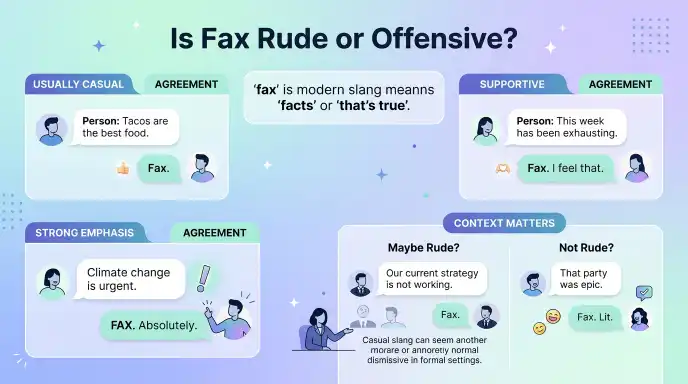
Fax is generally not rude or offensive when it is used as internet slang for “facts.”
It normally shows agreement rather than disrespect.
For example:
“Everyone deserves some time to relax.”
“Fax.”
There is nothing offensive about that response.
However, tone and context always matter. A short word can sometimes sound dismissive depending on the conversation.
For example, if someone is sharing a serious personal problem and you respond only with “fax,” they may feel that you are not giving their situation enough attention.
Is Fax Safe to Use?
In casual conversations, fax is generally safe to use.
It can work with:
- Friends
- Online communities
- Social media followers
- Gaming friends
- Casual group chats
It is less suitable when you need to sound formal or professional.
Can You Use Fax at School?
With friends at school, fax may be perfectly normal in casual messages.
However, it is not usually the best choice for an assignment, presentation, formal email, or message to a teacher.
Instead of writing:
“Fax.”
you could write:
“I agree.”
or:
“That is true.”
Can You Use Fax at Work?
In a professional workplace, it is better to consider the relationship and communication style before using slang.
A close coworker in a casual chat may understand fax, but a formal email should normally use professional language.
For example, instead of:
“Fax, that deadline is too short.”
you could write:
“I agree that the deadline is quite short.”
The second version is clearer and more professional.
Who Uses This Term?
The slang use of fax is mostly associated with people who spend time in online communities and use casual internet language.
Age Groups
You may see fax more often among teenagers and younger adults, particularly in informal digital conversations.
However, slang does not belong to one age group only. Older users who spend time on social media can also recognize or use the term.
Gen Z Usage
Gen Z internet culture has helped spread many short expressions used to show agreement, including fax.
It fits the style of quick online communication because one short word can communicate:
“That is true.”
“I agree.”
“Exactly.”
The term can also appear alongside other internet expressions.
Common Platforms
The slang can appear on platforms such as:
TikTok, Instagram, Snapchat, WhatsApp, Discord, Reddit, and text messaging.
Its use is not limited to one platform, though the style may differ between communities.
How Often Does Fax Appear Online?
There is no single reliable number that shows how often fax is used as slang across the entire internet.
Its visibility changes with trends, communities, and platform culture. You are more likely to encounter it in informal comments and conversations than in formal online writing.
Origin of the Fax
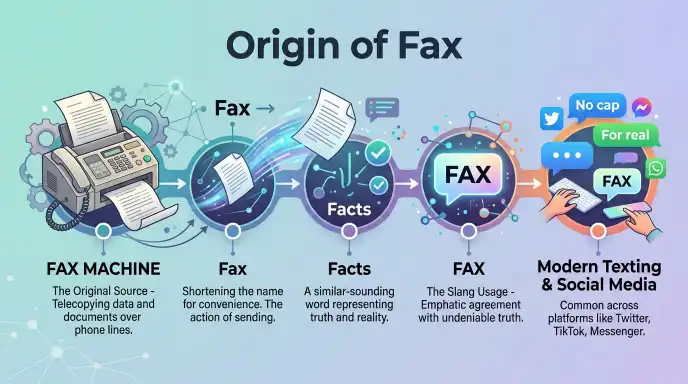
The slang meaning of fax is connected to the word “facts.” Online users began using the spelling fax as a playful phonetic form of facts, especially when agreeing strongly with someone’s statement.
The exact point when this slang usage began is difficult to establish with certainty. Internet slang often develops across multiple communities rather than coming from one clearly documented person or event.
The expression became more recognizable through online culture, memes, comments, music-related discussions, gaming communities, and social media conversations.
Why Does “Fax” Mean “Facts”?
The connection is mainly based on sound.
When facts are spoken quickly, it can sound similar to fax in casual speech. Internet users turned that similarity into a written slang form.
So:
Facts → Fax
The slang spelling is shorter and has a playful internet feel.
It is similar to other online language changes where people intentionally change spelling to make a word sound more casual, humorous, or distinctive.
Is the Origin Completely Clear?
Not completely.
There is no universally accepted single moment that can be identified as the official beginning of slang fax. Its development is better understood as part of broader internet and youth communication culture.
That is why it is useful to distinguish the documented meaning from uncertain claims about exactly who first used the expression.
Fax vs. Other Common Text Abbreviations
The following table compares fax with several familiar texting terms.
| Term | Meaning | Type | Usage | Popularity |
| Fax | Facts / That’s true | Internet slang | Agreement in casual chats and comments | Common in informal online spaces |
| IDK | I Don’t Know | Text abbreviation | Showing uncertainty or lack of knowledge | Very common |
| IDC | I Don’t Care | Text abbreviation | Showing indifference | Very common |
| IMO | In My Opinion | Text abbreviation | Introducing an opinion | Common |
| BRB | Be Right Back | Text abbreviation | Saying you will return shortly | Widely recognized |
The important difference is that fax is mainly an expression of agreement, while the other terms communicate different ideas.
For example:
IDK = uncertainty
IDC = indifference
IMO = personal opinion
BRB = temporarily leaving a conversation
Fax = agreement or confirmation
This makes fax particularly useful as a short reply.
Real-World Usage Example
Imagine two friends are talking after a long week at school or work.
One friend says:
“We seriously need a day where nobody expects us to do anything.”
The other replies:
“Fax.”
In this situation, the second person is not talking about sending a document. They are saying:
“That is true.”
“I completely agree.”
The word works because the conversation is casual and both people understand online slang.
Another example could happen in a group chat. Someone might say:
“We should start meeting earlier because traffic is getting worse.”
A friend responds:
“Fax.”
Again, the meaning is simply agreement.
The same word could have a completely different meaning in a business conversation:
“Please send the signed contract by fax.”
Here, fax refers to the traditional document-transmission method, not internet slang.
That is why reading the surrounding words is important.
Why Do People Say Fax Instead of Facts?
The main reason is internet-style communication.
Online conversations often shorten words, change spellings, and create playful alternatives. Fax is easy to type and instantly communicates agreement in communities where the expression is familiar.
It can also feel more expressive than simply writing:
“I agree.”
Compare these:
“I agree.”
“Facts.”
“Fax.”
The first sounds neutral. The second feels more casual. The third has an intentionally online and playful tone.
People may also write:
“FAX”
when they want to emphasize strong agreement.
Fax vs. Facts
Although fax and facts can have the same meaning in internet slang, they are not the same word in standard English.
Facts normally means pieces of information that are true or can be verified.
For example:
“Water freezes at 0°C under standard atmospheric pressure.”
That is a factual statement.
Fax, in standard English, refers to a method or machine used to transmit documents.
In internet slang, however, fax can be a playful spelling of facts.
So, context tells you which meaning is intended.
When Should You Avoid Using Fax?
You do not necessarily need to avoid the term completely. The main point is to use it where the informal tone makes sense.
Avoid using slang fax when writing:
- Formal school assignments
- Academic papers
- Professional reports
- Formal business emails
- Official applications
- Important customer communication
In these situations, clear standard English is usually better.
Use “I agree,” “That is true,” or “Exactly” instead.
For casual conversations, however, fax can be a perfectly natural response when the other person understands internet slang.
Frequently Asked Questions
Q1. What does fax mean in text messages?
Fax usually means “facts,” “that’s true,” or “I agree.” It is commonly used as a casual internet slang response.
Q2. What does fax mean on TikTok?
On TikTok, fax usually means “facts” or “I strongly agree.” It often appears in comments or replies to opinions and statements.
Q3. Is fax slang?
Yes. When fax is used to mean “facts,” it is considered internet slang or a playful slang spelling.
Q4. Is fax rude or offensive?
Generally, fax is not rude or offensive. It is usually a casual way to show agreement, although the tone can depend on the situation.
Q5. How should you reply to fax?
You can reply with “Exactly,” “True,” “I agree,” “For real,” or another casual response. A funny reply can also work when the conversation is playful.
Final Thoughts
Fax in text usually means “facts,” “true,” or “I agree.” It is a casual internet slang term commonly used when someone strongly agrees with another person’s statement.
You may see it in TikTok comments, Snapchat messages, Instagram posts, WhatsApp chats, and regular texting. It can also appear on other online platforms where informal language is common.
The word is generally not rude or offensive, but it is still slang. That makes it a better choice for casual conversations than formal school or workplace communication.
Remember that context matters. If someone says “fax the document,” they are talking about sending a document. If they simply reply “fax” after your opinion, they probably mean “facts” or “exactly.”

I’m Emily Carter, and I enjoy writing about slang, internet language, and modern English expressions. My goal is to explain word meanings in a simple, clear, and easy-to-understand way so anyone can learn with confidence.