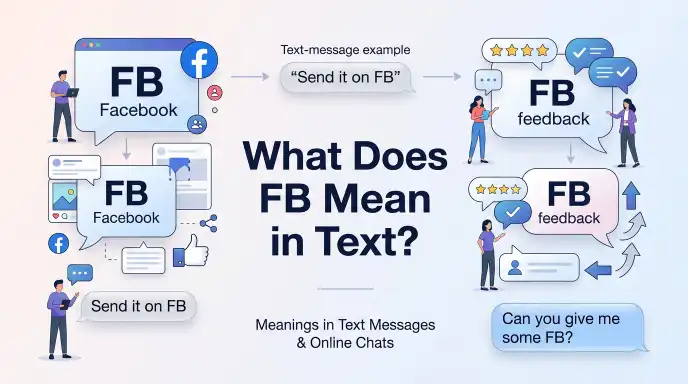
FB usually means Facebook in text messages, chats, and social media conversations. Depending on the context, it can also mean follow back, especially when people talk about social media followers.
You may see FB in texts, comments, DMs, TikTok conversations, Snapchat messages, Instagram chats, WhatsApp, or older social media posts. The exact meaning usually becomes clear from the sentence around it.
People search for what FB means in text because short forms can have more than one meaning. If someone sends “Add me on FB,” they almost certainly mean Facebook. If they say “FB me,” they may mean “follow me back” in a social media context.
Understanding the context is the easiest way to know which meaning someone intends. Below, you will see the common meanings, examples, replies, and situations where FB is used.
What Does FB Mean in Text?
The most common meaning of FB in text is Facebook. It is a shortened form of the social media platform’s name.
For example, someone might text:
“Are you on FB?”
This usually means:
“Are you on Facebook?”
Another common example is:
“I sent you a message on FB.”
Here, FB clearly refers to Facebook.
In some social media conversations, FB can also mean follow back. This meaning is more likely when people are discussing followers, accounts, or gaining connections.
For example:
“Follow me and FB.”
In this sentence, FB can mean follow back.
So, FB is best described as an abbreviation, rather than a traditional slang word. It is a shortened form used to make online communication faster and easier.
FB as Facebook
When FB means Facebook, it is usually used as a simple name abbreviation.
You might see phrases such as:
“Check my FB.”
“Find me on FB.”
“I posted it on FB.”
“Do you still use FB?”
In all of these examples, the meaning is Facebook.
This usage became especially common when people regularly used abbreviations for social networking platforms in text messages and online conversations.
FB as Follow Back
Another meaning of FB is follow back.
This meaning is more connected with social media interaction than ordinary texting.
For example:
“I followed you. FB?”
The person is asking the other user to follow them back.
You may also see:
“FB when you can.”
Here, the person may be asking for a follow-back.
Because this meaning depends heavily on context, you should not automatically assume that every FB means “follow back.”
Is FB Slang or an Abbreviation?
FB is mainly an abbreviation.
It is not usually considered slang in the same way as words such as bussin, goober, or cringe. Instead, it is a shortened form that people use in casual digital communication.
However, because abbreviations are common in online conversations, FB can appear alongside internet slang and texting shortcuts.
The meaning depends on the conversation, the platform, and the words around it.
Where People Use FB
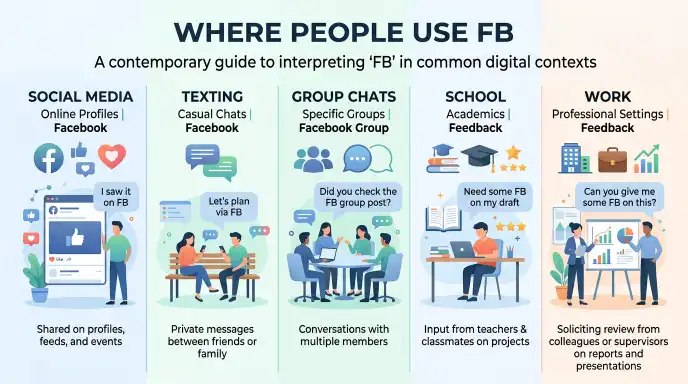
FB can appear across several messaging and social media platforms. Its meaning may stay the same, but the reason someone uses it can change depending on the platform.
FB on TikTok
On TikTok, FB may refer to Facebook when users are talking about sharing content or connecting on another platform.
For example:
“I also posted this on FB.”
Here, FB means Facebook.
In some social media conversations, however, FB may refer to follow back.
For example:
“Follow for FB.”
In that situation, the person is talking about following another account back.
Because TikTok has its own large vocabulary of abbreviations, context is especially important.
FB on Snapchat
On Snapchat, FB is not usually a special Snapchat feature or Snapchat-specific word.
Someone might use it while talking about Facebook:
“Do you have FB?”
They could also use it in a conversation about social media followers.
The meaning becomes easier to understand by looking at the rest of the message.
FB on Instagram
On Instagram, FB can sometimes mean Facebook, particularly when someone wants to connect their Instagram activity with Facebook.
It can also mean follow back in conversations about followers.
For example:
“I followed your page, FB?”
Here, the person is likely asking for a follow back.
FB on WhatsApp
On WhatsApp, FB usually means Facebook when someone is referring to the platform.
For example:
“Send me your FB profile.”
The person wants your Facebook profile.
It can also be used to follow back, although the surrounding conversation should make that meaning clear.
FB in SMS
In regular text messages, FB most commonly refers to Facebook.
For example:
“Are you still active on FB?”
This is a natural way to ask if someone still uses Facebook.
Since SMS conversations do not always provide extra social media context, the words around FB are useful for understanding the intended meaning.
Real Chat Examples
The following examples show how people might naturally use FB in everyday digital conversations.
Example 1
A: Are you on FB?
B: Yeah, I use it sometimes.
A: Cool, send me your profile.
Here, FB means Facebook.
Example 2
A: I posted the pictures on FB.
B: Okay, I’ll check them.
A: Let me know which one you like.
Again, FB means Facebook.
Example 3
A: Do you have an FB account?
B: Yes, but I rarely post.
A: That’s fine. I just wanted to add you.
The abbreviation refers to Facebook.
Example 4
A: I followed you on Instagram.
B: Thanks!
A: FB?
Here, FB most likely means follow back.
Example 5
A: Can you send me the link?
B: It’s on my FB profile.
A: Got it. I’ll look there.
In this conversation, FB means Facebook.
Example 6
A: Follow your account!
B: Thanks!
A: FB when you get a chance.
Here, FB means follow back.
Example 7
A: Where did you upload those photos?
B: On FB.
A: Send me your profile.
The speaker is referring to Facebook.
Example 8
A: Do you still check FB?
B: Not as much as I used to.
A: Same. I mostly use Instagram now.
Here, FB clearly means Facebook.
Example 9
A: I just followed you.
B: I saw it!
A: FB if you want.
In this example, FB means follow back.
Example 10
A: My aunt posted that on FB.
B: Seriously?
A: Yeah, she tagged everyone.
Here, FB means Facebook.
These examples show why context matters. The same two letters can refer to different things depending on what people are discussing.
How to Reply When Someone Says “FB”
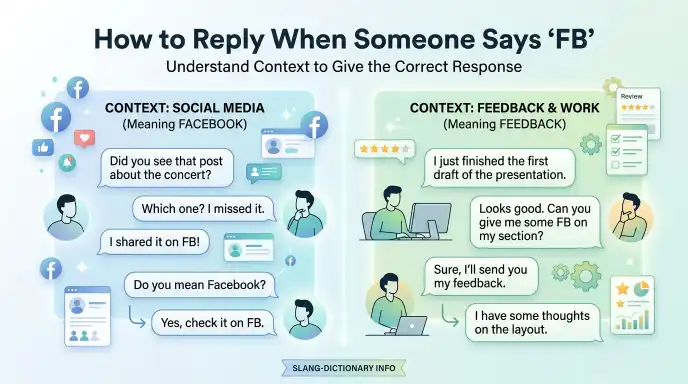
Your reply depends on what the person means. First, look at the conversation and determine if FB means Facebook or follow back.
Funny Replies
If the conversation is casual, you can answer with a playful response.
“FB? You mean Facebook?”
“My FB account is basically a digital museum.”
“I haven’t checked FB in forever!”
“FB? Throwback!”
These replies work best with friends who understand your sense of humor.
Casual Replies
If someone asks if you have Facebook, you can keep your answer simple.
“Yeah, I have Facebook.”
“Yep, I’m on FB.”
“I use it sometimes.”
“Sure, what’s your profile?”
If they mean follow back, you could say:
“Sure, I’ll follow you back.”
“Got you, follow back.”
Friendly Replies
A friendly response can make the conversation feel natural.
“Sure! Send me your FB name.”
“Yeah, I’d be happy to connect.”
“Thanks for the following. I’ll follow you back.”
“Of course! I’ll check your account.”
Neutral Replies
If you do not want to sound too casual, use a straightforward response.
“Yes, I have a Facebook account.”
“Do you mean Facebook?”
“Sure, I’ll check it.”
“Are you asking me to follow you back?”
These responses are useful when the meaning of FB is unclear.
Is FB Rude or Offensive?
FB is not normally rude or offensive. It is a common abbreviation used in casual digital communication.
The abbreviation itself does not contain an insult or offensive meaning in ordinary conversations.
However, the way someone uses it can affect the tone.
For example:
“Are you on FB?”
sounds completely normal.
But a message such as:
“Why aren’t you following me? FB now.”
could sound demanding, even though FB itself is not offensive.
Is FB Safe to Use?
Yes, FB is generally safe for casual online communication.
You can use it when texting friends, chatting with family members, or talking about social media.
Still, clear language can be better when there is a chance the reader may not understand the abbreviation.
Is FB Appropriate at School?
It depends on the situation.
In a casual message to a classmate, FB is usually fine.
In a formal school assignment, essay, presentation, or academic document, it is better to write Facebook instead.
Formal writing generally benefits from using complete names and words.
Is FB Appropriate at Work?
In a casual workplace chat, people may understand FB easily.
However, professional communication is usually clearer when you write on Facebook, especially when speaking with clients, customers, managers, or people outside your team.
For example, instead of:
“Check it on FB.”
a more professional message would be:
“You can find the post on Facebook.”
The issue is not that FB is offensive. It is mainly about clarity and formality.
Who Uses FB in Text and Online Chats?
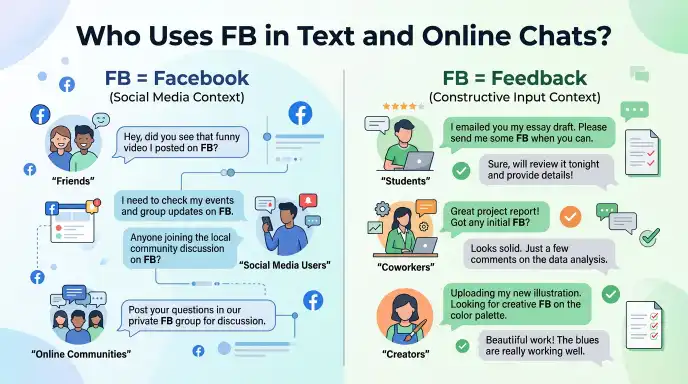
FB has been used by internet users for many years, especially people familiar with social media and texting abbreviations.
It can appear among different age groups because Facebook is used by a broad range of people.
Gen Z Usage
Younger users may recognize FB, but that does not mean they use it constantly.
Many Gen Z users communicate across several platforms, so they may use abbreviations differently depending on the conversation.
For example, someone may write FB when referring to Facebook but use another abbreviation when talking about following an account.
Older Social Media Users
People who have used Facebook for many years are also familiar with FB.
The abbreviation became convenient because it is much shorter than writing the full platform name.
You may see it in older posts, messages, profiles, and online conversations.
Common Platforms
You can find FB in conversations on:
TikTok
Snapchat
SMS
It may also appear in comments, direct messages, captions, forums, and other online spaces.
There is no single age group that owns the abbreviation. Its meaning is mostly determined by context.
Origin of the Term
The most common use of FB comes from shortening the name Facebook.
As online communication became faster, users began creating shorter versions of commonly used names and phrases. Writing two letters instead of the complete platform name was quick and convenient.
The exact point when FB became widely used is difficult to identify. Internet abbreviations usually spread gradually through everyday communication rather than appearing from one clearly documented event.
The meaning follows back also developed naturally from social media culture.
As platforms became centered around followers, following, and mutual connections, users needed quick ways to ask another person to return a follow. FB became one possible shorthand for that request.
Because both meanings developed through online communication, there is not always a single confirmed origin date for the abbreviation.
The safest way to understand FB is therefore to look at how it appears in the sentence.
If someone says:
“Add me on FB.”
they mean Facebook.
If someone says:
“I followed you, FB?”
they probably mean follow back.
FB vs. Other Common Text Abbreviations
Different abbreviations serve different purposes in online conversations. FB is usually connected with Facebook or follow back, while other common shortcuts express opinions, uncertainty, or timing.
| Meaning | Type | Usage | Popularity |
| FB | Abbreviation | Facebook or follow back | Common |
| IDK | Acronym | I don’t know | Very common |
| IDC | Acronym | I don’t care | Very common |
| IMO | Acronym | In my opinion | Common |
| BRB | Acronym | Be right back | Common |
The biggest difference is that FB can have multiple meanings.
For example, IDK almost always means “I don’t know” in ordinary texting. IDC usually means “I don’t care.” IMO generally means “in my opinion,” and BRB means “be right back.”
With FB, context matters more.
Real-World Usage Example
Imagine two classmates are talking after school.
One student recently created a Facebook account and wants to connect with an old friend. They send a message:
“Hey, are you on FB? I couldn’t find you on Instagram.”
The other person might respond:
“Yeah, I am. Search for my full name.”
In this situation, FB simply means Facebook.
Now imagine a different situation.
Someone follows a new Instagram account and wants the other person to return the follow. They might write:
“Just followed you. FB?”
Here, FB means follow back.
These two situations show why reading the entire message is important. The abbreviation alone does not always tell you exactly what the sender means.
If you are unsure, the easiest solution is to ask:
“Do you mean Facebook or follow back?”
That short question can prevent unnecessary confusion.
Frequently Asked Questions
Q1. What does FB mean in text messages?
FB most commonly means Facebook in text messages. In social media conversations, it can also mean follow back.
Q2. What does FB mean on TikTok?
On TikTok, FB can mean Facebook or follow back. The surrounding conversation usually tells you which meaning is intended.
Q3. Is FB slang?
FB is mainly an abbreviation, not traditional slang. It commonly shortens Facebook and can also mean follow back in social media conversations.
Q4. Is FB rude or offensive?
No. FB is generally neutral and is not considered rude or offensive. However, the tone of the full message can still sound friendly, demanding, or casual.
Q5. How should you reply to FB?
First, determine what the sender means. If they mean Facebook, you can say “Yes, I’m on Facebook.” If they mean follow back, you can say “Sure, I’ll follow you back.”
Final Thoughts
FB most commonly means Facebook when used in texts, chats, and social media conversations. In some situations, especially when people are discussing followers, it can also mean follow back.
The easiest way to understand it is to look at the surrounding words. “Find me on FB” means Facebook, while “I followed you, FB?” usually means follow back.
The abbreviation is generally safe and neutral for casual conversations. For school assignments, formal writing, or professional messages, writing the complete phrase Facebook can make your meaning clearer.
Once you understand the context, FB is a simple abbreviation that is easy to recognize and use.