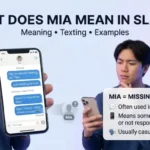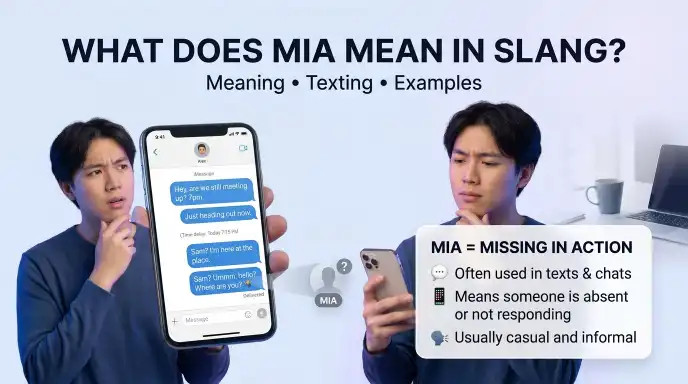
MIA means “Missing in Action.” In everyday slang, it usually describes someone who has gone quiet, stopped replying, or has not been around for a while. You might see “You’ve been MIA” in a text, Instagram message, Snapchat chat, TikTok comment, or group conversation.
The original phrase has a military meaning. It was used for military personnel whose status was unknown after combat. Today, the slang use is much less serious. A friend can say they were “MIA” simply because they were busy, offline, or taking a break from social media.
Dictionaries also recognize this figurative use for someone or something that is absent or inactive. If you search “what does MIA mean in slang,” this guide explains the full meaning, tone, origin, examples, platform use, and when the expression may not be appropriate.
Quick Answer: What Does MIA Mean in Slang?
MIA slang means “Missing in Action.” In casual conversation, it means someone is absent, unavailable, unusually quiet, or not responding. For example, “You’ve been MIA all week” means the person has not been around or answering messages.
What Does MIA Mean in Slang?
MIA is an abbreviation of “Missing in Action.” In slang, it usually means that a person has disappeared from normal contact.
Someone can be MIA because they:
- stopped answering texts
- disappeared from a group chat
- have not posted online
- missed social plans
- became unavailable
- took a break from social media
- have not been seen for a while
The phrase does not automatically mean that something bad happened.
For example:
“Sorry I was MIA yesterday. Work was intense.”
Here, the person simply means they were unavailable.
MIA can also describe things, not just people. You might say a missing document, item, or response is “MIA” when it is expected but cannot be found. Cambridge Dictionary specifically notes this broader informal use for someone or something that has disappeared or cannot be contacted.
What Does MIA Stand For?
MIA stands for “Missing in Action.”
The letters represent:
- M = Missing
- I = In
- A = Action
The original phrase is military terminology. Merriam-Webster records MIA as having a first known use in the 1940s, with the noun referring to a member of the armed forces reported missing in action.
In modern everyday speech, the phrase is usually figurative. Saying “My friend is MIA” normally does not mean the person is literally missing during a military operation.
MIA Meaning in Text Messages
In texting, MIA usually means someone has been absent or has stopped responding.
For example:
“Where have you been? You’ve been MIA.”
The sender is probably asking why the person has not been around or replying.
Another example:
“I’m going MIA for the weekend.”
This means the person plans to be unavailable or less active for a while.
The tone can change depending on the message. “You’re MIA 😂” may sound playful, while “You’ve been MIA. Is everything okay?” sounds concerned.
So, MIA describes the absence, but the surrounding words show the emotion.
MIA Meaning on Social Media
MIA can describe someone who suddenly becomes inactive on social media.
| Platform | Typical use | Example |
| TikTok | Someone has stopped posting or commenting | “She’s been MIA lately.” |
| A person has not posted or replied | “Why are you MIA?” | |
| Snapchat | Someone is not responding or active | “You went MIA yesterday.” |
| Discord | Someone has left a server or chat quiet | “Where’s Alex? He’s MIA.” |
| A user has stopped appearing in a community | “That account has been MIA.” | |
| Someone has stopped replying | “Sorry, I was MIA.” |
These platforms do not give MIA a special new definition. The core idea remains absence or unavailability.
Is MIA Rude, Offensive, or Harmless?
MIA is generally harmless and informal.
Calling someone “MIA” does not automatically insult them. It can be friendly, playful, concerned, or slightly annoyed depending on the situation.
Compare these examples:
“You’ve been MIA 😂”
This sounds playful.
“Why have you been MIA all week?”
This may sound mildly annoying.
“You’ve been MIA. Are you okay?”
This sounds concerning.
The phrase can therefore point out someone’s absence without directly accusing them of ignoring you.
In formal writing, though, “absent,” “unavailable,” or “not available” may be clearer.
Can MIA Have a Serious Meaning?
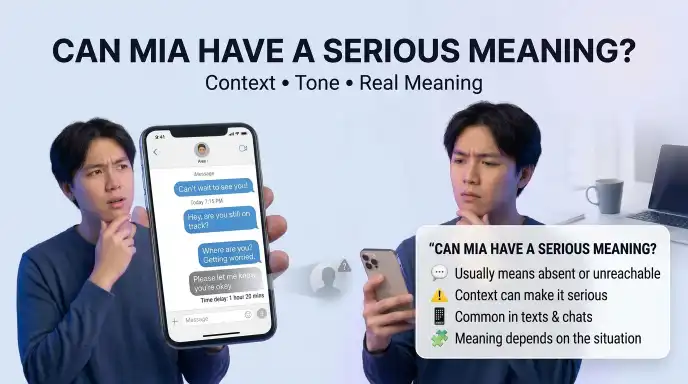
Yes. Context matters.
The original military meaning of MIA is serious. It refers to military personnel who are unaccounted for after combat or an operation. Oxford and Cambridge both retain this literal military definition.
The casual slang meaning is different.
If someone says:
“My coworker has been MIA all afternoon.”
they probably mean the coworker is unavailable.
If a news report discusses a soldier being listed as MIA, the military meaning applies.
This difference is important because the same abbreviation can describe something light and everyday or something connected to a serious military situation.
How Is MIA Used in Everyday Conversation?
People often use MIA as a simple way to explain a period of absence.
Common patterns include:
- “I was MIA.”
- “She’s been MIA.”
- “He went MIA.”
- “You’ve been MIA lately.”
- “I’m going MIA for a few days.”
These expressions can describe both planned and unplanned absence.
For example, someone may say “I’m going MIA” before taking a social media break. Another person might say “He went MIA” because their friend suddenly stopped replying.
The expression is flexible, but the central idea stays the same: someone or something is missing, absent, or unavailable.
MIA vs. Ghosting
MIA and ghosting can look similar, but they are not exactly the same.
| Term | Meaning | Usual tone |
| MIA | Absent, unavailable, or unusually quiet | Neutral to playful |
| Ghosting | Suddenly cutting off communication without explanation | More negative |
| Offline | Not currently connected | Neutral |
| Busy | Occupied with something | Neutral |
| Ignoring | Choosing not to respond | Can sound negative |
Someone can be MIA without ghosting anyone.
For example, a person who stops checking their phone while traveling may be MIA. They are absent, but they may not be intentionally avoiding anyone.
That distinction can help prevent misunderstandings.
Is MIA Still Used Today?
Yes, MIA remains a recognizable informal expression. Major dictionaries still record its figurative use for people or things that are absent, unavailable, or inactive.
Its exact frequency can vary by age, region, and social group. It is better to describe MIA as an established informal expression than to claim that every social media user uses it.
You may see it in texts, casual speech, social media posts, group chats, and informal workplace conversations.
Origin and History of MIA
MIA comes from the military phrase “missing in action.”
The abbreviation became established during the 20th century. Merriam-Webster lists 1944 as the first known use of MIA as a noun and 1946 for its adjective use.
The casual meaning developed from the basic idea of being missing or unaccounted for. Over time, speakers began using MIA outside military settings to describe ordinary absence.
That shift explains why someone can now say:
“I was MIA from Instagram.”
The speaker is borrowing the idea of being missing and applying it to everyday life.
When Should You Avoid Using MIA?
MIA is fine for most casual conversations, but choose your words carefully when the situation is serious.
Avoid using it as a joke when discussing:
- missing people
- military casualties
- serious emergencies
- real-life situations where someone’s safety is unknown
Calling a friend “MIA” after they stop replying for a few hours is very different from using the same phrase when someone is genuinely missing.
For formal documents, use clearer wording such as “absent,” “unavailable,” or “not responding.”
Common Misunderstandings About MIA
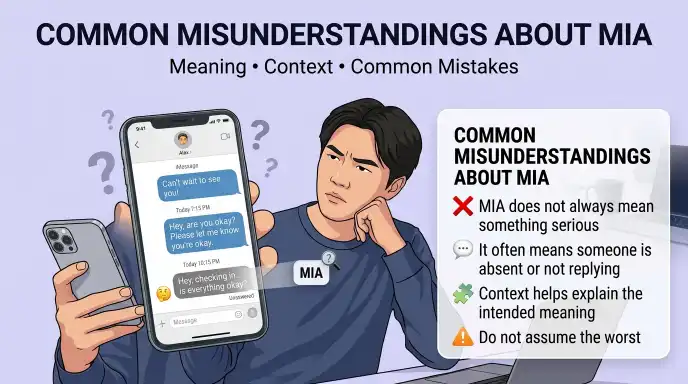
One common mistake is assuming MIA always means someone is deliberately ignoring messages.
It does not.
A person can be MIA because they are busy, asleep, traveling, taking a break, offline, or simply away from their phone.
Another mistake is thinking MIA always refers to people. It can describe things too:
“The report is MIA.”
Here, the report is missing or unavailable.
Finally, do not confuse casual MIA slang with serious military use. The surrounding context tells you which meaning is intended.
Key Takeaways
- MIA stands for “Missing in Action.”
- In slang, it usually means absent, unavailable, or unusually quiet.
- It is common in casual texting and online communication.
- MIA is usually harmless, but its tone can be playful, concerned, or annoyed.
- The original military meaning is more serious.
- MIA does not automatically mean someone is ghosting or deliberately ignoring you.
Frequently Asked Questions
Q1. What does MIA mean in slang?
MIA means “Missing in Action.” In casual slang, it describes someone who has disappeared, stopped replying, become inactive, or has not been around for a while. It is usually informal and does not imply that the person is literally missing.
Q2. What does MIA mean in texting?
In texting, MIA usually means that someone has been absent or unavailable. If a friend says, “You’ve been MIA,” they may mean you have not answered messages, joined conversations, or been around recently.
Q3. Is MIA a rude word?
No. MIA is generally not rude or offensive. It can sound playful, concerned, or mildly annoyed depending on the message. For example, “You’re MIA 😂” sounds much lighter than a serious complaint about someone’s absence.
Q4. Does MIA mean ghosting?
Not necessarily. MIA simply means someone is absent or unavailable. Ghosting usually suggests that someone has intentionally stopped communicating without explanation. A person can be MIA because they are busy or offline without ghosting anyone.
Q5. What does “going MIA” mean?
“Going MIA” means becoming unavailable or stepping away for a period of time. Someone might say, “I’m going MIA this weekend,” to tell friends that they will not be active or easy to reach.
Q6. What does MIA mean on Instagram or TikTok?
On Instagram or TikTok, MIA usually means someone has been absent from the platform. They may not be posting, commenting, replying, or appearing online as much as usual. The meaning remains the same across these platforms.
Q7. Is MIA appropriate for work?
MIA is understandable in casual workplace chat, especially among coworkers who already use informal language. For formal emails, reports, or communication with clients, “unavailable” or “absent” is usually clearer and more professional.
Q8. What is the opposite of MIA?
There is no single official slang opposite of MIA. Depending on the situation, words such as “active,” “present,” “available,” or “online” can express the opposite idea. If someone has returned after being MIA, you could simply say they are “back.”
Conclusion:
MIA is a familiar abbreviation that means “Missing in Action.” In everyday slang, it usually describes someone who has disappeared from conversations, stopped replying, gone quiet online, or has simply been unavailable for a while.
The expression is normally casual and harmless. Its tone depends on context. A friend may use “MIA” as a joke, while another person may use it to show concern or mild frustration. The original military meaning is more serious, so context is especially important when interpreting the abbreviation.
If someone tells you, “You’ve been MIA,” they usually mean, “I haven’t seen or heard from you lately.” That does not necessarily mean they think you are ghosting them.
The safest rule is simple: look at the surrounding conversation. Once you know whether the context is casual, professional, social, or military, the intended meaning of MIA becomes much easier to understand.

I’m Emily Carter, and I enjoy writing about slang, internet language, and modern English expressions. My goal is to explain word meanings in a simple, clear, and easy-to-understand way so anyone can learn with confidence.