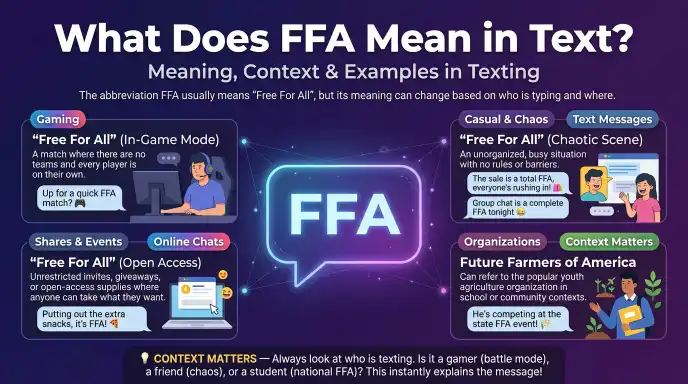
FFA usually means “Free For All” in text, describing a situation where everyone can participate, compete, or act independently without being placed into teams. You may see it in gaming chats, TikTok comments, Snapchat messages, Instagram DMs, WhatsApp groups, and casual texting.
People often search “what does FFA mean in text” because these three letters can look confusing without context. In most casual online conversations, the intended meaning is Free For All, but the exact meaning can change depending on the community or conversation.
The term is especially common around online gaming, where an FFA match means players compete individually rather than working in teams. Over time, people also began using it more loosely for busy, chaotic, or open situations.
FFA Meaning in Text
FFA means “Free For All.” In simple language, it describes a situation where everyone is allowed to participate or compete independently.
In gaming, an FFA usually means there are no fixed teams. Each player plays for themselves. Instead of protecting teammates or following team strategies, everyone is competing against everyone else.
For example:
“Let’s play FFA.”
This normally means:
“Let’s play free-for-all mode where everyone competes individually.”
FFA is best described as an acronym or abbreviation rather than a traditional slang word. However, because people use it casually in online conversations, it can function like internet slang.
What Does FFA Mean in Everyday Chat?
Outside gaming, FFA can describe something that feels open, uncontrolled, or available to everyone.
For example, imagine a group chat where everyone starts talking at the same time. Someone might jokingly say:
“This chat is FFA tonight.”
They are not necessarily talking about a game. They mean that everyone is jumping into the conversation, and there is little structure.
Another example is:
“The comments turned into an FFA.”
This suggests that many people are responding freely, possibly arguing or competing for attention.
The meaning is therefore closely connected to the basic idea of everyone being involved without strict teams or restrictions.
In gaming communities, the meaning is especially clear. FFA is widely used for multiplayer situations in which players compete independently.
Is FFA Always About Fighting?
No.
The word “free” does not automatically mean fighting. The context decides what the FFA involves.
An FFA game may involve competition, while an FFA conversation may simply mean everyone can join in.
For example:
“The meeting became an FFA for ideas.”
Here, the person may simply mean that everyone was free to share ideas.
So, when you see FFA, first look at the surrounding words before deciding exactly what the sender means.
Where People Use FFA
FFA is most strongly associated with gaming and online communities, but people can use it in many informal digital conversations.
FFA on TikTok
On TikTok, FFA may appear in comments, captions, videos, or discussions involving gaming and online communities.
A person might write:
“The comments are an FFA today 😂”
This could mean that everyone is freely arguing, joking, replying, or sharing opinions.
Another example is:
“FFA match tonight?”
Here, the meaning is clearly connected to gaming.
Because TikTok combines gaming content, memes, live discussions, and fast-moving comment sections, the meaning can depend heavily on context.
FFA on Snapchat
On Snapchat, FFA is more likely to appear in private chats or conversations between friends.
For example:
“Whoever wants to come can come. FFA.”
The sender may be saying that there are no strict restrictions about who participates.
Friends may also use the term jokingly:
“Our group chat is basically FFA 😂”
This means everybody is talking freely and the conversation has become difficult to control.
FFA on Instagram
On Instagram, you might see FFA in DMs, comments, captions, gaming posts, or group conversations.
For example:
“Bro, the comments are FFA 💀”
This suggests that the comment section has become very active or chaotic.
In a gaming-related post, however:
“FFA tonight?”
would most likely refer to a free-for-all game.
FFA on WhatsApp
WhatsApp groups can create plenty of situations where FFA works naturally.
Imagine a group planning a party. Nobody has assigned specific jobs, and everyone is free to suggest ideas.
Someone might say:
“Okay, this planning is FFA now 😂”
They are using the term humorously to describe a situation without much structure.
Gaming groups may also use it in its more traditional sense:
“No teams this time. FFA.”
That means everyone competes individually.
FFA in SMS
In regular text messages, FFA is usually used between people who already understand the abbreviation.
For example:
“Are you guys playing teams or FFA?”
A gamer will probably understand this immediately.
But if the person receiving the message does not know gaming abbreviations, they may need to ask what FFA means.
That is why context is important. Short abbreviations are convenient when both people know them, but they can be confusing when they do not.
Real Chat Examples of FFA
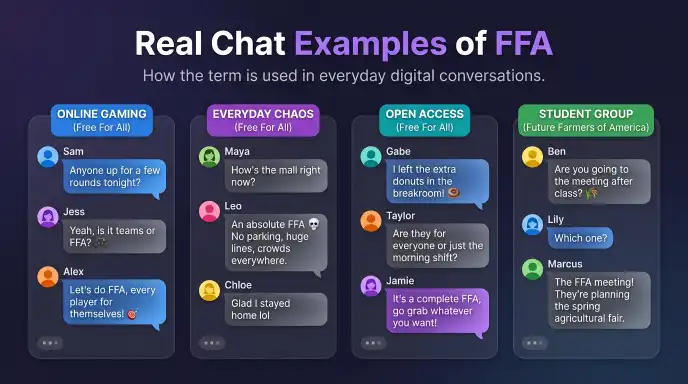
The following examples show how FFA can naturally appear in different types of conversations.
Example of FFA in a Gaming Chat
A: Are we making teams this round?
B: Nah, let’s do FFA.
A: So everyone for themselves?
B: Yep, exactly.
Example of FFA in a Group Chat
A: Why is everyone talking at once?
B: I don’t know 😂
A: This group is FFA tonight.
B: Literally nobody is waiting their turn.
Example of FFA on Social Media
A: Did you see the comments?
B: Yeah 😭
A: It became an FFA so fast.
B: Everyone started arguing.
Example of FFA Between Friends
A: Who’s choosing the movie?
B: Everyone can pick one.
A: So it’s FFA?
B: Pretty much 😂
Example of FFA in a Gaming Group
A: Team deathmatch or FFA?
B: FFA.
A: Fine, but don’t complain when I win.
B: We’ll see about that.
Example of FFA in a Casual Conversation
A: Are there assigned seats?
B: Nope, sit wherever you want.
A: Oh, so it’s FFA.
B: Yep.
Example of FFA in an Instagram DM
A: Why are you replying to all those comments?
B: Everyone keeps tagging me.
A: Your post turned into an FFA 😂
B: I noticed.
Example of FFA in a Snapchat Chat
A: Who’s coming tonight?
B: Anyone who wants to.
A: FFA then?
B: Basically.
Example of FFA During Online Gaming
A: Wait, where are my teammates?
B: There aren’t any.
A: Oh, this is FFA?
B: Yep. Good luck 💀
Example of FFA in a Busy Group
A: Can we make one plan?
B: Too late.
A: Why?
B: Everyone is doing their own thing. It’s FFA 😂
How to Reply When Someone Says “FFA”
Your best reply depends on what the person means by FFA.
If they are talking about gaming, you can respond about the match. If they are joking about a chaotic conversation, you can respond in the same playful way.
Funny Replies to FFA
“FFA? I’m not surviving this 😭”
“So basically everyone is my enemy?”
“FFA? Say goodbye to teamwork 😂”
“I joined for fun and now it’s war 💀”
These replies work well when the conversation is playful.
Casual Replies to FFA
“Sure, I’m down.”
“Okay, FFA works.”
“Yeah, let’s do it.”
“Sounds good.”
These are simple responses when you already understand the context.
Friendly Replies to FFA
“Haha, okay. Everyone can join then.”
“That sounds fun!”
“Sure, bring everyone.”
“I’m good with that.”
These replies keep the conversation relaxed and positive.
Neutral Replies to FFA
If you are unsure what the person means, the easiest response is:
“What do you mean by FFA?”
You can also ask:
“Do you mean free-for-all?”
This is better than guessing, especially if the conversation is not about gaming.
Is FFA Rude or Offensive?
FFA is generally not rude or offensive. The most common meaning, “Free For All,” is a neutral phrase used to describe a type of game or an open situation.
However, the tone can change depending on how someone uses it.
For example:
“Let’s play FFA.”
This is completely normal in a gaming conversation.
But:
“That meeting was an FFA.”
could sound slightly negative if the speaker means the meeting was chaotic or poorly organized.
So, the word itself is not offensive. The surrounding situation gives it its tone.
Is FFA Safe to Use?
Yes, in most casual conversations.
It is generally safe to use with:
- Friends
- Gaming teammates
- Online communities
- Social media followers
- Group chats
Still, abbreviations are not always ideal when speaking to someone who may not understand internet slang.
Can You Use FFA at School?
You can use FFA casually with friends, particularly if you are talking about gaming.
However, in a school assignment, presentation, or formal message, it is better to write “free-for-all” or explain the term first.
For example, instead of writing:
“The activity will be FFA.”
a formal instruction could say:
“The activity will be open to everyone, with participants competing individually.”
Can You Use FFA at Work?
FFA is usually too informal for professional emails and formal documents.
If coworkers already use the term casually, it may be fine in an informal chat. But in a formal email, plain language is clearer.
Instead of:
“The discussion became an FFA.”
you could write:
“The discussion became unstructured, with everyone speaking at once.”
This avoids possible confusion.
Who Uses FFA Mean in Text?
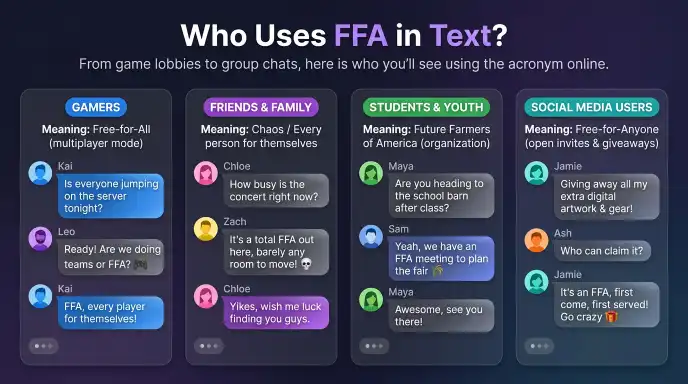
FFA is most strongly associated with gamers and online communities.
People who play multiplayer games may recognize it quickly because FFA is commonly used to describe a game mode where players compete individually.
Age Groups
Teenagers and young adults who spend time in gaming or online communities are likely to understand FFA.
Older users who regularly play multiplayer games or participate in online communities may know it as well.
There is no strict age group that owns the term.
Gen Z Usage
Gen Z users may use FFA casually, especially when talking about games, social media chaos, or group conversations.
However, it is not a word that every Gen Z user automatically uses. Someone may understand it perfectly without using it themselves.
That distinction matters because online slang varies between communities.
Common Platforms
FFA can appear across:
- TikTok
- Snapchat
- SMS
- Gaming chats
- Online communities
- Group conversations
Its strongest connection remains multiplayer gaming.
How Often Does FFA Appear Online?
FFA is recognizable online, but it is not necessarily as common in everyday texting as abbreviations such as IDK or BRB.
You are more likely to encounter it when the conversation involves gaming, competition, open participation, or a chaotic group situation.
That is why someone who rarely plays games might see FFA and have no idea what it means.
Origin of the Term
The phrase “free-for-all” existed before modern social media and texting. FFA is simply a shortened form of that phrase.
Its modern online use became especially connected with multiplayer gaming, where a free-for-all mode allows players to compete independently instead of being placed into teams. There is no reliable single person credited with inventing the abbreviation for gaming.
As online gaming became more popular, gaming vocabulary began appearing outside games.
That helped FFA develop a broader informal meaning.
Today, someone may describe a chaotic comment section as an FFA even though nobody is literally playing a game.
Internet Culture and FFA
Gaming has had a major influence on online language.
Words and abbreviations that were once limited to gaming communities often move into everyday internet conversations. FFA is a good example.
Its basic idea remains the same:
Everyone is involved independently.
The difference is that the “competition” can sometimes be figurative.
For example:
“The comments are an FFA.”
does not necessarily mean people are playing a game. It may simply mean that everyone is jumping into the discussion.
The exact historical starting point of the abbreviation is difficult to pin down, so it is better to describe its origin as an abbreviation of the established phrase “free-for-all,” strongly associated with multiplayer gaming, rather than claim that one person invented it.
FFA vs IDK vs IDC vs IMO vs BRB
These abbreviations can all appear in casual online communication, but they serve completely different purposes.
| Term | Meaning | Type | Usage | Popularity |
| FFA | Free For All | Acronym | Gaming, open participation, chaotic situations | Common in gaming and online communities |
| IDK | I Don’t Know | Acronym | Showing uncertainty or lack of knowledge | Very common |
| IDC | I Don’t Care | Acronym | Showing indifference | Very common |
| IMO | In My Opinion | Acronym | Giving a personal opinion | Common |
| BRB | Be Right Back | Acronym | Telling someone you will return shortly | Very common |
The biggest difference is that FFA describes a situation, while the others mainly communicate a person’s response or intention.
For example:
IDK = “I don’t know.”
IDC = “I don’t care.”
IMO = “In my opinion.”
BRB = “I will be right back.”
FFA = “Free for all.”
Understanding this difference makes FFA much easier to recognize in a conversation.
Real-World Usage Example
Imagine a group of friends planning a casual gaming night.
At first, they wanted to divide everyone into two teams. Then more people join the game, and someone suggests that they skip teams and let everyone play independently.
One person says:
“Let’s just make it FFA.”
Everyone understands that there will be no fixed teams. Each player will compete on their own.
Now imagine a different situation.
A group chat is normally quiet, but one evening everyone starts sending messages, memes, opinions, and jokes at the same time.
One friend might say:
“This group is FFA tonight 😂.”
Here, FFA is being used figuratively. There is no actual game. The person is comparing the chaotic conversation to a free-for-all.
This is an important part of understanding internet slang: the literal meaning and the conversational meaning can be slightly different.
Why Context Matters With FFA
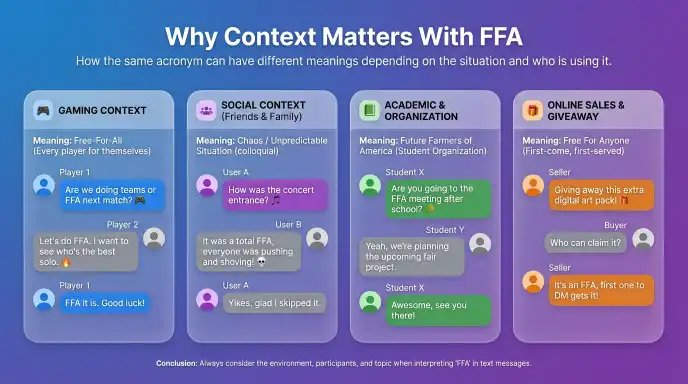
Short abbreviations can have more than one meaning.
For most casual gaming or internet conversations, Free For All is the main interpretation. But FFA can also refer to other things in different communities, organizations, or specialized conversations.
That means you should not automatically assume the same meaning every time you see FFA.
For example:
“FFA match”
almost certainly points toward Free For All gaming.
But:
“I joined FFA at school.”
could refer to something completely different depending on the school and context.
If you are unsure, look at the words around FFA.
Ask yourself:
Is the conversation about gaming?
If yes, Free For All is very likely.
Are people discussing a chaotic group conversation?
FFA may be a figurative way of saying everyone is doing their own thing.
Is the conversation about an organization or a specialized subject?
Then another meaning may be intended.
Context is the safest way to interpret abbreviations.
Capital Letters vs Lowercase FFA
You may see FFA, ffa, or occasionally Ffa in online conversations.
The capitalization usually does not change the meaning.
FFA is the standard form because it represents the first letters of Free For All.
In quick texting, however, people may type:
“ffa?”
instead of:
“FFA?”
Both can mean the same thing.
Capitalization is often a matter of typing style rather than a change in definition.
Is FFA Different From Free-for-All?
No. In the common internet and gaming meaning, FFA is simply the abbreviated form of “free-for-all.”
The full phrase is easier for beginners to understand, while FFA is faster to type.
For example:
“Do you want to play free-for-all?”
can become:
“Wanna play FFA?”
The shorter version is especially useful in gaming chats where people want to communicate quickly.
When Should You Avoid Using FFA?
You do not need to avoid FFA completely. It is a normal informal abbreviation.
However, there are situations where writing the full phrase is better.
Avoid relying on FFA when:
- The reader may not know internet abbreviations.
- You are writing a formal email.
- You are preparing a school assignment.
- You are writing a professional report.
- The meaning could be misunderstood.
- The conversation has nothing to do with gaming or casual internet culture.
In those cases, “free-for-all” or a simple explanation is clearer.
For example:
Casual:
“Let’s make it FFA.”
Clearer:
“Let’s make it a free-for-all.”
Formal:
“Participants will compete individually rather than in teams.”
Choosing the right version depends on your audience.
Frequently Asked Questions
Q1. What does FFA mean in text messages?
FFA usually means “Free For All.” It describes a situation where everyone can participate or compete independently, especially in gaming.
Q2. What does FFA mean on TikTok?
On TikTok, FFA usually means “Free For All.” It may describe a gaming situation or be used jokingly for a chaotic comment section or open discussion.
Q3. Is FFA slang?
FFA is an acronym or abbreviation, but it is commonly used as informal internet and gaming slang.
Q4. Is FFA rude or offensive?
No, FFA is generally not rude or offensive. Its tone depends on the situation, but “Free For All” itself is a neutral expression.
Q5. How should you reply to FFA?
If someone means Free For All, you can reply with “Sure,” “I’m down,” or “Everyone for themselves?” If you are unsure, simply ask what they mean.
Final Thoughts on FFA
So, what does FFA mean in text? In most online conversations, FFA means “Free For All.” It is especially common in gaming, where it describes a match in which players compete independently instead of playing on fixed teams.
People can also use FFA more casually to describe an open, unstructured, or chaotic situation. That is why you may see it in gaming chats as well as TikTok comments, Instagram messages, Snapchat conversations, WhatsApp groups, and regular texts.
FFA is generally not rude or offensive, but it is informal. It works well with friends and online communities, while the full phrase or a plain-English explanation is better for school and professional situations.
The easiest way to understand FFA is to remember its core idea: everyone is in the action, without fixed teams or strict structure. When you see it in a message, check the surrounding conversation and the meaning will usually become clear.

I’m Emily Carter, and I enjoy writing about slang, internet language, and modern English expressions. My goal is to explain word meanings in a simple, clear, and easy-to-understand way so anyone can learn with confidence.