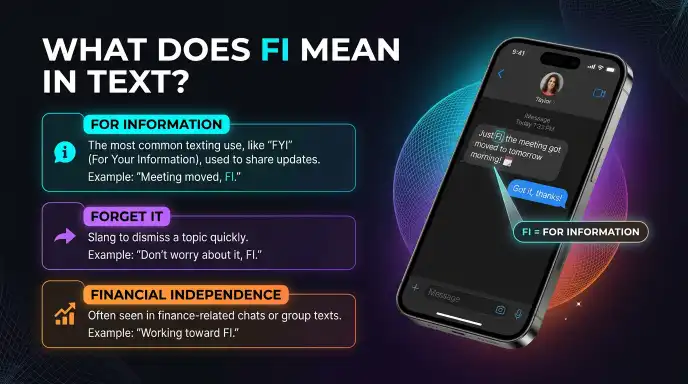
FI can mean “forget it” or “f* it” in informal text messages.** People may use it when they want to drop a subject, express frustration, or show that they no longer care about a situation. In some conversations, FI can also stand for “fiancé.”
You might see these two letters in WhatsApp messages, Snapchat chats, TikTok comments, or Instagram DMs. However, FI does not have one fixed meaning in every conversation. The words around it usually reveal what the sender wants to say.
That is why a message such as “FI, let’s go home” can feel different from “My FI is coming over.” One may express frustration, while the other may refer to an engaged partner.
Let’s look at the different meanings, everyday examples, and ways to reply without misunderstanding someone.
FI Meaning in Text
In casual texting, FI is an abbreviation that can mean “forget it” or “f* it.”** Both expressions can suggest that someone wants to stop discussing something or no longer spend energy on it. The second meaning is stronger and includes profanity.
The abbreviation may also appear in relationship conversations as a short form of “fiancé.” This use is less universal, so the surrounding discussion matters.
1. FI Means Forget It
One common texting interpretation is “forget it.” People use this phrase when they want to drop a topic, stop explaining something, or move on from a situation.
It can sound relaxed, disappointed, or slightly annoyed. The tone depends on what happened before the message.
Examples:
- “FI, I’ll do it myself.” : Forget it; I will handle it myself.
- “Never mind, FI.” : Forget it; there is no need to continue.
- “FI, it’s not worth arguing about.” : Let’s stop discussing this because the argument is not worth it.
For example, imagine someone is trying to explain a joke, but their friend keeps misunderstanding it. They might send “FI 😂” to end the conversation playfully.
However, the same abbreviation could sound irritated after an argument. A short message does not always show the sender’s full emotion.
2. FI Means F*** It
Another informal interpretation is “f* it.”** This expression is stronger than “forget it” and often communicates frustration, carelessness, or a decision to stop worrying about something.
People may use it when a plan goes wrong or a situation becomes too stressful.
Examples:
- “FI, I’m going home.” : I’m frustrated, so I’m leaving.
- “I can’t fix this tonight. FI.” : I’m giving up on trying to fix it right now.
- “FI, let’s order pizza instead.” : Let’s stop worrying about the original plan and do something else.
This version can sound casual among close friends, but it contains profanity. Therefore, it is not suitable for every audience.
Important: Although “forget it” and “f*** it” can both suggest moving on, they do not carry exactly the same tone. One can be relatively mild, while the other is more forceful.
3. FI Can Mean Fiancé
In some personal conversations, FI is also used as an abbreviation for “fiancé.” A fiancé is a person someone is engaged to marry.
This meaning is especially likely when the conversation includes engagement rings, wedding plans, marriage, or a partner.
Examples:
- “My FI is helping me choose a wedding venue.” : My fiancé is helping me choose a wedding venue.
- “I met my FI’s family yesterday.” : I met my fiancé’s family yesterday.
- “My FI picked the flowers for our wedding.” : My fiancé picked the flowers for our wedding.
This use should not be confused with “forget it.” The relationship context makes the intended meaning clearer.
Quick Guide to FI Meanings
| Meaning | Typical situation | Tone |
| Forget it | Ending a discussion or dropping a subject | Neutral or annoyed |
| F* it** | Giving up or reacting to frustration | Strong or careless |
| Fiancé | Engagement and wedding conversations | Personal or affectionate |
The easiest way to understand FI is to read the whole message. If someone is upset, it may express frustration. When they are talking about a wedding, it may refer to their fiancé.
Where People Use FI
People can use short abbreviations across several social platforms. Still, there is no guarantee that every platform or community uses FI in the same way.
The following examples show how the meaning might appear in everyday online conversations.
FI on TikTok
TikTok users often communicate through short comments, captions, and direct messages. An abbreviation such as FI may appear when someone reacts to a frustrating video or wants to stop discussing a topic.
Example:
Comment: “FI, I’m done trying to understand this trend 😂”
Meaning: The person is expressing frustration and wants to stop trying to understand the trend.
In a different video, someone might mention their FI while discussing an engagement or wedding preparation.
Tip: Check the video’s subject and the surrounding comments before deciding what the abbreviation means.
FI on Snapchat
Snapchat conversations are often quick and informal. Friends may use FI when they want to end a discussion or react to something annoying.
Example:
A: Are you still coming to the party?
B: FI, nobody has even told me the time.
A: Okay, I’ll ask them.
Meaning: B is frustrated and uses FI to suggest dropping the subject.
If the conversation is about a wedding, the same letters might refer to a fiancé instead.
FI on Instagram
Instagram users may use FI in comments, Stories, captions, and private messages. The meaning depends on the content being discussed.
For example, someone might write:
“FI, I’m not arguing with strangers in the comments today.”
Here, the abbreviation expresses frustration or a decision to stop engaging.
On a relationship post, however, a caption such as “My FI made this day special” may refer to an engaged partner.
FI on WhatsApp
WhatsApp is commonly used for personal conversations and group chats. Since people often share several messages in a row, the context can make abbreviations easier to understand.
Example:
A: Should we keep waiting for the delivery?
B: FI, let’s cook something at home.
A: Good idea. I’m getting hungry.
Meaning: B wants to stop waiting and choose another plan.
In a family or wedding-planning group, FI could instead mean fiancé. The topic makes a big difference.
FI in SMS Text Messages
FI can also appear in ordinary SMS messages. However, traditional text messages do not provide extra clues such as video content or comment threads.
Example:
A: The tickets are sold out.
B: FI, we’ll watch the movie next week.
A: Sounds good.
Meaning: B is suggesting that they move on from the failed plan.
If the recipient is unfamiliar with the abbreviation, writing the complete phrase is usually clearer.
Real Chat Examples: FI in Everyday Conversations
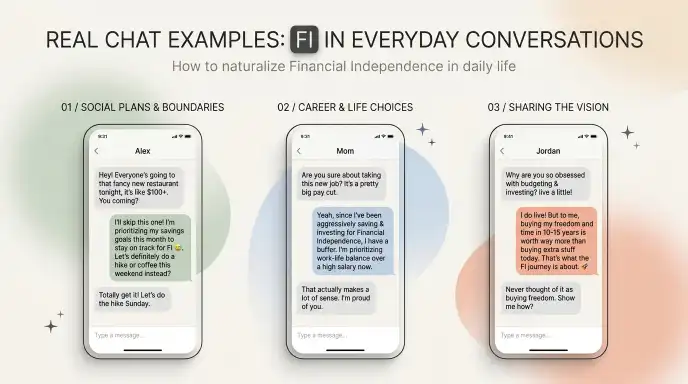
The following conversations show different ways someone might use FI. Each example is illustrative, so it demonstrates a possible meaning rather than suggesting that everyone uses the abbreviation identically.
Example 1: Ending an Argument
A: You keep changing your mind about the restaurant.
B: FI, let’s just stay home.
A: Fine, we can order something.
Meaning: FI means “forget it.” B wants to stop discussing the restaurant.
Example 2: Giving Up on a Plan
A: The website still isn’t working.
B: FI, I’ll try again tomorrow.
A: That’s probably better.
Meaning: FI expresses frustration and a decision to stop trying for now.
Example 3: Talking About an Engagement
A: Who helped you choose that beautiful ring?
B: My FI picked it out!
A: They have great taste.
Meaning: FI means “fiancé.” The conversation is about an engagement ring.
Example 4: Changing Dinner Plans
A: The restaurant says we need to wait another hour.
B: FI, let’s get burgers somewhere else.
A: I’m happy with that.
Meaning: The sender wants to drop the original plan and choose another option.
Example 5: Reacting to a Bad Day
A: I missed the bus and forgot my lunch.
B: Oh no!
A: FI, today is just not my day.
Meaning: FI is used as a strong expression of frustration.
Example 6: Talking About Wedding Plans
A: Did you and your partner choose the wedding date?
B: Yes, my FI wants a spring wedding.
A: That’s going to be beautiful!
Meaning: FI refers to the person’s fiancé.
Example 7: Stopping a Difficult Task
A: Have you finished fixing your laptop?
B: No, FI. I’ll take it to a repair shop.
A: That’s probably easier.
Meaning: B has decided to stop trying to repair the laptop alone.
Example 8: A Frustrating Group Project
A: Nobody has completed their part of the presentation.
B: FI, I’ll make a new plan.
A: Let me help you with it.
Meaning: FI expresses annoyance and a decision to move forward.
Example 9: Sharing Engagement News
A: I finally introduced my FI to my cousins.
B: How did everyone react?
A: They loved him!
Meaning: FI means “fiancé.” The speaker is discussing their engaged partner.
Example 10: When the Meaning Is Unclear
A: FI
B: Do you mean forget it?
A: Yes, I don’t want to talk about the problem anymore.
Meaning: This example shows why clarification can help. A two-letter abbreviation may be difficult to understand without a complete sentence.
How to Reply When Someone Says FI
Your response should match the sender’s meaning and mood. A person who is discussing a fiancé needs a different reply from someone who is annoyed.
Funny Replies
If the sender is joking or casually giving up on a plan, try a light response.
- “Already giving up? 😂”
- “Okay, dramatic exit accepted!”
- “Fine, pizza wins tonight.”
- “Let’s pretend this plan never happened!”
Use humor only when you know the person will understand your intention.
Casual Replies
These responses work well in everyday chats.
- “Okay, no problem.”
- “Sure, let’s move on.”
- “That’s fine with me.”
- “We can try again later.”
A simple reply is often enough when someone wants to end a discussion.
Friendly Replies
If the sender seems frustrated, respond with patience rather than adding more pressure.
- “Don’t worry, we can figure it out later.”
- “It’s okay. Take a little break.”
- “I understand why you’re annoyed.”
- “Let’s find another solution.”
When FI means fiancé, a friendly response could be:
“Aww, that’s exciting! How are the wedding plans going?”
Neutral Replies
If you cannot work out the meaning, ask directly.
- “What do you mean by FI?”
- “Are you saying forget it?”
- “Do you mean your fiancé?”
- “Can you explain what you meant?”
Asking for clarification is better than guessing, especially when the abbreviation could refer to completely different things.
Is FI Rude or Offensive?
FI is not always rude, but some of its meanings can be inappropriate. The phrase “forget it” is generally mild, while “f*** it” contains profanity. When FI means fiancé, it is normally harmless in a suitable relationship conversation.
When FI Is Harmless
The abbreviation is usually harmless when someone uses it to mean “forget it” in a relaxed conversation.
For example:
“FI, we can watch the movie tomorrow.”
This message simply suggests changing plans. It does not insult anyone.
Similarly, using FI to refer to a fiancé is generally fine in a personal conversation where the recipient understands the abbreviation.
When FI May Sound Rude
The meaning “f* it”** includes strong language. Some people use it casually with close friends, but others may consider it offensive.
For example:
“FI, I don’t care what happens now.”
This can sound dismissive or angry, depending on the situation.
Tone also matters. A person might use the phrase after a small inconvenience, while someone else might use it during a serious argument.
Shortening profanity into two letters does not automatically make it polite.
Is FI Safe to Use at School?
The answer depends on the intended meaning.
Using FI to mean “forget it” in a casual conversation may be understood by friends. However, the abbreviation can confuse teachers or classmates who are unfamiliar with it.
Avoid the profanity-based meaning in classroom discussions, assignments, and messages to school staff. It is better to use clear, respectful language.
Is FI Appropriate at Work?
In professional conversations, FI is best avoided when its meaning is unclear or includes profanity.
For example, instead of writing:
“FI, this task is impossible.”
You could say:
“I think we should try a different approach.”
This sounds more professional and helps coworkers understand the problem.
If you are discussing an engaged partner, use “my fiancé” rather than FI in formal messages. The full word is clearer to people who may not recognize the abbreviation.
Who Uses FI?
FI is not limited to one age group or social platform. People may encounter it in personal messages, online communities, and relationship discussions.
However, it is important not to assume that everyone recognizes it. FI is less self-explanatory than common abbreviations such as IDK or BRB.
Does Gen Z Use FI?
Some younger users may use FI in casual digital conversations, especially when expressing frustration or ending a discussion.
Still, it is not a universal Gen Z term. Slang changes between friend groups, countries, and online communities.
One person may understand FI immediately, while another may have no idea what it means.
Do Adults Use FI?
Adults may also use the abbreviation, particularly in personal messages. For example, someone planning a wedding might use FI as shorthand for fiancé.
Others may use it when chatting with friends or family members. The meaning still depends on the topic.
Where Might You See FI?
You may encounter the abbreviation in:
- Private text messages between friends.
- WhatsApp group chats about everyday plans.
- Snapchat conversations with close contacts.
- TikTok comments reacting to frustrating situations.
- Instagram DMs about relationships or personal experiences.
- Wedding discussions where FI may refer to a fiancé.
Is FI Very Popular Online?
FI is not as widely recognized as abbreviations such as IDK, LOL, or BRB. Some slang reference sites list “forget it” and “f*** it” as possible interpretations, but there is no reliable platform-wide data showing how frequently people use each meaning.
For that reason, it is more accurate to describe FI as a context-dependent abbreviation rather than a universally popular texting term.
Origin of FI
There is no single confirmed origin for every texting meaning of FI. Different uses may have developed independently as people shortened familiar phrases for quick communication.
The expression “forget it” has existed in everyday English for a long time. Shortening it to FI is a simple way to make a message more compact.
Likewise, the phrase “f* it”** is an informal expression that people may shorten when texting. Some slang reference sources list both expressions as meanings of FI.
How Did Texting Abbreviations Develop?
Text messaging encourages people to use shorter expressions. Instead of typing an entire sentence, someone might use a familiar abbreviation to communicate quickly.
This habit became common across online chats, social media, and mobile messaging. However, not every shortened phrase becomes widely recognized.
FI is a good example of why context matters. The same letters can represent different expressions, and readers may interpret them differently.
Does FI Have a Clear Internet Origin?
There is no strong evidence that FI started on one specific platform, such as TikTok, Snapchat, or Instagram.
It is safer to describe it as an informal abbreviation with several possible uses. The exact meaning depends on the speaker and the conversation rather than a single documented internet trend.
A Note About Lowercase “fi”
There is another important distinction. In Jamaican Patois, “fi” is a word used in ways that can mean “for” or “to,” depending on the sentence. It is part of the language’s grammar, not simply an English texting abbreviation.
For example, the phrase “fi mi” can mean “for me” or “mine,” depending on the context.
Therefore, not every lowercase “fi” in a message should be interpreted as “forget it” or profanity. The language and sentence structure may point to a completely different meaning.
FI Compared With IDK, IDC, IMO, and BRB
FI is different from several familiar texting abbreviations because it can have multiple interpretations. The terms below are more consistent in everyday English conversations.
| Abbreviation | Meaning | Type | Usage | Popularity |
| FI | Forget it; f*** it; sometimes fiancé | Context-dependent abbreviation | Ending a topic, expressing frustration, or discussing engagement | Less widely recognized |
| IDK | I don’t know | Initialism | Showing uncertainty | Widely recognized |
| IDC | I don’t care | Initialism | Expressing indifference | Widely recognized |
| IMO | In my opinion | Initialism | Sharing a personal view | Widely recognized |
| BRB | Be right back | Initialism | Temporarily leaving a conversation | Widely recognized |
FI vs. IDK
IDK means “I don’t know.” It is used when someone is unsure about something or does not have an answer.
Example:
“IDK what time the shop closes.”
FI has a different purpose. It may tell someone to drop a subject or express frustration.
FI vs. IDC
IDC means “I don’t care.” It expresses a lack of interest or concern.
Example:
“IDC which movie we watch tonight.”
FI may also sound dismissive, but it does not automatically mean “I don’t care.” The exact phrase depends on the conversation.
FI vs. IMO
IMO means “in my opinion.” People use it before sharing a personal thought.
Example:
“IMO, the blue dress looks better.”
FI does not introduce an opinion. Instead, it may communicate frustration, dismissal, or a relationship-related reference.
FI vs. BRB
BRB means “be right back.” Someone uses it when they need to leave a chat for a short time.
Example:
“BRB, I need to answer the door.”
FI has no standard meaning related to leaving and returning to a conversation. The two abbreviations serve different purposes.
Real-World Usage Example
Imagine two friends, Sara and Emma, are planning to meet for dinner.
Sara has already booked a table, but the restaurant calls to say that it cannot accommodate them. After trying several alternatives, Sara becomes frustrated.
She messages Emma:
“FI, let’s just order food at home.”
In this situation, FI means “forget it” or may carry the stronger sense of giving up on the original plan. Sara is not interested in continuing to search for another restaurant.
Now imagine a different conversation. Emma is preparing for her wedding and says:
“My FI wants a small garden ceremony.”
Here, FI means “fiancé.” The topic is marriage, so the meaning is much clearer.
These situations show why the surrounding words matter. The same abbreviation can communicate frustration in one conversation and affection in another.
If you receive a message that contains only “FI,” do not assume you know what the sender means. A simple question can clear things up.
Frequently Asked Questions
Q1: What does FI mean in text messages?
FI can mean “forget it” or “f* it”** in informal text messages. In relationship conversations, it may also stand for “fiancé.” The surrounding message helps identify the correct meaning.
Q2: What does FI mean on TikTok?
On TikTok, FI may be used to express frustration or suggest dropping a subject. In relationship-related posts, it may refer to a fiancé. The video’s topic and caption provide useful clues.
Q3: Is FI slang?
FI is an informal abbreviation that can function as texting slang. Its meaning may include “forget it,” “f*** it,” or “fiancé,” depending on the conversation.
Q4: Is FI rude or offensive?
It depends on the intended phrase. “Forget it” is generally mild, while “f* it” contains profanity.** The abbreviation for fiancé is normally harmless in personal conversations.
Q5: How should you reply to FI?
First, identify the meaning. If someone wants to drop a subject, you can reply, “Okay, no problem.” If they seem frustrated, offer support. When you are unsure, ask, “What do you mean by FI?”
Conclusion:
FI can have several meanings in text messages, including “forget it,” “f* it,” and sometimes “fiancé.”** The first two can express a desire to stop discussing something, while the third usually appears in relationship or wedding conversations.
You may see this abbreviation in private messages and social media discussions. However, not everyone understands it in the same way.
Pay attention to the topic and the sender’s tone before replying. Also, avoid profanity-based meanings in school or professional conversations.
When the meaning is unclear, asking for clarification is always better than guessing.