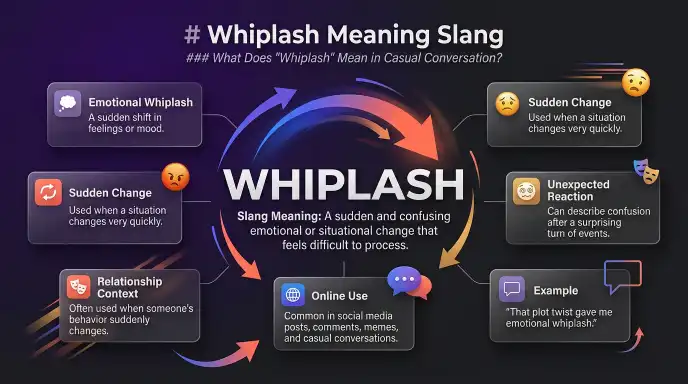
Whiplash meaning slang usually refers to the feeling of being suddenly confused, shocked, or emotionally overwhelmed because something changes very quickly. Online, people often say “I got whiplash” when a conversation, mood, story, or situation suddenly goes in a completely different direction.
The phrase is common in casual English and can describe anything from a funny change in someone’s behavior to a surprising twist in a video or argument. If someone says, “That conversation gave me whiplash,” they usually do not mean a physical neck injury. They mean the sudden change was hard to process.
In this guide, you will learn the slang meaning of whiplash, how people use it in texts and social media, its tone, examples, and when it may not be appropriate.
Quick Answer: Whiplash Meaning Slang
In slang, “whiplash” describes the feeling caused by a sudden and unexpected change in mood, opinion, behavior, topic, or situation. Saying “I got whiplash” often means something changed so quickly that it was surprising or difficult to follow.
What Does Whiplash Mean in Slang?
Whiplash slang means a sudden emotional or mental shift that leaves someone surprised, confused, or caught off guard.
The expression comes from the idea of a quick physical movement. In casual speech, however, people use it figuratively. Instead of describing a physical injury, they use “whiplash” to describe how quickly a situation changes.
For example, imagine someone is laughing with their friends and suddenly becomes serious because they receive bad news. A friend might say:
“That mood change gave me whiplash.”
The speaker is not talking about an actual injury. They are pointing out how fast the mood changed.
The slang can also describe a sudden change in:
- Mood
- Opinion
- Behavior
- Topic
- Relationship dynamics
- Story direction
- Emotions
- Social situations
The key idea is a sharp change that happens quickly.
Whiplash Meaning in Text
In text messages, “whiplash” is often used to react to something unexpected.
Someone may write:
“Wait, you hated him yesterday and now you like him? Whiplash 😭”
Here, “whiplash” means the person is surprised by the sudden change in opinion.
Another example is:
“This chat went from jokes to serious life advice in two seconds. Whiplash.”
The word adds an emotional reaction without requiring a long explanation.
In texting, the phrase can be playful, dramatic, or mildly critical. The exact meaning depends on what happened before it.
Common Texting Patterns
You may see phrases such as:
- “I got whiplash.”
- “That gave me whiplash.”
- “The emotional whiplash!”
- “Talk about whiplash.”
- “I’m getting whiplash from this.”
- “That was some serious whiplash.”
These expressions usually point to a fast change rather than a literal physical problem.
Whiplash Meaning on Social Media
On social media, whiplash is often used as a humorous reaction to sudden changes.
People may use it when watching a video with an unexpected ending, reading a post that changes tone, or seeing someone completely change their position.
For example, a person might post:
“The video started as a cooking tutorial and ended with a breakup story. Emotional whiplash.”
The phrase works well because it quickly communicates that the content took an unexpected turn.
On platforms such as TikTok, Instagram, Reddit, and Discord, “whiplash” can also describe fast changes between jokes and serious discussion. It is especially useful when the shift feels so sudden that the reader needs a moment to catch up.
Is Whiplash Slang Rude or Offensive?
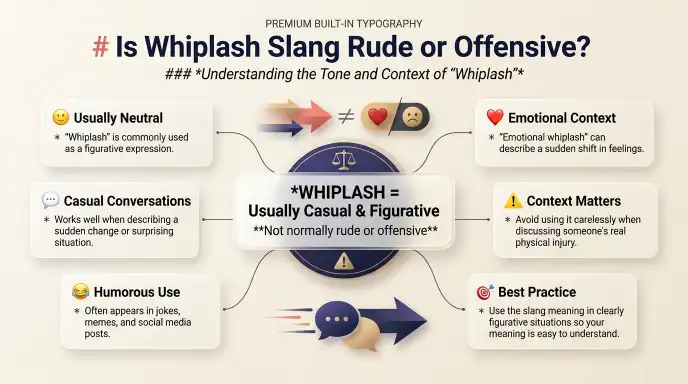
Whiplash slang is generally neutral and harmless when used to describe a sudden change.
It is not normally an insult or offensive expression. However, tone still matters.
For example:
“Your mood changed so fast. I got whiplash.”
This can sound playful between friends.
But saying:
“You keep changing your story. This is giving me whiplash.”
could sound critical or annoyed, especially during an argument.
So, the word itself is not rude. The situation and delivery determine how it feels.
Is It Appropriate at Work?
“Whiplash” is understandable in casual workplace communication, but it is still informal.
For example:
“That meeting took a few unexpected turns. I got a little whiplash.”
This may be fine in a relaxed team chat.
For formal emails, reports, or communication with clients, clearer wording is usually better:
- “The sudden change was unexpected.”
- “The change in direction was difficult to follow.”
- “The situation changed very quickly.”
These alternatives sound more professional.
Where Is Whiplash Slang Commonly Used?
Whiplash is most common in casual conversation and online communication.
| Place | Common Use |
| Texting | Reacting to a sudden change |
| TikTok | Describing an unexpected video shift |
| Reacting to posts or stories with sudden twists | |
| Describing surprising changes in a discussion | |
| Discord | Reacting to fast-changing conversations |
| Gaming | Describing sudden changes during a match or story |
| Workplace chat | Informally describing rapid changes |
| Everyday speech | Talking about surprising situations |
It is not limited to one age group. However, its figurative use is especially common in informal online communication.
Real-Life Examples of Whiplash Slang
The meaning becomes clearer when you see how the expression works in different situations.
Friendly Conversation
“You were complaining about that restaurant five minutes ago, and now you want to go back. Whiplash!”
Here, the speaker is joking about the sudden change in opinion.
Casual Texting
“First you said you were staying home, then you bought concert tickets. I got whiplash.”
The speaker is surprised by the quick change in plans.
Emotional Situation
“She was laughing, then suddenly started crying. The emotional whiplash was intense.”
Here, “emotional whiplash” describes a sharp change in feelings.
Argumentative Context
“Yesterday you said the plan was perfect. Now you say it was terrible. That’s some whiplash.”
This use sounds more critical. It points out an inconsistent position.
Gaming Context
“We were winning easily, then the other team made a comeback. Total whiplash.”
The word describes the sudden change in the game’s situation.
Social Media Context
“That post started as a joke and became a serious political discussion. Whiplash.”
The speaker is reacting to the unexpected change in tone.
Whiplash vs. Emotional Whiplash: What’s the Difference?
“Whiplash” describes a sudden change that catches you off guard. “Emotional whiplash” is more specific. It describes a quick and strong change in feelings.
For example, a sudden change in a story can cause whiplash, while going from happiness to sadness can feel like emotional whiplash.
“The story gave me whiplash.”
Emotional whiplash highlights a rapid emotional shift:
“That ending gave me emotional whiplash.”
For example, a movie may move from a funny scene to a sad scene very quickly. A viewer might call that emotional whiplash because the sudden shift affects their feelings.
Whiplash vs. Mood Swing
These terms are related but are not exactly the same.
A mood swing refers to a noticeable change in a person’s mood.
Whiplash focuses more on the suddenness of a change and the reaction it causes.
| Term | Main Idea |
| Whiplash | A sudden change that catches you off guard |
| Emotional whiplash | A sudden emotional shift |
| Mood swing | A change in someone’s mood |
| Plot twist | An unexpected change in a story |
| Change of direction | A situation taking a different path |
For example, if a movie suddenly changes from comedy to tragedy, “emotional whiplash” may fit better than “mood swing.”
Origin and Background of Whiplash Slang
The slang use of “whiplash” is based on the literal idea of a rapid movement that causes a sharp physical effect. Over time, English speakers began using the word figuratively to describe sudden changes that feel mentally or emotionally jarring.
The figurative expression is not limited to internet culture. People have used phrases such as “emotional whiplash” in everyday speech and writing for years.
Online communication helped make the expression especially easy to use as a short reaction. Instead of explaining that a situation changed extremely quickly, someone can simply say, “Whiplash.”
It is therefore better to view this usage as figurative everyday slang rather than a slang term created by one particular social media platform.
Why Do People Say “I Got Whiplash”?
People use the expression because it is short and expressive.
Instead of saying:
“The situation changed so suddenly that I was surprised and had trouble adjusting.”
someone can simply say:
“I got whiplash.”
The phrase communicates the reaction quickly.
People may use it to show:
- Surprise
- Confusion
- Amusement
- Emotional overload
- Disbelief
- Frustration
- Shock at a sudden change
The tone can range from completely playful to genuinely frustrated.
Is “Whiplash” Used as a Meme or Joke?
Yes. Online, “whiplash” can be used humorously when something changes very quickly.
For example:
“Me watching this video: 😂 → 😭 → 😂. Emotional whiplash.”
This type of use is informal and exaggerated for effect. It does not necessarily mean the person experienced serious emotional distress.
The phrase can also appear in reaction posts, comments, memes, and casual group chats where people want to point out an unexpected change without giving a long explanation.
When Should You Avoid Using Whiplash Slang?
You should avoid using “whiplash” when the context involves a real injury, serious trauma, or a sensitive personal situation unless you clearly mean the literal or medical sense.
The figurative slang is best for casual situations where something changes quickly.
Avoid using it when:
- Someone is discussing an actual neck injury.
- A person is dealing with serious emotional distress.
- You are writing a formal report or professional document.
- The meaning could be misunderstood as a medical claim.
- You are speaking to someone who may not understand the figurative expression.
For example, saying “That breakup gave me whiplash” may be fine among close friends. In a serious conversation about someone’s emotional wellbeing, however, a clearer phrase may be more respectful.
Polite Alternatives to Whiplash Meaning Slang
If your audience may not understand slang, you can use a clearer expression instead.
Some useful alternatives include:
- “That was a sudden change.”
- “That caught me off guard.”
- “That changed very quickly.”
- “I was not expecting that.”
- “That was a big shift.”
- “That took an unexpected turn.”
- “That was hard to follow.”
- “The change was surprising.”
For example:
Casual:
“That conversation gave me whiplash.”
Clearer:
“That conversation changed direction so quickly.”
Casual:
“I got an emotional whiplash from that movie.”
Clearer:
“That movie changed emotions so quickly.”
The best choice depends on your audience and the setting.
Why Do People Use Whiplash Meaning Slang?
People use “whiplash” because it describes a sudden change in a memorable way.
The expression is especially useful when a normal word such as “surprised” does not fully capture the situation. Someone may not simply be surprised; they may feel as if the conversation moved in a completely different direction without warning.
For example:
“We were talking about pizza, and suddenly we’re discussing someone’s wedding. Whiplash.”
The speaker is highlighting the speed and unexpected nature of the transition.
The expression can also make a message sound more playful. A short phrase like “emotional whiplash” can add personality to a text or social media comment.
Common Misunderstandings About Whiplash Slang
One common misunderstanding is assuming that every use of “whiplash” refers to a physical injury.
In casual online speech, that is often not the case. The surrounding sentence usually makes the intended meaning clear.
It Does Not Always Mean Confusion
Whiplash can describe surprise, but confusion is not required.
For example:
“That ending gave me whiplash.”
The viewer may understand the ending perfectly but still feel surprised by how quickly the story changed.
It Does Not Always Mean Something Negative
The expression can describe a funny or exciting change.
“The party went from quiet to dancing in five minutes. Whiplash!”
The speaker may actually enjoy the sudden change.
It Does Not Mean Someone Literally Has Whiplash
When used as slang, the phrase is usually figurative.
If someone says:
“This movie gave me whiplash.”
they normally mean the movie had sudden shifts, not that watching it physically injured them.
Whiplash Meaning Slang Across Different Platforms
The basic meaning stays the same, but the style can change depending on where it appears.
Texting
In texting, “whiplash” is often a short reaction.
“You changed your mind again? Whiplash 😂”
It can sound teasing or friendly.
TikTok and Instagram
On short-form video platforms, people may use it when a video changes direction unexpectedly.
“That ending gave me emotional whiplash.”
The phrase often works as a quick reaction to a sudden twist.
On Reddit, users may describe a discussion as giving them whiplash when the comments move rapidly between very different opinions or topics.
“I read the first half of the comments and then saw the updates. Total whiplash.”
Discord
In a Discord conversation, the term may describe a rapid shift from jokes to serious discussion.
“We went from memes to planning the tournament in one minute. Whiplash.”
Gaming
Gamers can use the word when a match changes suddenly.
“We were losing by ten, then took the lead. Absolute whiplash.”
The expression focuses on the speed of the change rather than a specific gaming mechanic.
Is Whiplash Meaning Slang Safe to Use on Social Media?
Yes. The slang use of “whiplash” is generally safe for normal social media conversations.
It is not inherently offensive, sexual, or threatening. However, context still matters because “whiplash” also has a literal meaning related to physical injury.
For ordinary reactions, phrases such as these are generally harmless:
“That plot twist gave me whiplash.”
“This comment section is giving me whiplash.”
“The mood changed so fast. Emotional whiplash.”
For sensitive topics, choose more direct language instead of making a joke about an injury.
Can You Use Whiplash Meaning Slang in School or at Work?
You can use it in casual conversations, but it is not the best choice for formal writing.
For example, in a friendly workplace chat, you might say:
“That meeting took a completely different direction. Whiplash.”
But in a formal email, write:
“The meeting took an unexpected direction.”
Similarly, students might use “whiplash” when talking with friends, but a school assignment should normally use precise language rather than slang.
Simple Rule
Use “whiplash” casually with people who understand the expression. Use clearer wording in formal or professional communication.
Real-Life Examples of Whiplash Meaning Slang
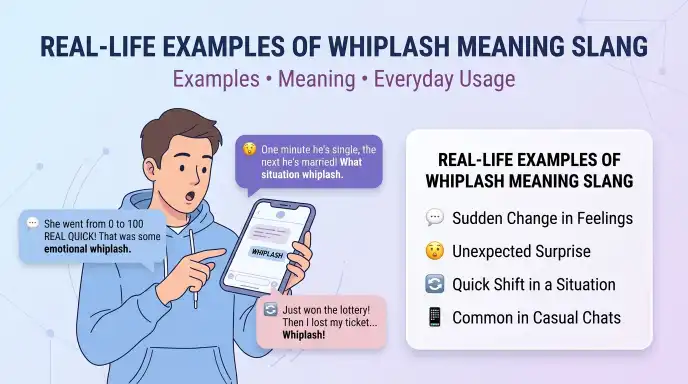
Here are more examples showing how the expression can work in different situations.
Friendly Example
“You said you hated spicy food, and now you’re ordering the hottest wings. Whiplash!”
The tone is playful.
Casual Example
“I thought the movie was a comedy. That ending gave me whiplash.”
The speaker is surprised by the sudden change in the story.
Argument Example
“First you said you agreed with me, and now you’re saying the opposite. That’s giving me whiplash.”
Here, the phrase sounds more critical.
Family Example
“Dad was joking five seconds ago, and now he’s giving us serious advice. Emotional whiplash.”
This describes a quick change in tone.
Social Media Example
“This post went from cute photos to a huge announcement. Whiplash.”
The speaker is reacting to an unexpected transition.
Gaming Example
“We were about to lose, then won in the final round. What a whiplash moment!”
The phrase highlights the sudden change in the game’s outcome.
Whiplash Slang vs. Similar Expressions
Several expressions can describe a sudden change, but they do not all have the same feeling.
| Expression | Meaning | Typical Tone |
| Whiplash | A sudden change that catches you off guard | Casual |
| Emotional whiplash | A sudden and strong emotional shift | Casual |
| Plot twist | An unexpected change in a story | Neutral/Casual |
| Caught me off guard | Something was unexpected | Neutral |
| Mood swing | A change in someone’s mood | Neutral |
| Roller coaster | Many rapid emotional changes | Casual |
| Out of nowhere | Something happened unexpectedly | Casual |
“Whiplash” is useful when the speed or sharpness of the change is the main point.
Does Whiplash Mean Someone Changed Their Mind?
It can, but not always.
If someone says:
“You wanted to stay home, and now you’re planning a road trip. Whiplash.”
the phrase points to a sudden change in plans or opinion.
However, “whiplash” can also describe a change in a movie, conversation, mood, event, or game. It is broader than simply changing your mind.
So, the meaning depends on what changed.
Is Whiplash Considered Modern Slang?
The figurative use is better described as informal modern usage rather than a newly invented internet abbreviation.
The word itself is much older and has a literal meaning. The slang-like use comes from applying that idea to sudden emotional, conversational, or situational changes.
Social media and messaging have made this usage easy to spot because short reaction phrases work well in comments and chats.
It is also not restricted to one particular platform or online community.
Frequently Asked Questions About Whiplash Meaning Slang
Q1. What does whiplash mean in slang?
Whiplash means a sudden change that makes someone feel surprised, confused, or emotionally caught off guard. It is usually a figurative expression, not a reference to a physical injury.
Q2. What does “I got whiplash” mean in texting?
“I got whiplash” means something changed very quickly and unexpectedly. The speaker may be reacting to a sudden change in mood, plans, opinions, conversation, or emotions.
Q3. Is whiplash slang rude?
No. “Whiplash” is generally not rude or offensive when used as slang. However, it can sound critical if you use it to point out someone’s sudden or inconsistent behavior.
Q4. What does emotional whiplash mean?
Emotional whiplash describes a rapid change between different emotions. For example, moving suddenly from laughter to sadness in a movie or conversation may be called emotional whiplash.
Q5. Can I use whiplash slang at work?
You can use it in a relaxed workplace conversation, but it is informal. For formal emails, reports, or professional communication, phrases such as “sudden change” or “unexpected shift” are safer choices.
Q6. Is whiplash used on TikTok and Instagram?
Yes. People can use “whiplash” in captions and comments to describe videos or posts that suddenly change mood, topic, or direction. It is usually a humorous or casual reaction.
Q7. Does whiplash mean a plot twist?
Not exactly. A plot twist is an unexpected development in a story, while whiplash describes the reaction to a sudden change. A surprising plot twist can cause someone to say they experienced “whiplash.”
Q8. Is “whiplash” the same as a mood swing?
No. A mood swing refers specifically to a change in someone’s mood. Whiplash is broader and can describe sudden changes in mood, conversation, plans, opinions, or situations.
Q9. Can whiplash slang be positive?
Yes. It can be used positively or humorously. For example, someone might say “whiplash” after an exciting comeback in a game or a funny unexpected turn in a conversation.
Q10. Does “whiplash” always mean confusion?
No. It can mean surprise, shock, amusement, or difficulty adjusting to a sudden change. The person may understand what happened but still feel surprised by how quickly it happened.
Conclusion: Whiplash Meaning Slang
Whiplash slang describes the feeling of dealing with a sudden and unexpected change. In texts, social media, gaming chats, and everyday conversation, people use it to describe quick shifts in mood, opinions, plans, stories, or situations.
The expression is usually casual and harmless. It can be funny when friends react to an unexpected change, but it may sound critical when used during an argument. In formal writing, clearer phrases such as “sudden change” or “unexpected shift” are usually better.
The easiest way to understand “whiplash” is to focus on the idea of a sharp change that happens so quickly that it catches you off guard.

I’m Emily Carter, and I enjoy writing about slang, internet language, and modern English expressions. My goal is to explain word meanings in a simple, clear, and easy-to-understand way so anyone can learn with confidence.