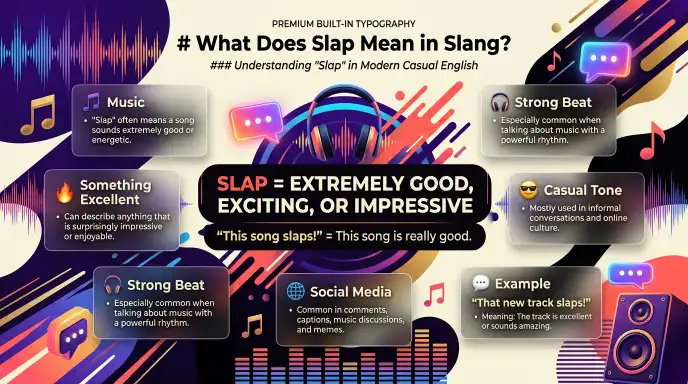
What does slap mean in slang? In casual slang, “slap” often means that something is very good, enjoyable, or exciting, especially music. For example, “This song slaps” means the song sounds really good or has a strong beat.
People often search for the meaning of “slap” after seeing phrases like “this song slaps” or “that beat slaps” in texts and social media comments. The word can be confusing because “slap” also has a literal meaning related to hitting someone.
In this guide, you will learn the slang meaning of “slap,” how people use it in conversations, where it appears online, and how its meaning changes with context. You will also see simple examples that make the expression easy to understand.
Quick Answer: What Does Slap Mean in Slang?
In slang, “slap” usually means something is very good, especially a song, beat, or piece of music. For example, “This track slaps” means “This track is excellent or sounds really good.”
What Does Slap Mean in Slang?
“Slap” is commonly used as a strong way to praise something. The expression is especially popular when people talk about music.
If someone says:
“This song slaps.”
They are not talking about physically hitting the song. They mean the song is enjoyable, powerful, catchy, or has a great beat.
The expression is casual and energetic. It often shows stronger excitement than simply saying something is “good.”
Example
“I heard your new track. It slaps!”
This means the person really likes the track.
The word can also be used outside music. In some casual conversations, people use “slap” to describe food, entertainment, or other things they enjoy.
“These fries slap.”
Here, the speaker means the fries taste really good.
Slap Meaning in Text
In texting, “slap” usually works as a quick positive reaction.
A friend might send you a new song and ask:
“What do you think?”
You could reply:
“It slaps!”
This means you like the song a lot.
You may also see the plural form “slaps”:
“This whole album slaps.”
The meaning stays the same. The speaker thinks the album is very good.
Because texting is informal, short slang words like “slap” make it easy to show excitement without writing a long response.
What Does “Slaps” Mean?
“Slaps” is the common form used when describing one thing in the third person.
For example:
- “This song slaps.”
- “That beat slaps.”
- “The new soundtrack slaps.”
- “This playlist slaps.”
In each sentence, “slaps” means sounds very good or is highly enjoyable.
The form “slaps” is especially common when people are talking about music.
Different Meanings of Slap
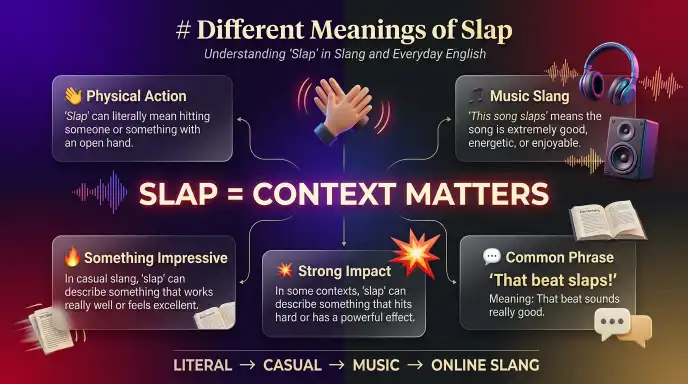
The word “slap” has several meanings. Context is important because the slang meaning is very different from the literal meaning.
1. Slap Means “Very Good”
This is one of the most common slang uses.
When people say something “slaps,” they usually mean it is excellent, exciting, or enjoyable.
Example:
“That new song slaps.”
Meaning: The new song is really good.
This use is positive and informal.
2. Slap Means “Hit”
“Slap” also has its normal dictionary meaning. It can describe hitting someone or something with an open hand.
Example:
“He slapped the table.”
This sentence is about a physical action, not slang.
3. Slap Can Describe a Strong Beat
Music is one of the main areas where this slang appears.
Someone might say:
“The bass really slaps.”
This means the bass sounds strong, powerful, or impressive.
The phrase often expresses excitement about how the music sounds.
4. Slap Can Describe Great Food
Some speakers use the expression more broadly for food.
“These tacos slap.”
This means the tacos taste excellent.
This use is casual and playful. It is not as closely tied to the original music-related use, but it can appear in everyday online conversations.
Slap Meaning in Music
The music-related meaning is probably the use most people mean when they say something “slaps.”
The phrase can describe:
- Songs
- Beats
- Bass lines
- Albums
- Remixes
- Playlists
- Soundtracks
- DJ mixes
For example:
“That beat slaps.”
The speaker thinks the beat has a strong and enjoyable sound.
It can also suggest that the music has enough energy to make the listener want to move, dance, or keep listening.
Is Slap Rude, Offensive, or Harmless?
When “slap” means “very good,” it is generally harmless and positive slang.
For example:
“This song slaps!”
There is nothing offensive about this sentence.
However, the literal meaning can have a more serious tone.
“I’ll slap you.”
This refers to hitting someone and may sound threatening or aggressive.
That is why context matters. The word itself is not automatically rude. The surrounding sentence determines what the speaker means.
| Phrase | Meaning | Tone |
| “This song slaps.” | The song is excellent. | Positive |
| “That beat slaps.” | The beat sounds great. | Positive |
| “These wings slap.” | The food tastes great. | Casual |
| “He slapped the table.” | He hit the table. | Literal |
| “I’ll slap you.” | A threat to hit someone. | Aggressive |
Where Is Slap Commonly Used?
The slang meaning is mainly found in casual communication and online spaces.
Texting
Friends may use “slap” when sharing songs or playlists.
“Listen to this. It slaps.”
TikTok
TikTok users may describe songs, remixes, sounds, or edits as “slapping.”
The expression can appear in comments, captions, Stories, and direct messages.
“This remix slaps 🔥”
Discord
People may use “slap” in music, gaming, and community chats.
“The new game soundtrack slaps.”
Reddit users may use the word while discussing music, albums, food, or entertainment.
Gaming
Gamers may use “slap” to praise a game’s soundtrack, theme, remix, or beat.
The expression is generally more natural in casual communities than in formal settings.
Slap Across Different Platforms
The meaning usually stays the same online, but the context can change.
| Platform | Common Use | Typical Tone |
| TikTok | Songs and trending sounds | Excited |
| Music, videos, reels | Casual | |
| Discord | Music and gaming | Friendly |
| Music and entertainment discussions | Casual | |
| Texting | Songs, food, entertainment | Informal |
| Workplace chat | Less common | Usually avoid in formal messages |
The important point is that “slap” is informal slang. It works best when the people involved are comfortable with casual language.
Real-Life Examples of Slap Slang
Friendly Conversation
“Have you heard this new track?”
“Yeah, it slaps!”
The speaker is giving the song a strong compliment.
Casual Texting
“Send me some songs for my playlist.”
“I got you. These three all slap.”
Here, the speaker means the songs are very good.
Social Media Comment
“This remix slaps 🔥”
The commenter is showing strong approval.
Gaming Context
“The new boss theme absolutely slaps.”
The gamer is praising the music in the game.
Food Context
“I wasn’t expecting much, but this pizza slaps.”
The speaker means the pizza tastes much better than expected.
When Does “Slap” Sound Positive?
“Slap” usually sounds positive when it follows a noun describing something enjoyable.
Common patterns include:
- This song slaps.
- That beat slaps.
- This album slaps.
- These fries slap.
- That remix slaps.
- This soundtrack slaps.
Words such as “really,” “hard,” or “absolutely” can add more excitement.
“This track really slaps.”
“That beat absolutely slaps.”
These are still informal expressions of strong approval.
Origin and Background of “Slap” Slang
The slang use of “slap” is closely linked to music. It developed as an expressive way to describe music that feels strong, exciting, or especially enjoyable.
There is no single confirmed person, song, or online platform that can be credited with inventing this meaning. Because slang often spreads through speech, music communities, and popular culture, its exact starting point is difficult to pinpoint.
The expression became widely familiar in informal English as people used it to praise songs and beats. Later, its use expanded to other things, such as food and entertainment.
It is best to avoid claims that give one exact year or person as the origin unless reliable historical evidence supports them.
Similar Slang Words for “Slap”
Several slang expressions can have a similar meaning, especially when talking about music.
| Slang | Meaning | Example |
| Slap | Very good or enjoyable | “This song slaps.” |
| Fire | Excellent or impressive | “This track is fire.” |
| Banger | A very good song | “That’s a banger.” |
| Heat | Excellent content | “This album is heat.” |
| Goes hard | Very powerful or impressive | “That beat goes hard.” |
| Hits | Has a strong emotional effect | “This song hits.” |
These expressions overlap, but they are not always identical.
For example, “this song hits” can focus on emotional impact, while “this song slaps” often highlights its strong sound, beat, or overall quality.
Slap vs. “Banger”
“Slap” and “banger” are often used when talking about great music.
A banger usually refers to a particularly exciting or impressive song.
“This is a banger.”
“Slap” can work more like a verb.
“This song slaps.”
Both are positive, but the sentence structure is different.
Slap vs. “Fire”
“Fire” is another common compliment.
“This song is fire.”
This means the song is excellent or impressive.
“This song slaps.”
This also expresses strong approval, especially about how the music sounds.
Both are casual and common in online conversations.
When Should You Avoid Using “Slap”?
The slang meaning is best saved for informal situations.
You may want to avoid it in:
- Academic essays
- School assignments
- Job applications
- Business reports
- Formal presentations
- Professional emails
- Official documents
For example, instead of:
“The new campaign video slaps.”
a formal report could say:
“The new campaign video is highly effective.”
The second version is clearer and more professional.
Can You Use “Slap” at Work?
It depends on the workplace and the situation.
In a relaxed team chat, saying:
“That playlist slaps.”
may be perfectly understandable.
But in a formal email to a manager, client, or customer, it is better to use standard English.
For example:
“The presentation was excellent.”
is more professional than:
“The presentation slaps.”
The key difference is audience and setting.
Can Students Use “Slap” at School?
Students can use the slang in casual conversations with friends.
For example:
“This song slaps.”
is natural among friends.
However, students should avoid slang in formal assignments unless the teacher specifically asks them to discuss slang or informal language.
A school essay should normally use words such as:
- Excellent
- Impressive
- Enjoyable
- Powerful
- Effective
instead of slang.
Why Do People Use “Slap”?
People use “slap” because it gives a stronger reaction than simply saying “good.”
Compare:
“This song is good.”
with:
“This song slaps.”
The second sentence sounds more energetic and enthusiastic.
The slang can also make a conversation feel more relaxed. It works well in short comments, texts, and social media posts.
People may use it because it:
- Shows excitement quickly.
- Give a strong compliment.
- Sounds casual and friendly.
- Fits music conversations naturally.
- Works well in short online comments.
- Adds personality to a reaction.
It is especially useful when someone wants to show that they really enjoyed something.
Common Misunderstandings About “Slap”
One common misunderstanding is assuming that “slap” always means hitting.
That is true when the word is being used literally.
For example:
“She slapped the table.”
This describes a physical action.
But:
“That song slaps.”
uses the word as slang.
Another mistake is assuming that “slap” is always positive.
Consider:
“This song slaps.”
This is positive.
But:
“I’m going to slap you.”
can sound aggressive or threatening.
So, never interpret the word by itself. Look at the full sentence.
Is “Slap” Safe for Social Media?
Yes, the slang meaning is generally safe for casual social media use.
A comment such as:
“This track slaps!”
is simply a positive reaction.
However, the literal meaning can create a different impression. A sentence about slapping another person may sound threatening, even if the speaker intended it as a joke.
For public posts, it is always better to make your meaning clear.
How “Slap” Changes by Context
Context can completely change how readers understand the word.
Music
“This song slaps.”
Meaning: The song is excellent.
Food
“These noodles slap.”
Meaning: The noodles taste great.
Physical action
“He slapped the table.”
Meaning: He hit the table with an open hand.
Threat
“Don’t make me slap you.”
Meaning: The speaker is talking about hitting someone.
The first two examples are casual and positive. The last two use the more literal meaning.
Is “Slap” Still Common Slang?
“Slap” remains recognizable as informal slang, especially in conversations about music.
However, slang changes over time. Different age groups and online communities may prefer different expressions.
Words such as “fire,” “banger,” and “goes hard” can overlap with “slap.” This means the popularity of any one expression can vary by community.
There is no need to force the word into every conversation. Use it naturally when it fits your tone.
Polite Alternatives to “Slap”
If you are speaking in a formal setting, you can replace “slap” with clearer standard English.
Instead of:
“This song slaps.”
Try:
- “This song is excellent.”
- “This song sounds great.”
- “I really enjoy this song.”
- “The beat is impressive.”
- “The track has a strong rhythm.”
Instead of:
“These tacos slap.”
Try:
- “These tacos taste great.”
- “These tacos are delicious.”
- “I really like these tacos.”
These alternatives work better in formal or professional communication.
Impact of Using “Slap” in Communication
Using slang can make casual communication feel more natural and expressive.
When someone says:
“That song slaps!”
the listener can usually understand that the speaker feels strongly positive about the song.
However, slang can also create confusion when people are unfamiliar with the expression.
For example, someone learning English may understand the literal meaning of “slap” but not know the slang meaning.
That is why context is especially important in conversations between people from different age groups, cultures, or language backgrounds.
Frequently Asked Questions
Q1. What does slap mean in slang?
In slang, “slap” usually means something is very good, enjoyable, or impressive, especially music.
Q2. What does “this song slaps” mean?
“This song slaps” means the speaker thinks the song is excellent, enjoyable, or has a great beat.
Q3. Is slap a positive slang word?
Yes. When used to describe music, food, or entertainment, “slap” is generally positive slang.
Q4. Is “slap” rude?
The slang meaning is usually not rude. However, the literal meaning can involve hitting someone, so the full context matters.
Q5. Can I use “slap” on TikTok or Instagram?
Yes. “Slap” can be used casually on social media, especially when talking about songs, beats, videos, or entertainment.
Q6. Is “slap” appropriate at work?
It is usually better to avoid slang in formal workplace communication. Use words such as “excellent,” “impressive,” or “effective” instead.
Q7. What does “that beat slaps” mean?
“That beat slaps” means the speaker thinks the beat sounds very good, powerful, or exciting.
Q8. Does “slap” always mean hit?
No. “Slap” can mean “very good” in slang, especially when discussing music. The sentence and context determine the meaning.
Conclusion:
So, what does slap mean in slang? In casual English, “slap” often means that something is really good, especially a song, beat, or other enjoyable form of entertainment.
The phrase “this song slaps” is a positive way to show strong approval. It is common in texting, social media, music discussions, and other informal conversations.
Still, remember that “slap” also has a literal meaning connected to hitting. If the word appears in a sentence about a person or physical action, the meaning may be completely different.
For friends and casual online conversations, “slap” can sound natural and expressive. For school assignments, professional writing, and formal communication, standard alternatives are usually the better choice.