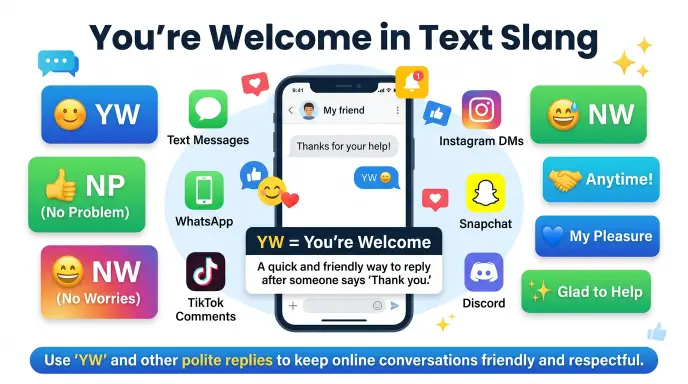
You’re welcome in text slang is a polite reply to someone who says “thank you.” It lets the other person know you were happy to help.
In texting, people often shorten or replace it with casual expressions like YW, NP (No Problem), No Worries, or Anytime.
Many people search for you’re welcome in text slang because they see short replies in messages, on social media, or in online games and want to know what they mean. Some replies are friendly, some are casual, and others are better for work or school.
In this guide, you’ll learn the meaning of you’re welcome in text slang, its common abbreviations, where people use it, when to avoid certain replies, and real life examples from texting, Discord, TikTok, Snapchat, Instagram, Reddit, gaming, and everyday conversations. The goal is to help you choose the right response for every situation.
Quick Answer: You’re Welcome in Text Slang
You’re welcome in text slang refers to short, informal ways of replying after someone says “thank you.” Popular options include YW, No Problem (NP), No Worries, Anytime, Sure, and Glad to Help. The best choice depends on who you’re talking to and the situation.
| Expression | Meaning | Tone | Best Used In |
| You’re Welcome | A polite response to thanks | Polite | Any situation |
| YW | Short for “You’re Welcome” | Casual | Texting, chats |
| NP | No Problem | Friendly | Friends, gaming |
| No Worries | It was no trouble | Relaxed | Casual conversations |
| Anytime | Happy to help again | Warm | Friends, family |
| Glad to Help | Happy I could assist | Friendly and professional | School, work |
What Does “You’re Welcome” Mean in Text Slang?
In text slang, you’re welcome has the same basic meaning as it does in everyday speech. It tells the other person that helping them was not a problem and that you appreciate their thanks.
Unlike formal writing, texting often uses shorter replies to save time. Instead of typing the full phrase, many people send quick alternatives that still sound polite and friendly.
Why People Use Short Replies
People choose shorter versions because they:
- Type faster on phones.
- Keep conversations moving.
- Match the casual style of texting.
- Sound relaxed with friends.
- Fit naturally in online chats and games.
Although these shortened replies are common, the full phrase “You’re welcome” is still the safest choice when talking to teachers, coworkers, clients, or someone you don’t know well.
Does “You’re Welcome” Have Multiple Meanings?
The main meaning stays the same across most conversations it is a polite response to gratitude. However, the tone can change depending on how it is written.
| Reply | Possible Tone |
| You’re welcome! | Friendly and cheerful |
| You’re welcome 😊 | Warm and kind |
| YW | Quick and casual |
| No problem | Relaxed and informal |
| Sure | Neutral, depending on context |
| You’re welcome… | May sound annoyed or sarcastic if punctuation suggests it |
Because tone is harder to judge in text messages, emojis or punctuation can sometimes change how the message feels.
Common Text Slang Alternatives to “You’re Welcome”
Instead of writing the full phrase, many people use other casual expressions. Here are some of the most common ones.
YW
YW simply stands for “You’re Welcome.”
Example:
Alex: Thanks for sending the notes!
Sam: YW!
NP (No Problem)
This tells someone that helping them wasn’t difficult.
Example:
Chris: Thanks for fixing the link.
Taylor: NP!
No Worries
A relaxed reply that means there was nothing to worry about.
Example:
Emma: Thanks for waiting.
Ryan: No worries!
Anytime
This shows you’re happy to help again in the future.
Example:
Lily: Thanks for explaining that.
Ben: Anytime!
Glad to Help
A friendly reply that also works well in school or professional chats.
Example:
Manager: Thanks for finishing the report.
Employee: Glad to help!
Sure
A short reply that can mean “you’re welcome,” especially after doing a small favor.
Example:
Friend: Thanks for opening the door.
You: Sure!
Context matters. In some conversations, “Sure” can sound less warm than “You’re welcome,” so it’s best used with people who know your communication style.
Where Is “You’re Welcome” Commonly Used?

The phrase and its shorter versions appear across many online platforms. The wording often changes depending on the audience and the type of conversation.
Text Messages
People commonly use:
- YW
- No problem
- Anytime
- No worries
These replies are fast and friendly.
Social Media
On platforms like TikTok, Instagram, and Snapchat, users usually prefer brief responses because conversations move quickly.
Examples include:
- YW ❤️
- Anytime!
- No worries 😊
Discord and Gaming
Gamers often keep replies short during fast paced chats.
Common responses include:
- YW
- NP
- All good
- Anytime
These expressions let the conversation continue without interrupting gameplay.
School and College Chats
Students often use:
- You’re welcome
- YW
- No problem
- Glad to help
These are friendly while still sounding respectful.
Workplace Messaging
In work chats, it’s usually better to choose replies such as:
- You’re welcome.
- Happy to help.
- Glad to help.
- My pleasure.
These options sound more professional than abbreviations like YW.
Is “You’re Welcome” Rude, Offensive, or Harmless?
“You’re welcome” is generally a polite and harmless expression. It is one of the most common ways to respond when someone thanks you. In most situations, it shows good manners and appreciation.
However, the tone and context can change how it is received.
| Expression | Tone | Appropriate? |
| You’re welcome | Polite | ✅ Yes |
| YW | Casual | ✅ Friends and texting |
| No problem | Relaxed | ✅ Informal conversations |
| My pleasure | Professional | ✅ Work and customer service |
| Sure | Neutral | ⚠️ Depends on context |
| You’re welcome… | Can sound sarcastic | ❌ Avoid unless joking |
Can It Sound Sarcastic?
Yes. Like many text messages, punctuation, emojis, and timing can change the meaning.
For example:
Friendly
“You’re welcome! 😊”
Neutral
“You’re welcome.”
Possibly Sarcastic
“You’re welcome…”
(Often used when someone forgot to say thank you.)
Because text messages do not include facial expressions or tone of voice, readers may misunderstand your intention. When in doubt, choose a friendly reply or add a smile emoji if appropriate.
Real Life Examples of “You’re Welcome” in Text Slang
Seeing the phrase in real conversations makes it easier to understand when to use it.
Friendly Conversation
Mia: Thanks for helping me with my homework.
Jake: You’re welcome!
Text Message
Emma: Thanks for reminding me about the meeting.
Liam: YW!
Discord Chat
Player 1: Thanks for the backup!
Player 2: NP!
Gaming
Teammate: Thanks for the revive.
You: Anytime!
Instagram Direct Message
Friend: Thanks for tagging me in the giveaway.
You: No worries!
Snapchat
Friend: Thanks for sending the notes.
You: Glad to help!
User A: Thanks for explaining the rules.
User B: You’re welcome. Happy to help.
School Group Chat
Student: Thanks for sharing today’s homework.
Classmate: Anytime!
Workplace Chat
Coworker: Thanks for covering my shift.
You: You’re welcome. Glad I could help.
Family Conversation
Mom: Thanks for cleaning the kitchen.
You: You’re welcome!
Origin and History of “You’re Welcome”
The phrase “You’re welcome” is not internet slang. It has been part of English for centuries as a polite response to gratitude.
As texting became popular in the late 1990s and early 2000s, people began shortening common phrases to save time. This led to abbreviations such as:
- YW (You’re Welcome)
- NP (No Problem)
- NVM (Never Mind)
- TY (Thank You)
- TYSM (Thank You So Much)
Today, people often switch between the full phrase and shorter alternatives depending on the conversation.
Is YW Still Popular?
Yes, but not as much as it once was.
Many people today prefer replies such as:
- No problem
- No worries
- Anytime
- Happy to help
Younger users, especially on messaging apps, may choose these because they sound more natural in casual conversations. However, YW is still widely understood and remains a common abbreviation.
Similar Slang and Related Terms
Many expressions have the same purpose as “you’re welcome,” although each has a slightly different tone.
| Expression | Meaning | Formality |
| YW | You’re Welcome | Casual |
| NP | No Problem | Casual |
| No Worries | It wasn’t a problem | Casual |
| Anytime | Happy to help again | Friendly |
| Happy to Help | Glad I could assist | Professional |
| Glad to Help | Happy to assist | Professional |
| My Pleasure | I enjoyed helping | Formal |
| Don’t Mention It | No thanks needed | Informal |
| Sure Thing | Happy to do it | Casual |
| Of Course | It was expected | Friendly |
Choosing the right reply depends on who you’re talking to and how formal the conversation is.
Text Slang vs. Professional Replies
Although abbreviations are common online, they are not always the best choice.
| Situation | Best Reply |
| Friends | YW, NP, Anytime |
| Family | You’re welcome, Anytime |
| Gaming | NP, YW |
| Discord | YW, No worries |
| School | You’re welcome, Glad to help |
| Workplace | You’re welcome, Happy to help |
| Customer Service | My pleasure, Happy to help |
Using the full phrase in professional settings leaves a better impression than using abbreviations.
Why Do People Use “You’re Welcome” in Text Slang?
People shorten messages because they want conversations to feel quick and natural.
Common reasons include:
- Saving time while typing.
- Keeping chats informal.
- Matching internet culture.
- Responding quickly during games.
- Making conversations feel relaxed.
- Using familiar texting abbreviations.
Despite the shorter forms, the goal stays the same—to politely acknowledge someone’s thanks.
When Should You Avoid Using “You’re Welcome” Text Slang?
While abbreviations like YW and NP are common, they are not suitable for every situation.
Choose your reply based on who you’re talking to and the setting.
Professional Emails
Avoid:
- YW
- NP
- Sure
Better choices:
- You’re welcome.
- Happy to help.
- My pleasure.
- I’m glad I could help.
These responses sound more professional and respectful.
Talking to Teachers or Professors
If a teacher thanks you, the full phrase “You’re welcome” is usually the best choice.
Example:
Teacher: Thank you for submitting your project early.
Student: You’re welcome!
Speaking With Customers or Clients
Customer-facing roles often require a warm and professional tone.
Good replies include:
- You’re welcome.
- Happy to help.
- My pleasure.
- It was my pleasure to assist you.
Avoid very casual abbreviations unless your workplace culture encourages them.
Formal Events
In formal conversations, writing the full phrase shows respect and good manners.
Instead of:
YW
Use:
You’re welcome.
Polite Alternatives to “You’re Welcome”
Sometimes you may want a reply that sounds warmer or fits a specific situation better.
| Alternative | Best For |
| My pleasure | Customer service, business |
| Happy to help | Work and school |
| Glad to help | Friendly and professional chats |
| Anytime | Friends and family |
| Of course | Casual conversations |
| No worries | Relaxed texting |
| Don’t mention it | Informal situations |
| It was nothing | Helping with a small favor |
| You’re very welcome | Extra appreciation |
| Always happy to help | Friendly and professional |
Each alternative carries the same basic message: you’re happy you could help.
Why Do People Use “You’re Welcome” Instead of Other Replies?
Different replies create different impressions.
People choose “You’re welcome” because it:
- Sounds polite.
- Acknowledges the other person’s gratitude.
- Works in almost every situation.
- Is understood around the world.
- Shows good manners.
Shorter alternatives are popular because they save time, but the complete phrase remains the safest option in both personal and professional communication.
Common Misunderstandings
Some people are unsure if certain replies mean the same thing.
Here are a few common misunderstandings.
Is “YW” Different From “You’re Welcome”?
No.
YW is simply an abbreviation of “You’re welcome.” The meaning is the same, but YW is much more casual.
Does “No Problem” Mean the Same Thing?
Almost.
“No problem” tells someone that helping them was easy or didn’t cause any inconvenience.
“You’re welcome” focuses more on politely accepting their thanks.
Both are widely accepted in everyday conversatio
Is “No Worries” Rude?
No.
In many English speaking countries, “No worries” is a friendly and positive reply.
However, in very formal business communication, “You’re welcome” or “My pleasure” may sound more professional.
Is “Sure” the Same as “You’re Welcome”?
Sometimes.
When someone thanks you after a small favor, “Sure” can mean you’re welcome.
However, depending on the tone, it may sound less warm or even slightly dismissive.
If you’re unsure, choose “You’re welcome” instead.
Can You Use Emojis?
Yes.
Many people add emojis to make their reply feel friendlier.
Examples:
- You’re welcome! 😊
- Anytime! 👍
- No worries 😄
- Happy to help! 🙌
Emojis can help show a positive tone, especially in casual text messages.
Frequently Asked Questions
Q1. What does “you’re welcome” mean in text slang?
It is a polite reply after someone says “thank you.” In texting, people may also use YW, NP, No Worries, or Anytime instead.
Q2. What does YW stand for?
YW stands for “You’re Welcome.” It is a common texting abbreviation used in casual conversations.
Q3. Is “you’re welcome” considered slang?
No. “You’re welcome” is a standard English expression. However, shortened versions like YW are considered texting slang or internet shorthand.
Q4. Is YW rude?
No. It is generally friendly and polite. However, because it is very brief, some people may prefer the full phrase in professional or formal situations.
Q5. Can I use YW at work?
It depends.
In casual workplace chats with coworkers, YW may be acceptable. In emails or client communication, it’s better to use “You’re welcome” or “Happy to help.”
Q6. Is “No Problem” more common than “You’re Welcome”?
In many casual conversations, yes. Younger speakers often use “No problem” because it sounds relaxed, while “You’re welcome” remains common in formal and professional settings.
Q7. What is the most professional way to reply to “Thank you”?
Professional options include:
- You’re welcome.
- Happy to help.
- My pleasure.
- Glad I could assist.
These responses sound courteous and appropriate in business communication.
Conclusion:
“You’re welcome” in text slang refers to the casual ways people respond after someone says “thank you.” While the full phrase is always polite and appropriate, abbreviations like YW, NP, and expressions such as “No worries” or “Anytime” are widely used in texting, social media, gaming, and online chats.
The best response depends on the situation. Casual conversations with friends allow for shorter replies, while school, workplace, and professional settings usually call for the complete phrase or a more formal alternative like “Happy to help” or “My pleasure.”
Understanding these differences helps you communicate clearly, sound polite, and choose the right response if you’re texting a friend, chatting on Discord, replying on Instagram, or sending a work message.

I’m Emily Carter, and I enjoy writing about slang, internet language, and modern English expressions. My goal is to explain word meanings in a simple, clear, and easy-to-understand way so anyone can learn with confidence.