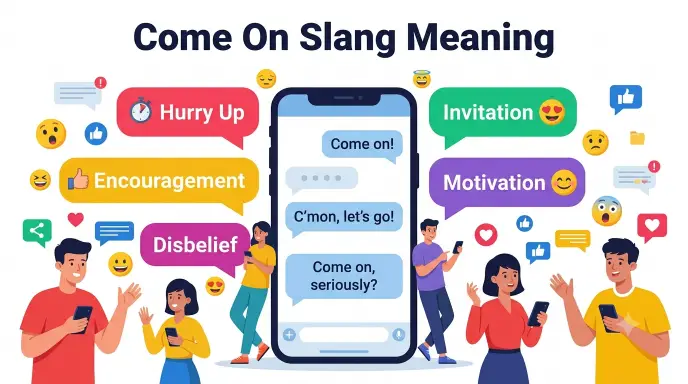
Come on is a common slang phrase used to show surprise, disbelief, encouragement, impatience, or a request for someone to act. The meaning changes depending on the situation and tone of voice. People often use come on in casual conversations, texting, social media, and everyday speech.
The slang phrase come on is one of the most common expressions in English. It is used by people of all ages in daily conversations, online chats, and social media posts. While the literal meaning suggests asking someone to move closer or follow, its slang use has many different meanings.
People use come on to motivate others, express frustration, show excitement, or react when something seems surprising or unfair. Understanding the tone and context is important because the same phrase can sound friendly, playful, or annoyed depending on how it is used.
Quick Answer: Comeon Slang
Come on in slang is a casual expression used to show surprise, disbelief, encouragement, frustration, or to ask someone to hurry up. Its meaning depends on the tone and situation.
Example: Come on, you know that’s not true!
What Does Comeon Slang Mean?
Comeon slang is a casual internet and texting version of the phrase “come on.” People often remove the space and write it as “comeon” when typing quickly on social media, messaging apps, or online platforms.
The expression can have different meanings depending on the conversation.
Common meanings include:
- encouraging someone
- showing surprise or disbelief
- expressing annoyance
- asking someone to hurry
- showing excitement
For example:
“Comeon, you can do it!”
This means:
“Keep trying” or “Don’t give up.”
Another example:
“Comeon, that’s not true.”
This shows disbelief or disagreement.
The spelling “comeon” is mostly used in informal digital communication. In standard writing, the correct form is usually two words: “come on.”
Why Do People Write Comeon Instead of Come On?
People write comeon because online communication is often fast and informal. Texting and social media encourage shorter, quicker ways of typing.
Common reasons include:
- faster typing
- casual conversation style
- matching online language trends
- creating a relaxed tone
- copying how people speak
Many internet users write words differently from formal English because chats are more like conversations than essays.
Examples:
Formal:
“Come on, we need to leave now.”
Casual text:
“Comeon, we gotta go.”
Both sentences have the same basic meaning, but the second one feels more relaxed.
Different Meanings of Comeon Slang
Comeon slang does not have one fixed meaning. The emotion behind it changes depending on the speaker’s intention.
Comeon as Encouragement
One common use of comeon is to motivate someone or show support.
People use it when they want someone to continue trying or take action.
Examples:
“Comeon, you are almost finished.”
“Comeon, we believe in you.”
In this context, comeon has a positive and friendly tone.
It is often used in:
- sports conversations
- gaming chats
- friendly messages
- motivational situations
Example in gaming:
“Comeon team, we can win this round.”
Meaning:
The speaker is encouraging teammates.
Comeon as Disbelief
Comeon can also show that someone does not believe what they just heard.
Examples:
“Comeon, you really did that?”
“Comeon, that cannot be true.”
Here, the speaker is expressing surprise or doubt.
The tone can be playful or serious depending on the relationship between people.
For example:
A friend saying:
“Comeon, you forgot my birthday?”
may be joking.
But:
“Comeon, you cannot blame me for this.”
may show frustration.
Comeon as Frustration
People also use comeon when something is annoying or not going as expected.
Examples:
“Comeon, my internet stopped again.”
“Comeon, why is this taking so long?”
This use often shows impatience.
The meaning is close to:
- seriously?
- really?
- hurry up
- this is annoying
The tone depends on the situation.
Comeon as a Request to Hurry
Another common meaning is asking someone to move faster.
Examples:
“Comeon, we are late.”
“Comeon, everyone is waiting.”
This use is common in everyday conversations between friends and family.
It is usually not rude, but the tone of voice can make it sound impatient.
Is Comeon Slang Used in Texting?
Yes, comeon slang is commonly seen in texting and online conversations.
People may use it in:
- SMS messages
- Instagram DMs
- Snapchat chats
- Discord conversations
- gaming messages
- social media comments
In texting, users often write phrases in shorter or combined forms because messages are quick and informal.
Examples:
Friend:
“I don’t think I can finish this project.”
Reply:
“Comeon, you’re almost done!”
Meaning:
The person is encouraging their friend.
Another example:
“Comeon 😂 that was obviously a joke.”
Meaning:
The person is showing playful disbelief.
Comeon on TikTok
On TikTok, comeon often appears in comments and captions.
Users may write it when reacting to videos.
Examples:
“Comeon, this is amazing.”
“Comeon, that transition was perfect.”
The tone is often emotional and expressive because TikTok comments usually react to entertainment, trends, and viral content.
Comeon on Instagram
Instagram users may use comeon in:
- comments
- stories
- direct messages
- captions
Examples:
“Comeon, this photo is perfect.”
“Comeon, you look amazing.”
It can show excitement, support, or playful reaction.
Comeon on Discord and Gaming Chats
In gaming communities, comeon is often used during matches or group conversations.
Examples:
“Comeon, we need one more player.”
“Comeon team, focus.”
In gaming, the phrase usually works as encouragement or a request for action.
Because gaming chats are fast paced, short expressions like comeon are common.
Is Comeon Slang Different From “Come On”?
The meaning is usually the same, but the writing style is different.
| Form | Usage | Example |
| Come on | Standard English | Come on, let’s go. |
| Comeon | Informal online writing | Comeon, hurry up. |
“Come on” is the correct spelling for formal writing.
“Comeon” is mainly used in casual digital communication and should not be used in professional documents.
Is Comeon Slang Rude, Offensive, or Harmless?
Comeon slang is usually harmless. It is a common expression used to show feelings such as excitement, encouragement, surprise, or frustration.
However, the meaning depends on the tone and situation.
A friendly:
“Comeon, you can do it!”
sounds supportive.
A frustrated:
“Comeon, why did you do that?”
may sound annoyed.
The words themselves are not rude, but the emotion behind them can change how people understand the message.
When using comeon in text messages, remember that written words do not include facial expressions or voice tone. A message meant as a joke may sometimes sound serious.
Can You Use Comeon Slang at Work?
Comeon slang is usually not suitable for formal workplace communication.
In casual workplace chats with close coworkers, some informal expressions may be acceptable. However, professional messages should usually use standard language.
Examples:
Casual:
“Comeon, we can finish this today!”
Professional:
“Let’s work together to finish this today.”
Casual:
“Comeon, that result is surprising.”
Professional:
“That result is unexpected.”
Using the standard phrase “come on” is already informal, so the combined spelling “comeon” is even more casual.
Avoid using it in:
- business emails
- official reports
- job applications
- professional presentations
Where Did Comeon Slang Come From?
Comeon slang comes from the spoken phrase “come on,” which has been part of English communication for a long time.
The exact moment when people began writing it as one word, “comeon,” is difficult to identify. Unlike many internet slang terms, it did not start from one specific online community or platform.
The combined spelling became more visible through:
- online chats
- instant messaging
- social media comments
- gaming conversations
People often remove spaces or shorten phrases while typing quickly. Similar changes happen with many casual internet expressions.
It is important to understand that “comeon” is not a new word with a completely different meaning. It is mainly an informal spelling style of the existing phrase “come on.”
Why Do People Use Comeon Slang?
People use comeon slang because it feels natural and conversational.
It helps users express emotions quickly without writing long explanations.
Common reasons include:
Showing Emotion
Instead of writing:
“I cannot believe what just happened.”
Someone may write:
“Comeon, seriously?”
The shorter expression immediately shows surprise.
Creating a Friendly Tone
Friends often use casual spelling to make messages feel warmer.
Example:
“Comeon, join us!”
feels more relaxed than:
“Please join us.”
Saving Time While Typing
Online conversations move quickly. Many users prefer shorter forms because they are faster to type.
This is especially common in:
- gaming chats
- group messages
- social media comments
Common Misunderstandings About Comeon Slang
Some people misunderstand comeon because they focus only on the words instead of the context.
Comeon Does Not Always Mean Anger
A person may see:
“Comeon!”
and assume someone is angry.
However, it can also mean:
- encouragement
- excitement
- surprise
- playful reaction
Example:
“Comeon, that goal was incredible!”
This is positive.
Comeon Is Not the Same as “Come Here”
Some learners confuse come on with an invitation to physically come somewhere.
While “come on” can sometimes encourage someone to move, it often means something different.
Examples:
“Come on, let’s leave.”
Meaning:
Let’s go.
“Come here.”
Meaning:
Move toward this location.
Comeon Is Not a Formal English Word
Although people use comeon online, the standard spelling is still:
“come on”
For school writing, professional communication, and formal documents, use the two word version.
Similar Slang and Related Expressions
Comeon slang is connected with other casual expressions that show encouragement, surprise, or excitement.
| Expression | Meaning | Example |
| Let’s go | Showing excitement or motivation | Let’s go, we can win! |
| No way | Showing disbelief | No way, that happened? |
| Seriously | Showing surprise or doubt | Seriously, you did that? |
| Come on | Encouraging or reacting | Come on, try again. |
| You got this | Supporting someone | You got this, keep going. |
These expressions often appear in the same types of conversations.
Comeon Slang Compared With Similar Internet Expressions
Different slang phrases can show similar emotions but have slightly different tones.
| Phrase | Feeling | Common Use |
| Comeon | Encouragement or disbelief | Texting and casual chats |
| Let’s go | Excitement and motivation | Gaming, sports, events |
| No way | Surprise or disbelief | Reactions |
| Seriously? | Doubt or frustration | Conversations |
| You got this | Support | Motivation |
Choosing the right phrase depends on what feeling you want to express.
When Should You Avoid Using Comeon Slang?
Comeon slang is useful in casual conversations, but there are situations where it may not be the best choice.
Avoid using the combined spelling “comeon” when you need to sound formal, clear, or professional.
Examples of situations where you should avoid it:
- job applications
- academic writing
- official emails
- business communication
- formal reports
- professional presentations
Instead of:
“Comeon, this is a great opportunity.”
Use:
“This is a great opportunity.”
Instead of:
“Comeon, we need to fix this issue.”
Use:
“We need to address this issue.”
The phrase “come on” may still be acceptable in some casual workplace conversations, but “comeon” as one word looks very informal.
Is Comeon Slang Used by Gen Z?
Comeon slang is not specifically a Gen Z invention. The phrase “come on” has existed in English for many years.
However, younger internet users often use casual spellings like “comeon” in:
- texting
- memes
- social media comments
- online communities
Gen Z and younger users commonly adapt language for quick digital communication, but the phrase itself is much older than modern internet culture.
This is an important difference. A word appearing online does not always mean it started online.
Is Comeon Slang Still Popular?
Yes, the expression is still understood and used, but “comeon” is not usually considered a major trending slang term.
Unlike newer internet expressions that quickly become viral, comeon is simply a casual spelling style of a common English phrase.
Its popularity continues because people naturally use “come on” in everyday speech.
The combined spelling may appear in:
- casual texts
- gaming messages
- social media replies
- online conversations
However, many users still prefer the standard spelling:
“come on”
because it looks more natural.
How Comeon Slang Changes Across Platforms
The meaning of comeon slang can stay the same, but the tone may change depending on where it appears.
Comeon in Text Messages
In texting, comeon is often emotional and casual.
Examples:
“Comeon 😂 you knew that was funny.”
Meaning:
A playful reaction.
“Comeon, answer my message.”
Meaning:
A request mixed with impatience.
Comeon on TikTok
On TikTok, comeon often appears as a reaction in comments.
Examples:
“Comeon, this deserves more views.”
“Comeon, that was amazing.”
The tone is usually supportive or excited.
Comeon on Instagram
Instagram users may use it in comments or direct messages.
Examples:
“Comeon, this picture is perfect.”
“Comeon, you look great!”
It often shows praise or encouragement.
Comeon on Discord
Discord users may use comeon during conversations, gaming sessions, or community chats.
Examples:
“Comeon guys, join the voice chat.”
“Comeon, we need one more player.”
The meaning depends on the discussion.
Comeon in Gaming
Gaming communities often use comeon when reacting quickly during matches.
Examples:
“Comeon, we almost won!”
“Comeon teammate, follow me.”
It usually shows motivation, urgency, or frustration.
The Tone of Comeon Slang
The tone of comeon depends heavily on punctuation, emojis, and the relationship between people.
Compare these examples:
“Comeon.”
This may sound annoyed or impatient.
“Comeon!”
This may sound excited or encouraging.
“Comeon 😂”
This usually feels playful.
“Comeon ❤️”
This can sound friendly or supportive.
Online, small details can change how a message feels.
How to Reply When Someone Says Comeon
The best reply depends on what the person means.
When Someone Is Encouraging You
Message:
“Comeon, you can do it!”
Possible reply:
“Thanks, I’ll try my best.”
When Someone Is Surprised
Message:
“Comeon, you really won?”
Possible reply:
“Yes, I actually did!”
When Someone Is Asking You to Hurry
Message:
“Comeon, we’re waiting.”
Possible reply:
“I’m coming, give me one minute.”
When Someone Is Frustrated
Message:
“Comeon, why did this happen?”
Possible reply:
“I know, that was unexpected.”
Understanding the emotion behind the phrase helps you respond correctly.
Examples of Comeon Slang in Different Contexts
| Situation | Example | Meaning |
| Sports | “Comeon, we can win!” | Encouragement |
| Gaming | “Comeon team!” | Motivation |
| Friends | “Comeon, join us.” | Invitation |
| Texting | “Comeon, seriously?” | Disbelief |
| Family | “Comeon, hurry up.” | Requesting speed |
| Social media | “Comeon, this is amazing.” | Excitement |
The same expression can communicate different emotions.
Why Context Matters More Than the Word
Slang does not have a single meaning by itself. The situation, relationship, and tone create the real meaning.
For example:
“Comeon, you are better than this.”
From a coach, it may sound motivating.
From an angry person, it may sound critical.
The words are the same, but the intention changes.
This is why understanding online slang requires looking at the whole conversation, not just one phrase.
Frequently Asked Questions About Comeon Slang
Q1: What does comeon slang mean?
Comeon slang means the informal online spelling of “come on.” People use it in texts and online chats to show encouragement, disbelief, frustration, excitement, or to ask someone to hurry.
Q2: Is comeon a real slang word?
Comeon is not a separate slang word with a unique definition. It is an informal spelling style of the phrase “come on” used in casual digital communication.
Q3: What does comeon mean in texting?
In texting, comeon can mean different things depending on context. It may encourage someone, show surprise, express frustration, or ask someone to act quickly.
Q4: Is comeon rude?
Comeon is usually not rude. However, it can sound impatient or annoyed depending on the situation and the person’s tone.
Q5: Can I use comeon in professional writing?
No. It is better to use the standard phrase “come on” or choose more formal wording. The combined spelling “comeon” is mainly for casual online conversations.
Q6: Is comeon used on social media?
Yes. People may use comeon in comments, captions, and messages on platforms like TikTok, Instagram, Snapchat, and Discord.
Real Life Examples of Comeon Slang
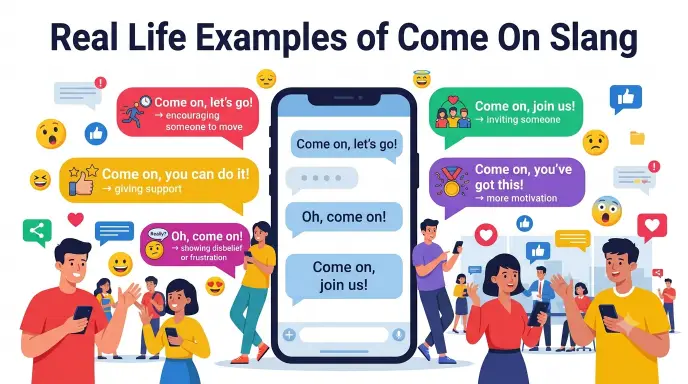
Seeing comeon slang in different situations makes its meaning easier to understand. The expression changes slightly depending on the relationship between speakers and the emotion behind the message.
Example in a Sports Conversation
Person A:
“Our team is losing by two points.”
Person B:
“Comeon, we can still win!”
Meaning:
The speaker is encouraging the team and showing confidence.
Example Between Friends
Friend 1:
“I don’t want to go to the concert anymore.”
Friend 2:
“Comeon, we bought tickets already.”
Meaning:
The person is trying to convince their friend to join.
Example in an Online Community
User:
“I think I made a mistake with my design.”
Reply:
“Comeon, it looks great!”
Meaning:
The commenter is offering support and encouragement.
Example in a Gaming Chat
Player 1:
“We lost the last match.”
Player 2:
“Comeon, let’s try one more time.”
Meaning:
The player is motivating the group.
Example in a Funny Situation
Friend 1:
“I accidentally sent the message to the wrong person.”
Friend 2:
“Comeon 😂 how did you do that?”
Meaning:
The person is reacting with playful surprise.
How Parents and Teachers Can Understand Comeon Slang
Parents and teachers may see expressions like comeon in messages, comments, or online conversations.
The phrase is generally harmless and does not automatically indicate negative behavior.
Understanding the context is more important than focusing only on the spelling.
For example:
“Comeon, you can finish your homework.”
This is encouragement.
“Comeon, that was ridiculous.”
This may show frustration or disagreement.
Adults should look at the full conversation before interpreting the meaning.
How Writers Should Explain Comeon Slang
When writing about comeon slang, it is important to explain that it is a spelling variation, not a completely new word.
A clear explanation should include:
- the standard phrase: “come on”
- the informal spelling: “comeon”
- common meanings
- examples of use
- situations where it is appropriate
Avoid describing it as a brand new internet word because the expression existed before online communication became popular.
Related Internet Language Patterns
Comeon slang is part of a larger pattern where people change spelling online to make communication faster or more casual.
Similar examples include:
- gonna instead of going to
- wanna instead of want to
- gotta instead of have to
- cuz instead of because
These forms are common in informal writing but are usually avoided in formal documents.
The internet has made these casual forms more visible, but many existed in spoken language before appearing online.
Difference Between Spoken and Written Comeon
When people say “come on” aloud, their voice helps show the meaning.
The same phrase can sound:
- excited
- annoyed
- surprised
- supportive
- playful
In writing, people use punctuation and emojis to show similar feelings.
Examples:
“Come on!”
This may show excitement.
“Comeon 😂”
This may show joking disbelief.
“Comeon…”
This may show disappointment or frustration.
Digital communication often uses extra signals to replace voice and facial expressions.
Should You Add Comeon Slang to Your Vocabulary?
Understanding comeon slang can help you follow modern conversations, especially online.
You do not need to use every slang expression you understand.
Knowing slang helps you:
- understand messages
- follow social media conversations
- communicate with different age groups
- understand online communities
Good communication is not about using the newest slang. It is about knowing when certain words fit.
Final Thoughts on Comeon Slang
Comeon slang is an informal online spelling of the phrase “come on.” People use it in texts, comments, gaming chats, and social media conversations to express encouragement, disbelief, frustration, excitement, or a request to hurry.
The meaning of comeon depends on context. A message like “Comeon, you got this!” is supportive, while “Comeon, seriously?” may show surprise or frustration.
Although the combined spelling is common in casual digital communication, the standard form “come on” is better for formal writing, school work, and professional situations.
The best way to understand comeon slang is to consider the full conversation, the relationship between speakers, and the tone behind the message.

I’m Emily Carter, and I enjoy writing about slang, internet language, and modern English expressions. My goal is to explain word meanings in a simple, clear, and easy-to-understand way so anyone can learn with confidence.