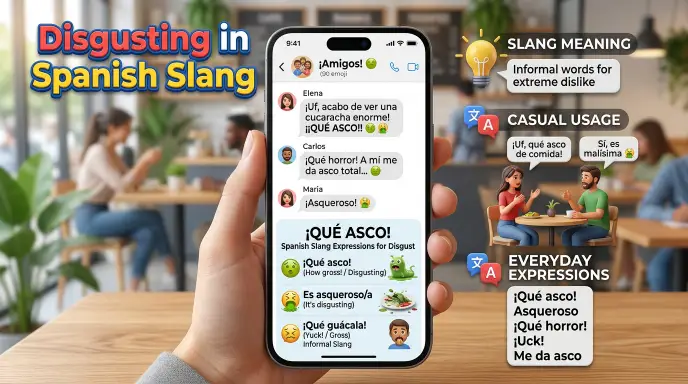
“Disgusting” in Spanish slang can be expressed in different ways depending on the country, situation, and level of emotion. Common informal words include expressions like “asqueroso,” “qué asco,” “guácala,” and “puaj,” which people use to show that something feels gross, unpleasant, or unacceptable.
People search for disgusting in Spanish slang because direct translations do not always sound natural in real conversations. A word used in Spain may sound different in Mexico, Colombia, Argentina, or online communities.
In this guide, you will learn the real meaning of Spanish slang expressions for disgust, where they are used, their tone, examples from texting and social media, and which words are safe to use with friends, family, or in formal situations.
Quick Answer: Disgusting in Spanish Slang
Disgusting in Spanish slang is commonly expressed with informal phrases like “qué asco” (how disgusting), “guácala” (gross/yuck), and “puaj” (ew). These expressions show a strong negative reaction to something unpleasant, dirty, or unwanted.
The exact slang word changes by region. Some expressions are playful among friends, while others can sound rude if used in serious conversations.
What Does “Disgusting in Spanish Slang” Mean?
Disgusting in Spanish slang refers to casual words and phrases people use to describe something that is gross, nasty, unpleasant, or makes them feel disgusted.
Unlike a simple dictionary translation, slang expressions often carry emotion. A person may use them because something is physically dirty, tastes bad, looks unpleasant, or even because they strongly dislike an idea.
For example:
- A friend shows a strange-looking meal, and someone says “¡Qué asco!”
“That’s disgusting!” - Someone sees a dirty room and says “Está asqueroso.”
“It’s disgusting.” - A person reacts to an annoying situation online with “Guácala.”
“Gross.”
Spanish speakers usually choose different words depending on:
- Country or region
- Age group
- Relationship between speakers
- Level of disgust
- if the situation is serious or joking
Common Spanish Slang Words for “Disgusting”
There is no single Spanish slang word that works everywhere. Different communities use different expressions.
| Spanish Expression | English Meaning | Tone |
| Qué asco | That’s disgusting / Gross | Very common, casual |
| Guácala | Yuck / Eww | Playful, informal |
| Puaj | Ew / Yuck | Reaction sound |
| Asqueroso | Disgusting / Nasty | Stronger, direct |
| Qué repugnante | How repulsive | More formal or dramatic |
| Qué horrible | How horrible | Depends on context |
Each expression has its own feeling. Some are emotional reactions, while others directly describe a person, thing, or situation.
“Qué Asco” The Most Common Way to Say Disgusting
“Qué asco” is one of the most widely used Spanish expressions for saying something is disgusting.
The phrase literally means “what disgust” or “how disgusting,” but native speakers use it like English speakers use:
- “That’s gross.”
- “Ew.”
- “That’s disgusting.”
It can describe:
- Bad smells
- Dirty objects
- Unpleasant behavior
- Strange food
- Awful situations
Examples:
Text message:
Ana: “I found old food under my bed.”
Luis: “Qué asco 😭”
Meaning:
“That’s so gross.”
Social media example:
A TikTok video shows a very dirty place.
Comment:
“Qué asco, no puedo mirar esto.”
Meaning:
“That’s disgusting, I can’t watch this.”
Tone of “Qué Asco”
The tone depends on the situation.
It can be:
Playful:
“You ate pizza with chocolate? Qué asco 😂”
The speaker may be joking.
Serious:
“Tratar mal a los animales es qué asco.”
Meaning:
“Treating animals badly is disgusting.”
Here, it expresses strong disapproval.
“Guácala” A Playful Slang Reaction
“Guácala” is a casual Spanish slang expression similar to “yuck” or “ew.”
It is especially common in parts of Latin America, including Mexico and some other Spanish-speaking communities.
People often use it when reacting quickly to something unpleasant.
Examples:
“Guácala, that smell is terrible.”
Spanish:
“Guácala, ese olor es horrible.”
Another example:
“Guácala, I don’t like that food.”
Spanish:
“Guácala, no me gusta esa comida.”
The word is often used by children, teenagers, and people joking with friends. It usually sounds less serious than directly calling something asqueroso.
“Puaj” The Spanish Version of “Ew”
“Puaj” is an expressive sound people write or say when they feel disgusted.
It works like English reactions:
- Ew
- Ugh
- Yuck
It is common in:
- Text messages
- Comments
- Memes
- Casual conversations
Examples:
“Puaj, that drink looks terrible.”
Spanish:
“Puaj, esa bebida se ve horrible.”
Online, people may type variations like:
- “puaj 🤢”
- “ewww”
- “qué asco 🤮”
These are emotional reactions rather than formal descriptions.
Are These Words Actually Slang?
Yes, many expressions for disgust are informal, but they are not all “slang” in the same way.
Some are everyday Spanish:
- Qué asco common casual phrase
- Asqueroso normal adjective
- Puaj reaction sound
Others are more playful or regional:
- Guácala stronger slang feeling in some countries
A Spanish learner should understand that “slang” does not always mean a new internet word. Many informal expressions have existed for years and are simply part of everyday speech.
Different Meanings of “Disgusting in Spanish Slang”
The meaning of disgusting in Spanish slang changes depending on what someone is reacting to. The same phrase can describe something physically unpleasant, emotionally wrong, or simply something a person dislikes.
Understanding the context is important because Spanish speakers often use these expressions casually, jokingly, or dramatically.
1. Physical Disgust (Something Gross or Dirty)
The most common meaning is a reaction to something unpleasant that someone can see, smell, taste, or touch.
Examples:
- A dirty bathroom
- Spoiled food
- Bad smells
- Insects
- Messy places
Common expressions:
- Qué asco “That’s disgusting.”
- Está asqueroso “It is disgusting.”
- Puaj “Ew.”
Example:
“I opened the fridge and found rotten food.”
Spanish:
“Abrí el refrigerador y encontré comida podrida. Qué asco.”
Here, the speaker is reacting to a physical thing.
2. Disgust Toward Behavior or Actions
Spanish speakers also use disgust expressions when they dislike someone’s behavior.
In this context, the meaning is closer to:
- “That is horrible.”
- “That behavior is unacceptable.”
- “That is shameful.”
Examples:
Consider using an alternative, such as older people, unless referring to someone who explicitly wants to be referred to with this term. Or, if possible, be specific about the group you are referring to (e.g. people older than 70)
Spanish:
“Robar a personas mayores es asqueroso.”
Another example:
“Treating workers badly is disgusting.”
Spanish:
“Tratar mal a los trabajadores es asqueroso.”
In these cases, the word is not about dirt or appearance. It expresses a moral reaction.
3. Playful or Exaggerated Disgust

Friends often use Spanish disgust slang in a funny or dramatic way.
Someone may say “qué asco” even when something is not truly terrible.
Example:
Friend:
“I put ketchup on ice cream.”
Reply:
“¡Qué asco! 😂”
The person may not actually feel serious disgust. They are joking or showing surprise.
This type of usage is common in:
- Group chats
- TikTok comments
- Instagram replies
- Gaming conversations
Where Is “Disgusting in Spanish Slang” Commonly Used?
Spanish slang expressions for disgust appear in many everyday situations.
They are common in:
- Face to face conversations
- Text messages
- Social media comments
- Video reactions
- Online communities
- Gaming chats
However, the exact word depends on the Spanish speaking region.
Usage on Texting and Messaging Apps
In texting, people usually prefer short emotional reactions.
Common examples:
- “Qué asco 🤢”
- “Guácala”
- “Puaj”
- “Nooo, qué asco”
People often add emojis to increase the feeling:
- 🤢 (nauseated face)
- 🤮 (vomiting face)
- 😭 (dramatic reaction)
Example:
Friend:
“I tried a weird seafood dish today.”
Reply:
“Puaj 🤢 how was it?”
The expression makes the conversation feel casual and emotional.
Usage on TikTok and Instagram
On platforms like TikTok and Instagram, Spanish speakers often use disgust slang in comments.
Common situations include:
- Strange food videos
- Unusual trends
- Bad fashion choices
- Dirty places
- Shocking content
Examples:
TikTok comment:
“Qué asco, why would someone do that?”
Meaning:
“That is disgusting.”
Instagram reaction:
“Guácala 😭”
Meaning:
“Ew.”
On social media, these words are often exaggerated for entertainment.
A person may write “qué asco” because something is surprising, not because it is truly harmful.
Usage on Discord and Gaming Communities
Spanish-speaking gamers also use these expressions in casual chats.
Examples:
“Bro, that strategy is disgusting.”
In English gaming slang, “disgusting” can sometimes mean something extremely good or powerful.
However, Spanish speakers usually need extra context. Saying:
“Ese ataque es asqueroso”
usually means:
“That attack is nasty/gross.”
It does not always mean “amazing.”
For gaming, Spanish players may use other slang words when praising skill, such as:
- brutal incredible
- increíble amazing
- bestial beast like
So, do not automatically translate English gaming slang directly into Spanish.
Regional Differences in Spanish Disgust Slang
Spanish is spoken across many countries, so expressions can change.
| Region | Common Expression | Meaning |
| Mexico | Guácala, qué asco | Yuck, disgusting |
| Spain | Qué asco, qué guarro | Gross, dirty |
| Argentina | Qué asco, qué asqueroso | Disgusting |
| Colombia | Qué asco | That’s gross |
| Chile | Qué asco | Disgusting |
These differences do not mean one word is “correct” and another is wrong. They simply reflect local speech habits.
“Asqueroso” vs “Qué Asco” What Is the Difference?
Many learners confuse these two expressions.
| Expression | Meaning | How It Is Used |
| Qué asco | That’s disgusting | A reaction |
| Asqueroso | Disgusting / nasty | Describes something |
Examples:
Reaction:
“Qué asco, this milk smells bad.”
Meaning:
“Gross, this milk smells bad.”
Description:
“This milk is asqueroso.”
Meaning:
“This milk is disgusting.”
A simple way to remember:
- Qué asco = your reaction
- Asqueroso = the thing you describe
Is “Disgusting in Spanish Slang” Rude or Offensive?
Most Spanish disgust expressions are not offensive by themselves. They are informal reactions.
However, the situation matters.
Usually Safe:
Among friends:
“Qué asco 😂”
about strange food or funny situations is normal.
Can Sound Rude:
If you say:
“Eres asqueroso.”
Meaning:
“You are disgusting.”
This directly insults a person.
It can sound harsh, especially toward:
- Teachers
- Parents
- Coworkers
- Strangers
The same word can be harmless when describing an object but offensive when aimed at someone.
Can You Use These Words at Work?
Generally, avoid casual disgust slang in professional situations.
Examples:
❌ Workplace meeting:
“Qué asco, this report is terrible.”
This sounds unprofessional.
Better options:
- “This needs improvement.”
- “This is not appropriate.”
- “This is concerning.”
However, casual workplace chats with close coworkers may sometimes include mild expressions, depending on the company culture.
Why Do People Use Spanish Disgust Slang?
People use these expressions because they communicate feelings quickly.
A short phrase like “qué asco” can show:
- Surprise
- Humor
- Disapproval
- Shock
- Strong dislike
Slang also helps conversations feel natural and emotional.
For example:
Without slang:
“I do not like this food because it looks unpleasant.”
With slang:
“Qué asco, I’m not eating that.”
The second version feels more like everyday speech.
Origin and History of Spanish Disgust Expressions
The expressions used for disgusting in Spanish slang do not all come from the same source. Some are old Spanish words, while others developed as regional expressions or emotional reactions.
Unlike modern internet slang, phrases like “qué asco” and “asqueroso” have been used in everyday Spanish for many years.
“Asco” and “Asqueroso”
The word asco has a long history in Spanish and refers to a feeling of disgust or strong dislike.
From this word comes:
- Asqueroso disgusting, unpleasant, nasty
- Dar asco to disgust someone / to be disgusting
- Qué asco how disgusting
These expressions are not new internet creations. They are part of normal Spanish vocabulary and appear in both casual speech and written Spanish.
“Guácala”
The expression guácala is more closely connected with informal speech, especially in parts of Latin America.
It works like an emotional sound rather than a formal word. Similar examples in English are:
- “Yuck”
- “Ew”
- “Ugh”
Because it is expressive, people often use it in:
- Children’s conversations
- Friendly jokes
- Social media reactions
- Casual messages
The exact history and spread of guácala are not always clearly documented, so it is better understood as a regional informal expression rather than a slang word with one confirmed origin story.
Similar Spanish Slang Words for Disgust
If you want to understand Spanish conversations better, it helps to know related expressions.
| Spanish Word/Phrase | English Meaning | Tone |
| Qué asco | That’s disgusting | Casual |
| Guácala | Yuck / Ew | Playful |
| Puaj | Ew / Ugh | Reaction |
| Asqueroso | Disgusting | Strong |
| Repugnante | Repulsive | Stronger, more formal |
| Qué horror | How horrible | Dramatic |
| Qué feo | That’s ugly/bad | Mild |
“Qué Horror” vs “Qué Asco”
These phrases can look similar, but they are not the same.
Qué asco
Used when something feels:
- Dirty
- Gross
- Unpleasant
Example:
“That food smells terrible.”
Spanish:
“Qué asco.”
Qué horror
Used for something shocking, terrible, or upsetting.
Example:
“I heard about the accident.”
Spanish:
“Qué horror.”
Meaning:
“How terrible.”
It is not always about disgust.
When Should You Avoid Using Disgusting Spanish Slang?
Spanish learners often understand the meaning but miss the social context.
Here are situations where you should be careful.
1. Formal Conversations
Avoid slang expressions during:
- Job interviews
- Business meetings
- Presentations
- Academic discussions
Instead of:
“Qué asco.”
Use:
- “Es desagradable.”
- “Es inapropiado.”
- “No me parece adecuado.”
These sound more professional.
2. Talking About People
Be careful when describing a person.
Saying:
“Ese hombre es asqueroso.”
means:
“That man is disgusting.”
This can be a strong insult.
It may suggest:
- Bad behavior
- Poor hygiene
- Moral problems
If you only mean someone is annoying, use softer words:
- Molesto annoying
- Grosero rude
- Desagradable unpleasant
3. Speaking With Native Speakers From Different Countries
A word that sounds normal in one country may feel stronger somewhere else.
For example:
- Guácala often sounds playful.
- Asqueroso sounds much stronger.
- Repugnante can sound serious.
When learning Spanish, listen to how native speakers use these expressions before using them yourself.
Common Misunderstandings About Spanish Disgust Slang
Misunderstanding 1: “Disgusting” Always Translates to One Spanish Word
A common mistake is thinking there is only one translation.
English:
Disgusting
can become:
- Qué asco
- Asqueroso
- Guácala
- Puaj
- Repugnante
The correct choice depends on the situation.
Misunderstanding 2: “Qué Asco” Is Always an Insult
Not always.
Among friends, it can be playful.
Example:
Friend:
“I ate fries with ice cream.”
Reply:
“Qué asco 😂”
This is usually a joke.
But:
“Tu comportamiento es un asco.”
Meaning:
“Your behavior is disgusting.”
This is much more serious.
Misunderstanding 3: Spanish Slang Works the Same Everywhere
Spanish changes across countries.
A learner who only studies one region may not recognize expressions from another.
For example:
- A Mexican speaker may commonly use guácala.
- A Spanish speaker from Spain may hear it less often.
- Many countries commonly understand qué asco.
Regional awareness helps avoid awkward situations.
Frequently Asked Questions About Disgusting in Spanish Slang
What is the most common way to say “disgusting” in Spanish slang?
The most common casual expression is “qué asco,” which means “that’s disgusting” or “that’s gross.”
It is widely understood across Spanish speaking communities.
What does “guácala” mean in Spanish?
Guácala means “yuck,” “ew,” or “gross.”
It is a playful informal expression often used when reacting to something unpleasant.
Is “asqueroso” a bad word?
No, asqueroso is not a swear word, but it can sound harsh.
Calling an object or situation asqueroso is normal. Calling a person asqueroso can be insulting.
How do you say “that’s disgusting” in Spanish texting?
Common texting options include:
- Qué asco 🤢
- Guácala 😭
- Puaj 🤮
- Nooo, qué asco
People often add emojis to show emotion.
Can I use “qué asco” with Spanish friends?
Yes. It is commonly used with friends and in casual conversations.
However, avoid using it toward people unless you want to criticize them.
Is “disgusting in Spanish slang” used on TikTok and social media?
Yes. Expressions like qué asco, guácala, and puaj appear frequently in comments, reactions, and memes.
They are often used dramatically for entertainment.
Conclusion
Disgusting in Spanish slang is not just one word. Spanish speakers use different expressions depending on the country, emotion, and situation.
The most common choices are:
- Qué asco “That’s disgusting”
- Guácala “Yuck” or “Ew”
- Puaj a disgust reaction
- Asqueroso “Disgusting” or “nasty”
These expressions are common in everyday conversations, texting, and social media. They can be funny and casual with friends, but they may sound rude if used toward people or in professional settings.
The best way to use Spanish disgust slang is to focus on context. A phrase that sounds playful in a group chat may sound offensive in a serious conversation.
Understanding the tone behind the words will help you communicate more naturally and avoid misunderstandings.

I enjoy writing about English vocabulary and making difficult words easier to understand. I create simple guides on synonyms, word meanings, example sentences, quizzes, and everyday English to help students, ESL learners, and writers improve their vocabulary. Before publishing any article, I research trusted dictionaries and language resources to keep the information clear and accurate. My goal is to make learning English simple, practical, and enjoyable for everyone.