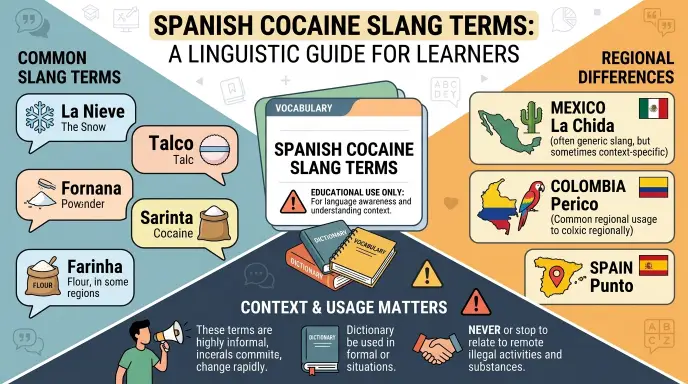
Slang for cocaine in Spanish refers to informal words and expressions that some Spanish speakers use to talk about cocaine in casual conversations, music, movies, or online discussions.
These terms can vary widely by country and region, and many are not understood everywhere. Some words may also have other meanings unrelated to drugs, so context is very important.
People search for slang for cocaine in Spanish to understand lyrics, social media posts, conversations, or cultural references.
This guide explains common meanings, regional differences, how these expressions are used, and why you should be careful when interpreting them.
Quick Answer: Slang for Cocaine in Spanish
Slang for cocaine in Spanish includes informal terms such as “coca,” “cocaína,” “blanca,” and other regional expressions. The exact meaning depends on the country, speaker, and situation because some slang words can have different meanings outside drug-related conversations.
What Does Slang for Cocaine in Spanish Mean?
Slang for cocaine in Spanish means unofficial or informal words used to refer to cocaine instead of using the formal name. These expressions may appear in street conversations, songs, films, online discussions, or fictional stories.
The word “cocaine” in Spanish is “cocaína.” However, many languages develop shortened forms or coded expressions for sensitive topics. Spanish speaking communities have different slang terms depending on location, culture, and time period.
A word used in one country may sound unfamiliar or mean something completely different in another Spanish speaking region.
For example:
“Coca” can be understood as a shortened form of “cocaína” in some contexts, but it can also refer to other things depending on the country.
Because slang changes quickly, understanding the surrounding conversation is necessary.
Why Do People Use Slang Words for Cocaine?
People may use slang instead of formal words for several reasons. Slang can create a sense of belonging, hide the direct meaning from outsiders, or reflect a specific social group.
Common reasons include:
- Informal conversations
- Music and entertainment
- Fictional characters in movies or shows
- Online discussions about culture
- Avoiding direct language in certain situations
However, using slang does not always mean someone is talking about real drug use. Sometimes people mention these words while discussing songs, news, history, or media.
Common Spanish Words Associated With Cocaine
Spanish slang changes from region to region. The following terms are commonly encountered in Spanish language discussions, but their meaning depends on context.
Coca
“Coca” is often used as a shortened form of “cocaína” in some Spanish-speaking areas.
It is a casual expression and may appear in conversations, music, or media.
Example:
“En la canción hablan de coca.”
Meaning:
“The song talks about cocaine.”
Important note:
“Coca” is not always related to cocaine. It can also refer to other things, including coca plants or cultural references in some regions.
Blanca
“Blanca” means “white” in Spanish. In some contexts, it can be used as a reference to cocaine because of its appearance.
This word is highly dependent on context. It does not automatically refer to drugs.
Example:
“The character used a nickname connected to ‘white’ in a crime movie.”
A listener must understand the surrounding conversation before deciding what it means.
Nieve
“Nieve” means “snow” in Spanish. In some places and contexts, it may be used as a slang reference because cocaine is often described as a white powder.
Like many slang expressions, it can also simply mean snow or have another meaning.
Example:
“Los personajes usan una palabra relacionada con nieve en una película.”
Meaning:
“The characters use a word related to snow in a movie.”
Regional Differences in Spanish Cocaine Slang
Spanish is spoken across many countries, and slang changes from place to place. A term that is familiar in one country may sound unusual somewhere else.
Latin America
Different regions may develop their own informal expressions. Local culture, music, and social groups often influence which words become common.
A slang term from Mexico may not be commonly understood in Argentina, Colombia, Spain, or Chile.
Spain
Spanish speakers in Spain may recognize some general slang terms but may also use expressions that are different from those found in Latin America.
Caribbean Regions
Caribbean Spanish has its own vocabulary influenced by local history, music, and cultural exchanges.
The key point is that there is no single universal list of Spanish cocaine slang. Meaning depends heavily on location and context.
Is Slang for Cocaine in Spanish Offensive or Harmless?
The slang itself is not always offensive, but the topic is sensitive because cocaine is an illegal drug in many places and can have serious health and legal consequences.
The words may appear in:
- Songs
- Movies
- News reports
- Discussions about addiction
- Educational content
Using these terms casually may create misunderstandings, especially when speaking with people from different backgrounds.
A person should not assume that every slang word has the same meaning everywhere.
Where Is Spanish Cocaine Slang Commonly Seen?
These expressions may appear in different types of media and conversations.
Music
Some Spanish language music genres mention drug related slang as part of storytelling, social commentary, or fictional themes.
Listeners often search for meanings because slang in songs can be difficult to understand.
Movies and Television
Crime dramas and documentaries may include slang terms to represent certain characters or environments.
Understanding the language helps viewers follow the story, but it does not mean the audience supports the behavior shown.
Social Media
Platforms like TikTok, Instagram, Reddit, and online forums may contain discussions where people explain or reference slang terms.
Online meanings can change quickly, so context remains important.
Different Meanings of Slang for Cocaine in Spanish
Slang words connected to cocaine can have different meanings depending on the speaker, country, and situation. A common mistake is assuming that every use of a word refers to drugs.
The same word may have a normal everyday meaning in one conversation and a drug-related meaning in another.
Coca as a Drug Reference
In some contexts, “coca” is used as a shortened form of “cocaína.” It is usually understood through the surrounding conversation.
Example:
“Los personajes hablan de coca en la película.”
Meaning:
“The characters are talking about cocaine in the movie.”
However, “coca” may also refer to other meanings, such as the coca plant or cultural references connected to certain regions.
Blanca as a Description
“Blanca” literally means “white.” In some situations, it can be used as a reference to cocaine because of its color.
The meaning is not automatic. Someone saying “blanca” may simply be talking about something white.
Example:
“La palabra blanca tiene otro significado en esta escena.”
Meaning:
“The word white has another meaning in this scene.”
Nieve as a Metaphor
“Nieve” means “snow.” It can appear as a metaphor because cocaine is often described as a white powder.
However, the normal meaning of “nieve” is snow.
Example:
“En la conversación, nieve puede tener un significado diferente.”
Meaning:
“In the conversation, snow may have a different meaning.”
Slang for Cocaine in Spanish: Platform Usage
The way people encounter these words changes depending on the platform.
Text Messages
In private chats, people may use shortened words or informal expressions. However, without context, it can be difficult to understand the intended meaning.
A message containing a slang term may refer to:
- A song lyric
- A joke
- A movie quote
- A real conversation
The surrounding messages usually provide clues.
TikTok and Instagram
Short videos and comments may include slang because users discuss music, entertainment, or internet trends.
Some users may search these terms because they hear them in songs or viral videos.
A word used in a video does not always show the creator’s personal behavior. It may simply be a cultural reference.
Reddit and Online Forums
Discussion communities often explain slang meanings, regional differences, or references from movies and music.
Users may ask what a word means because Spanish slang varies greatly between countries.
Discord and Online Communities
Gaming and online groups may sometimes discuss songs, shows, or cultural topics where these terms appear.
The meaning depends on the conversation, not just the word itself.
Real Life Examples of Spanish Cocaine Slang Context
Understanding context is more important than memorizing a list of words.
Example From Music Discussion
Person 1:
“What does this word mean in the song?”
Person 2:
“It is a slang reference related to cocaine.”
Here, the word is being explained, not necessarily used as part of a personal conversation.
Example From a Movie
Viewer:
“Why did the character say that word?”
Answer:
“It is a slang term used to show the character’s background.”
The term helps explain the story.
Example From Language Learning
Student:
“I heard this word in a Spanish video. What does it mean?”
Teacher:
“It can have different meanings, so check the context.”
This shows why direct translation is not always enough.
Origin and History of Spanish Cocaine Slang
There is no single origin point for Spanish cocaine slang. These expressions developed in different Spanish speaking communities over time.
Many slang terms come from:
- Local street language
- Music and entertainment
- Regional speech patterns
- Social groups
- Informal conversations
Some words are shortened versions of formal terms, while others use metaphors based on appearance or cultural references.
The exact history of many slang expressions is difficult to verify because slang often spreads through spoken language before appearing in written records.
A careful explanation should avoid claiming that one person, country, or year created a specific term unless there is reliable evidence.
Similar Terms Related to Cocaine in Spanish
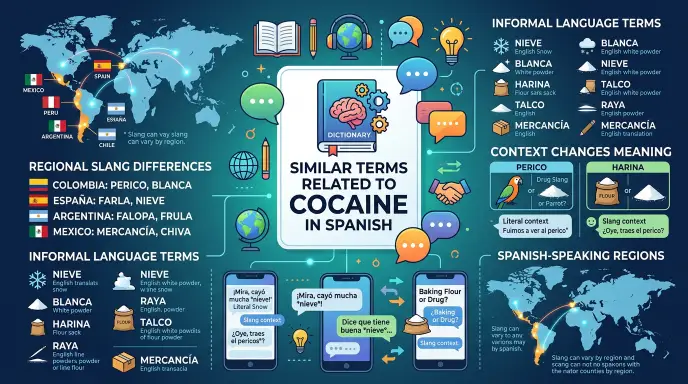
Spanish speakers may use different informal expressions depending on region and context.
Cocaína
Meaning: The formal Spanish word for cocaine.
Usage:
Used in medical, legal, educational, and news contexts.
Coca
Meaning: A shortened informal form that may refer to cocaine in some contexts.
Usage:
Mostly informal conversations and media references.
Blanco or Blanca
Meaning: A word connected with the color white that may be used metaphorically.
Usage:
Meaning depends heavily on context.
Polvo
Meaning: Powder in Spanish.
Usage:
Can have many meanings, so context is necessary.
A word list alone cannot explain slang completely. The situation, speaker, and country matter.
When Should You Avoid Using Spanish Cocaine Slang?
Using drug related slang can create confusion or uncomfortable situations. It is important to understand when informal language is not appropriate.
Avoid It in Professional Settings
Workplaces, schools, interviews, and formal conversations usually require clear language.
Instead of slang, use:
- “cocaine”
- “cocaína”
- “substance use”
- “Drug related topic”
Avoid Using It Without Understanding the Region
A slang word may be understood differently across Spanish speaking countries.
A term that sounds normal in one place may confuse or offend someone elsewhere.
Avoid Using It as a Joke With Strangers
Drug related jokes can be misunderstood. People may not know if you are discussing a real situation or making a reference.
Context and audience matter.
Is It Safe to Use Slang for Cocaine in Spanish?
Slang for cocaine in Spanish is not a term category that should be used casually without understanding the context. These words may refer to illegal drug use, but they can also appear in songs, movies, news, education, or language discussions.
The meaning depends on:
- The speaker
- The country
- The conversation topic
- The platform where it appears
A person learning Spanish should focus on understanding these words rather than using them freely. Some expressions may sound natural in one group but inappropriate or confusing in another.
Polite Alternatives to Drug Related Slang
When discussing the topic in a serious or educational way, clear language is usually better than slang.
Cocaína
This is the standard Spanish word for cocaine.
It is appropriate for:
- Educational discussions
- News reports
- Medical topics
- Academic writing
Sustancia or Droga
These words mean “substance” or “drug.”
They are broader terms used when discussing drug related topics generally.
Substance Use or Addiction Terms
For health related conversations, professional terms are usually more accurate than slang.
Using formal language helps avoid confusion and keeps the conversation respectful.
Why Do People Search for Slang for Cocaine in Spanish?
People search for these meanings for many different reasons. Not every search means personal involvement with drugs.
Common reasons include:
- Understanding Spanish songs
- Translating movie dialogue
- Learning regional slang
- Understanding social media comments
- Studying language and culture
- Reading news stories
Spanish slang can be difficult because direct translation does not always explain the real meaning.
For example, a dictionary may show the literal meaning of a word, but it may not explain how people use it in everyday conversations.
Common Misunderstandings About Spanish Cocaine Slang
Many mistakes happen because people treat slang like a simple vocabulary list.
One Word Does Not Always Have One Meaning
A slang term may have multiple meanings.
For example, a word connected with color or objects may have a drug related meaning in one situation but a normal meaning in another.
The full sentence is important.
Slang Is Not the Same in Every Country
Spanish is spoken in many countries, and each region develops different expressions.
A person from Spain may not use or understand every slang term used in Latin America.
Hearing a Word Does Not Prove the Meaning
A person may mention a slang term while discussing:
- A song
- A documentary
- A news story
- A language lesson
The context decides the meaning.
Frequently Asked Questions
Q1: What is slang for cocaine in Spanish?
Slang for cocaine in Spanish refers to informal words used to talk about cocaine. Common examples include shortened or metaphorical expressions, but meanings vary by country and context.
Q2: What is cocaine called in Spanish?
The formal Spanish word for cocaine is “cocaína.” This is the standard term used in medical, educational, and official contexts.
Q3: Is “coca” the same as cocaine in Spanish?
“Coca” can be a shortened form of “cocaína” in some conversations, but it can also have other meanings. The context is necessary to know what someone means.
Q4: Do all Spanish speaking countries use the same cocaine slang?
No. Spanish speaking countries have different slang expressions. A term used in one region may not be common or understood in another.
Q5: Is Spanish cocaine slang used on TikTok or social media?
Yes, these expressions may appear in discussions about music, movies, culture, or online conversations. However, the meaning depends on the content and context.
Q6: Should language learners use Spanish drug slang?
Language learners should understand slang when they encounter it, but they should be careful about using drug related slang. Formal words are usually safer and clearer.
Q7. What do Spanish people call coke?
Spanish speakers may use slang terms like coca, cocaína, or farlopa when referring to cocaine in informal conversations.
Q8. What is the slang term for cocaine?
Common slang terms for cocaine include coke, snow, blow, and in Spanish speaking areas, words like farlopa or perico may be used.
Q9. What is the Spanish slang for drugs?
Spanish slang for drugs varies by region, but terms like droga, porro, or chuches can appear in informal speech depending on the substance and location.
Q10. What is yayo slang for?
“Yayo” is a Spanish slang term often used to refer to cocaine, especially in some Spanish speaking communities.
Conclusion
Slang for cocaine in Spanish includes informal expressions that may appear in conversations, music, films, and online discussions. These terms do not have one universal meaning because Spanish slang changes across countries and communities.
The most important thing to remember is context. A word that refers to cocaine in one conversation may have a completely different meaning somewhere else. People searching for slang for cocaine in Spanish are often trying to understand culture, lyrics, or online language rather than simply translate a word.
For clear and respectful communication, the formal term “cocaína” is usually the best choice. Understanding slang helps you recognize meaning, but using it requires careful attention to the situation.

I enjoy writing about English vocabulary and making difficult words easier to understand. I create simple guides on synonyms, word meanings, example sentences, quizzes, and everyday English to help students, ESL learners, and writers improve their vocabulary. Before publishing any article, I research trusted dictionaries and language resources to keep the information clear and accurate. My goal is to make learning English simple, practical, and enjoyable for everyone.