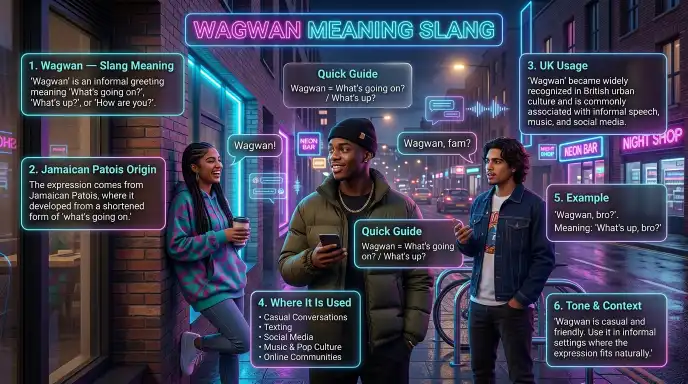
Wagwan meaning slang is “What’s going on?” or “What’s up?” It is a casual greeting used to ask how someone is doing or what they are doing. The expression comes from Jamaican English and is widely linked with Jamaican and Caribbean speech.
You may see “wagwan” in texts, social media posts, music, or casual conversations. It can sound friendly, relaxed, or playful depending on who says it and how it is used.
If you are searching for the wagwan meaning slang, you may also wonder where the word came from, if it is rude, and how to reply to it. This guide explains the meaning, origin, tone, common uses, and real-life examples in simple English.
Quick Answer: Wagwan Meaning Slang
Wagwan means “What’s going on?” or “What’s up?” It is a casual Jamaican greeting used to ask how someone is doing or what is happening.
What Does Wagwan Mean in Slang?
Wagwan is a casual way to say “What’s going on?” or “What’s up?”
It is often used as a greeting rather than a serious question. Someone may say “Wagwan?” simply to start a conversation.
For example:
“Wagwan, bro?”
This can mean:
“What’s up, bro?”
The expression can also be written as “wagwan,” “wagwan?” or “wah gwaan.” The spelling may change because it represents a spoken expression.
The meaning stays close to “What’s going on?” in most casual conversations.
What Does Wagwan Stand For?
Wagwan does not have a traditional full form like an acronym.
It comes from the Jamaican English phrase “What’s going on?” The spoken form became shortened and changed over time.
You may see several spellings, including:
- Wagwan
- Wah gwaan
- Wah gwan
- Wa gwan
These spellings usually point to the same expression.
So, if someone asks, “What does wagwan stand for?” the simple answer is:
Wagwan is a casual form of “What’s going on?” or “What’s up?”
Different Meanings of Wagwan
Wagwan mainly has one core meaning, but its use can change slightly with the situation.
Wagwan as a Greeting
This is the most common use.
A person may say “wagwan?” when they meet someone or start a chat.
Example:
“Wagwan, how are you?”
Here, the speaker is simply saying hello and asking how the other person is doing.
Wagwan as “What’s Happening?”
Wagwan can also ask about what is happening.
Example:
“Wagwan with the party tonight?”
In this context, the speaker is asking what is happening with the party or what the plans are.
Wagwan as “What’s New?”
Sometimes it works like “What’s new?” or “How have you been?”
Example:
“Wagwan? Haven’t seen you in ages.”
The speaker is using the phrase as a friendly way to reconnect.
The exact feeling depends on the conversation and the speaker’s tone.
Is Wagwan Rude, Offensive, or Neutral?
Wagwan is generally casual and friendly. It is not normally a rude or offensive expression.
However, it is closely associated with Jamaican English and Caribbean culture. Because of that, people who do not normally use the expression should understand its cultural background before using it.
Using a phrase from another variety of English is not automatically offensive. The key issue is context and respect.
For example:
“Wagwan, mate?”
This may sound like a casual greeting.
But using Jamaican expressions in a way that mocks Jamaican speech can be disrespectful.
The safest approach is to use the term naturally and avoid exaggerating a Jamaican accent or speech pattern for humor.
Where Is Wagwan Commonly Used?
Wagwan is most common in informal speech and online communication.
Texting
Friends may use “wagwan” as a quick greeting.
“Wagwan bro, you free later?”
The meaning is close to:
“What’s up? Are you free later?”
You may see wagwan in comments, captions, or direct messages.
Example:
“Wagwan! It’s been a long time.”
The writer is greeting someone they have not spoken to recently.
TikTok
The term can appear in videos, comments, memes, and discussions connected with UK, Jamaican, or Caribbean culture.
Its meaning usually remains “What’s up?” or “What’s going on?”
Snapchat
Friends may use wagwan in quick messages.
“Wagwan 😂”
This can simply mean:
“What’s up?”
Discord
Wagwan may appear in casual group chats.
Example:
“Wagwan everyone, who’s playing tonight?”
Here, the speaker is greeting the group before asking about the game.
Gaming
Wagwan does not have a special gaming meaning.
A gamer may use it as a normal greeting:
“Wagwan guys, ready to play?”
It simply means:
“What’s up, guys? Ready to play?”
Workplace Chat
Wagwan is usually too informal for professional communication unless you already have a very casual relationship with your coworkers.
In a work message, “Hi,” “Hello,” or “How are you?” is usually a better choice.
Real-Life Examples of Wagwan
The tone of wagwan depends on the situation. Here are examples that show how people may use it.
Friendly Conversation
“Wagwan, man? How have you been?”
Meaning: “What’s up? How have you been?”
The tone is friendly and relaxed.
Casual Text
“Wagwan? Are you coming out tonight?”
Meaning: “What’s up? Are you coming out tonight?”
Greeting a Friend
“Wagwan bro!”
Meaning: “What’s up, bro?”
The expression works as a simple greeting.
Social Media Comment
“Wagwan 😂 Haven’t seen you here in forever.”
The person is greeting someone in a playful way.
Gaming Context
“Wagwan, team? Are we starting now?”
Meaning: “What’s up, team? Are we starting now?”
Asking About Plans
“Wagwan with the weekend plans?”
Meaning: “What’s happening with the weekend plans?”
Friendly Reunion
“Wagwan! It’s been so long.”
Meaning: “What’s up? It’s been so long.”
How to Reply to Wagwan
If someone sends you “wagwan?”, you can reply in several natural ways.
Casual Replies
- “Not much, you?”
- “I’m good. You?”
- “All good!”
- “Doing well. What about you?”
- “Nothing much, bro.”
For example:
Person A: “Wagwan?”
Person B: “Not much, you?”
This is a normal casual exchange.
You do not need to reply with “wagwan” yourself. A simple “I’m good, you?” works perfectly.
Origin and Background of Wagwan
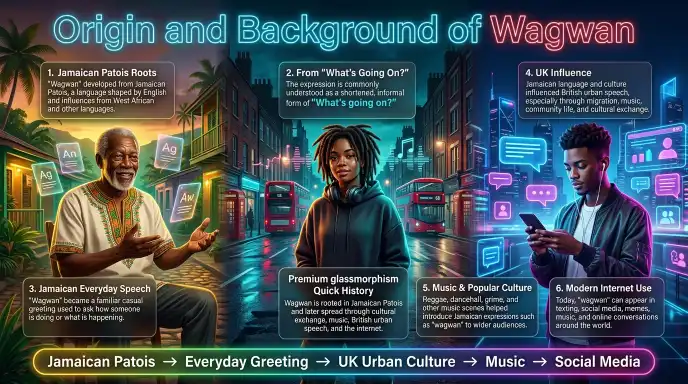
Wagwan comes from Jamaican English and is connected to the Jamaican phrase “What’s going on?”
The expression reflects the way spoken English can change when words are used quickly and naturally. “What’s going on?” can be pronounced in a shorter form that sounds similar to “wah gwaan.”
The expression became strongly associated with Jamaican speech and later spread through Caribbean communities and popular culture.
It also became familiar to wider audiences through music, entertainment, and UK urban culture. Jamaican influence has played an important role in many expressions used in British informal speech.
Because the term has a real cultural and linguistic background, it is more accurate to describe wagwan as an expression rooted in Jamaican English rather than simply calling it generic internet slang.
Wagwan vs. What’s Up
Wagwan and “what’s up?” are close in meaning, but they are not identical in style.
| Expression | Meaning | Tone |
| Wagwan | What’s up? / What’s going on? | Casual |
| What’s up? | How are you? / What’s happening? | Casual |
| What’s going on? | What is happening? | Neutral |
| How are you? | Asking about someone’s well-being | Neutral |
| Hello | Greeting | Neutral/Formal |
The biggest difference is cultural and stylistic.
“What’s up?” is widely used in general English.
Wagwan vs. Wah Gwaan
“Wagwan” and “wah gwaan” usually represent the same expression.
The difference is mainly spelling.
“Wah gwaan” is closer to how the phrase may be represented in Jamaican speech, while “wagwan” is a common shortened spelling used online.
You may therefore see:
“Wagwan?”
or:
“Wah gwaan?”
Both can mean:
“What’s going on?”
The spelling does not necessarily indicate a different meaning.
When Should You Avoid Using Wagwan?
Wagwan is best kept for informal situations.
You may want to avoid it when:
- Writing a formal email
- Speaking to a teacher in a formal setting
- Writing a job application
- Talking to a customer
- Writing an academic paper
- The person may not understand the expression
- You are using it only to imitate someone’s accent or culture
For example, instead of writing:
“Wagwan, Professor?”
a student should normally write:
“Hello, Professor.”
This is clearer and more respectful in a formal setting.
Polite Alternatives to Wagwan
If you want a more neutral greeting, you can use:
- What’s up?
- How are you?
- How’s it going?
- What’s going on?
- How have you been?
- Hello
- Hi
The best choice depends on the situation.
For a friend, “What’s up?” is natural. For a teacher, manager, or customer, “Hello” or “How are you?” is usually more appropriate.
Why Do People Use Wagwan?
People use wagwan because it is short, familiar, and expressive.
It can help a conversation feel:
- Friendly
- Relaxed
- Informal
- Social
- Playful
For people familiar with Jamaican or Caribbean speech, it can also carry a sense of cultural connection.
Online, short expressions are useful because they let people communicate a greeting quickly without writing a full sentence.
Is Wagwan Meaning Slang Safe for Social Media?
Yes. Wagwan is generally safe for normal social media use.
It is a casual greeting and does not normally contain offensive meaning.
Still, context matters. If you use the expression in a way that mocks Jamaican speech or culture, people may react negatively.
Use it as a genuine casual expression rather than as a joke about someone’s accent.
Common Misunderstandings About Wagwan Meaning Slang
One common mistake is treating wagwan as an acronym.
It is not.
Another mistake is assuming that it always means exactly “hello.” It can also mean “What’s up?” or “What’s going on?” depending on the situation.
A third mistake is assuming that every person who uses wagwan is Jamaican. The expression has spread beyond Jamaica through music, social media, Caribbean communities, and UK culture.
The important point is that the expression has Jamaican linguistic roots, even though many different people may use it today.
Frequently Asked Questions
Q1. What does wagwan mean in slang?
Wagwan means “What’s up?” or “What’s going on?” It is a casual greeting with roots in Jamaican English.
Q2. Is wagwan a Jamaican word?
Wagwan comes from Jamaican English and is closely associated with Jamaican speech and culture.
Q3. Is wagwan rude?
No. Wagwan is generally friendly and casual. It is not normally considered rude or offensive.
Q4. What is the correct reply to wagwan?
You can reply with “Not much, you?”, “I’m good, you?”, or another casual response. You can also simply say “Wagwan” back.
Q5. Is wagwan the same as what’s up?
Yes, they are very close in meaning. Both can be used as casual greetings, although wagwan has Jamaican linguistic and cultural roots.
Q6. Can I use wagwan at work?
It depends on the workplace, but it is usually better to use a neutral greeting in professional communication. “Hi” or “How are you?” is safer.
Conclusion:
Wagwan is a casual greeting that means “What’s up?” or “What’s going on?” It comes from Jamaican English and has become familiar in Caribbean communities, music, UK culture, and online conversations.
You may see it in texts, TikTok comments, Instagram, Snapchat, Discord, gaming chats, and other informal settings. The expression is usually friendly, but it should be used with respect for its Jamaican roots.
The simplest way to remember the wagwan meaning slang is: wagwan = “What’s up?” or “What’s going on?”