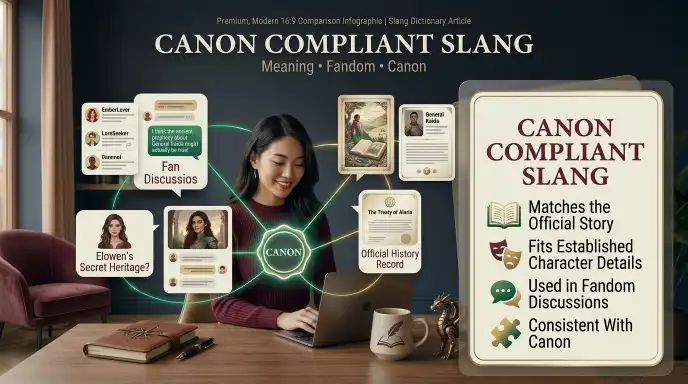
Canon compliant slang is a fandom term used for a story, character, or idea that fits with the established events and details of an original work. In simple words, canon compliant means staying consistent with the original story while adding new scenes, ideas, or details.
You may see this term in fanfiction, anime, books, movies, TV shows, and online fandoms. Understanding canon compliant slang can help readers and writers explain how closely a fan-created story follows the original canon.
Quick Answer: What Does Canon Compliant Mean in Slang?
Canon compliant slang means a fan-created story or idea that stays consistent with the established canon of an original work. It usually follows known events, characters, settings, and important details without creating major contradictions.
In simple words, canon compliant means a fanfiction or story that fits within the original storyline.
What Does Canon Compliant Mean?
Canon compliant describes a fan-created story, scene, or idea that fits with the established facts of an original work. The writer keeps important characters, events, timelines, settings, and details consistent with the source material.
For example, a fanfiction writer might create a missing scene between two episodes of a TV show. If that scene fits naturally between those episodes, readers may describe it as canon compliant.
The term does not make the fan-created work official. Instead, it explains how the work relates to the original canon.
What Does Canon Mean in Fandom?
In fandom, canon means the official story, facts, events, characters, and details established by an original work. These details can come from books, movies, TV shows, anime, comics, or video games.
For example, an officially revealed character backstory becomes part of the canon. Fans can then use that information when discussing if a fanfiction or theory fits the original story.
Knowing what canon means makes canon compliant much easier to understand. The phrase simply describes a fan-created work that aims to stay consistent with those established details.
Canon Compliant Meaning in Fanfiction
In fanfiction, canon compliant means the writer creates a story that fits the established events and details of the original work. New scenes and conversations can appear as long as they do not create major contradictions.
A writer might explore what happened between two episodes or describe a character’s thoughts during an event that the original story already showed. Such additions can fit within the existing storyline.
The exact standard can differ between fandoms. Some fans may expect very close adherence to canon, while others may allow more interpretation.
What Does Canon Compliant Mean on AO3?
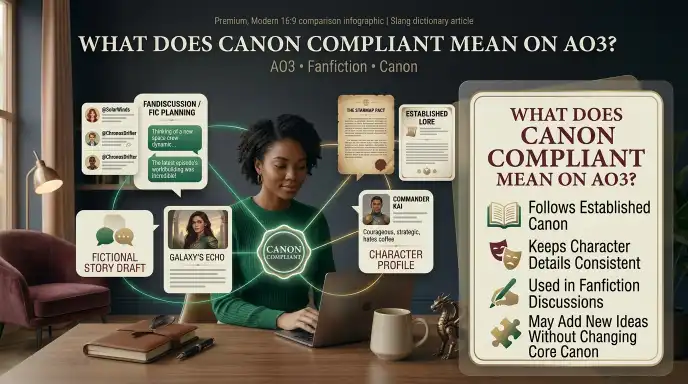
On AO3 (Archive of Our Own), Canon Compliant describes a fanwork that the writer intends to fit with the canon of its source material. Writers can use the term when their stories add material without deliberately changing important canon events.
For example, an author might write an unseen conversation between two characters during an existing episode. The new scene can expand the story while keeping the known events unchanged.
AO3 also has a Canon Compliant tag that writers can use to describe this relationship between their work and the source material.
Canon Compliant Examples
Canon compliant stories can take several forms. The common idea is that the new material fits alongside the established story.
Some examples include:
- A fanfic shows what a character did between two episodes.
- A story explores a character’s thoughts during an existing canon event.
- A writer creates a conversation that the original work never showed.
- A fanfiction adds a small event without changing the main timeline.
- A writer explores an unexplained part of a character’s life.
- A story adds new details that do not conflict with established facts.
These examples show how writers can create fresh material while keeping the original canon intact.
How to Use Canon Compliant in a Sentence
People usually use canon when discussing fanfiction, fan-created stories, or ideas that follow an original work.
Here are some natural examples:
- “This fanfic is canon compliant and fits between the second and third episodes.”
- “I wanted to write a canon compliant story about their friendship.”
- “Is this chapter canon compliant, or does it change the timeline?”
- “The author added a missing scene while keeping the story canon compliant.”
- “This fic feels canon compliant because the major events remain unchanged.”
The phrase works best when readers already understand the fandom context.
What Makes a Story Canon Compliant?
A story usually feels canon compliant when its important details can exist alongside the original source material. Writers generally avoid contradictions that would make the new story impossible within the established timeline.
Several parts of a story can affect its compatibility with canon:
- Characters: Their actions should make sense based on their established personalities and histories.
- Timeline: New events should fit the known order of events.
- Setting: The story should follow the established world and its rules.
- Backstory: Important character history should remain consistent.
- Major events: Existing events should remain intact.
- Relationships: Established relationships should not receive major changes without explanation.
A writer can still add original scenes and interpretations. The important point is that those additions should fit with the known story.
Can Fanfiction Be Canon Compliant?
Yes, fanfiction can be canon compliant. A writer can create new material while keeping the established storyline and important details consistent.
For example, a fanfiction might show what two characters discussed after an official scene. The original event stays unchanged, while the writer adds something that the source material never showed.
Such a story remains fan-created, even when it fits the original canon. It does not become an official part of the source material.
Is Canon Compliant the Same as Canon?
No, canon compliant and canon have different meanings.
Canon refers to the official story and details established by the original work. Canon compliant describes a fan-created work that fits those established details.
For example, an official episode belongs to the canon. A fanfiction that adds an unseen conversation between two scenes may be canon compliant, but the fanfiction itself is not automatically official canon.
In simple terms, canon is the original material, while canon compliant describes how a fan-created work fits that material.
Canon Compliant vs. Canon Divergent
Canon compliant and canon divergent describe different relationships between fanfiction and the original story.
A canon compliant story works within established canon. A canon divergent story starts from the original canon but changes an important event or decision and then follows a different path.
| Term | Simple Meaning |
| Canon compliant | A fan-created work that fits the established story. |
| Canon divergent | A fan-created work that changes an established event and follows another path. |
For example, a fanfic that adds an unseen conversation after a canon event can remain canon compliant. If the writer changes the result of that event, the story may become canon divergent.
Canon Compliant vs. Fanon
Canon compliant and fanon describe different concepts in fandom.
Canon compliant explains how a fan-created work fits with the original story. Fanon refers to ideas that fans develop, repeat, or accept even though the original work does not officially establish them.
For example, an officially confirmed character hobby belongs to canon. A popular fan idea about that character having another hobby may count as fanon if the source never confirms it.
A writer can include fanon in a story without automatically making the entire work non-compliant. The important question is if the added idea conflicts with established canon.
Canon Compliant vs. Headcanon
Canon compliant and headcanon are related to fan interpretations, but they describe different things.
Canon compliant describes a fan-created work that fits established canon. Headcanon describes a personal interpretation or belief that a fan has about a character, relationship, event, or fictional world.
For example, a fan may believe that a character enjoys a certain hobby even though the original story never confirms it. That personal belief can become their headcanon.
A writer can include such an interpretation in a fanfiction. If it does not contradict important canon details, the resulting story may still be canon compliant.
Canon Compliant vs. Canon Typical
Canon compliant and canon typical are related fandom expressions, but they focus on different qualities.
Canon compliant focuses on if a story fits established facts and events. Canon typically focuses more on if the characters, behavior, tone, or situations feel natural for the original work.
For example, a fanfiction can follow the official timeline and remain canon compliant. However, the characters might behave in unusual ways that do not feel canon typical.
In simple terms, canon compliant focuses on consistency with established canon, while canon typically focuses on if something feels like it belongs naturally in the original work.
Canon Compliant vs. Canon Adjacent
Canon compliant and canon adjacent both connect a fan-created work to the original story, but they can describe different relationships.
Canon compliant usually means the work fits within established canon without directly contradicting important details. Canon adjacent can describe a work or idea that stays close to canon while exploring material outside the main storyline.
For example, a fanfic that fills an unseen moment in the official timeline may be canon compliant. A story that focuses on an original character or an unexplored part of the fictional world may be described as canon adjacent, depending on the community.
Because canon adjacent does not have one strict meaning across every fandom, context matters.
Can Canon Compliant Stories Add New Information?
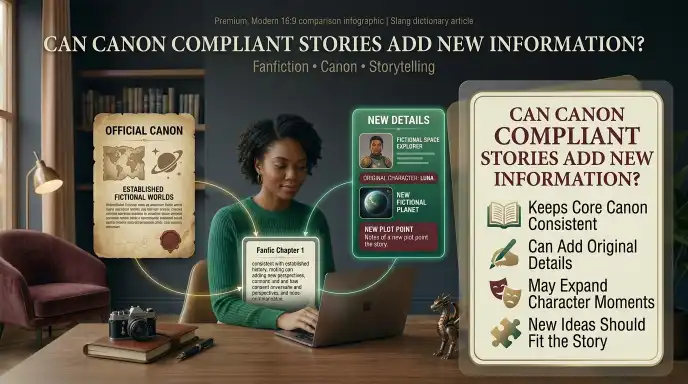
Yes, a canon compliant story can add new information when those additions fit the established story.
Writers often use this approach to explore areas that the original work did not explain. They may create private conversations, character thoughts, background events, or other unseen moments.
For example, a writer could describe what a character did while another canon event was happening. If the new event fits the timeline and does not contradict known facts, readers may consider it canon compliant.
Different fans may set different limits on how much new information a story can contain.
Can Canon Compliant Stories Change Canon Events?
Usually, a canon compliant story does not change major events that the original work has already established. Instead, the writer builds new material around those events.
For example, a writer could add a conversation before an important canon event. The official event still happens in the same way, so the new scene can fit into the original timeline.
When a writer changes a major event and follows a different outcome, the story may become canon divergent. This approach deliberately moves away from the original path.
The boundary can vary between fandoms because fans may have different ideas about what counts as a major contradiction.
Canon Compliant and Characterization
Characterization plays an important role in many canon compliant stories. It describes how a writer presents a character’s personality, behavior, relationships, and established traits.
A writer can place a character in a new situation while keeping their known personality in mind. For example, a normally quiet character may react differently to a new problem, but the reaction should still make sense within the character’s established traits.
Canon compliance does not require every character to behave exactly as they did in the original work. New situations can produce new reactions.
However, extremely different behavior may lead readers to describe the character as out of character (OOC) rather than canon typical.
Canon Compliant and Timeline
The timeline can also affect if a story feels canon compliant. New events should fit with the known order of events in the original work.
A writer might place a story before, during, or after a specific canon event. A missing-scene fanfic, for example, can take place between two episodes while leaving both episodes unchanged.
Stories can also explore events after an original ending. The writer simply needs to keep important established details consistent with the source.
If a new event makes a later canon event impossible, readers may instead view the story as canon divergent.
Canon Compliant in Different Fandoms
Fans can use canon compliant across many types of fandoms. The term may appear in discussions about anime, manga, books, movies, TV shows, comics, and video games.
Each community may focus on different details. One fandom might pay close attention to the timeline, while another might focus more on character relationships, world-building, or backstory.
For example, a TV fanfiction could fit between two official episodes. A book-based story might expand on an event that the original novel only briefly mentioned.
Canon compliance can work like a sliding scale, so fans may disagree about if a particular work completely fits the source material.
Common Misunderstandings About Canon Compliant
People who are new to fandom may misunderstand canon in several ways.
- It does not mean official: A canon-compliant fanfiction remains a fan-created work.
- It does not mean copying canon: Writers can create new scenes and conversations.
- It does not mean every detail must appear in the source: A writer can explore events that the original never showed.
- It does not have one universal standard: Different fandoms and readers may interpret compliance differently.
- It does not mean canon divergent: Canon divergence involves changing an established event or following a different storyline.
The main idea is simple: canon compliant means fitting with the original canon rather than becoming part of the official story.
When Should You Use the Term Canon Compliant?
You can use canon when you want to explain that a fan-created story, scene, or idea fits with the established details of an original work.
The term works well when:
- You are describing a fanfiction that follows the original timeline.
- You want to explain that a story does not contradict major canon events.
- You are discussing a missing scene that could fit into the original story.
- You are comparing fanfic with canon divergent or AU stories.
- You are explaining how closely a fan-created work follows its source material.
For example, you could say, “This fic is canon compliant because it fits between two events from the original story.”
The phrase is especially useful in fandom and fanfiction discussions.
When Should You Avoid Using Canon Compliant?
You may want to choose another fandom term when canon compliant does not accurately describe the work.
For example, avoid using it when:
- A story deliberately changes major canon events.
- The work takes place in a completely different alternate universe (AU).
- You are discussing a personal headcanon rather than a complete story.
- The work clearly follows a different timeline.
- You are asking if something is officially part of the original story.
In these situations, terms such as canon divergent, AU, or headcanon may provide a clearer description.
When writing for people who are unfamiliar with fandom terminology, explain the phrase the first time you use it.
Related Fandom Terms
Several fandom terms connect closely with canon compliant.
- Canon: Official events, facts, characters, and details established by the original work.
- Canon divergent: A fan-created story that changes an established event and follows a different storyline.
- Fanon: An idea commonly used by fans but not officially confirmed.
- Headcanon: A personal fan interpretation or belief.
- Alternate Universe (AU): A story that places characters or events in a different setting or version of the fictional world.
- Canon-compatible: A term that can describe a work that fits with canon without directly contradicting it.
Knowing these terms makes it easier to understand how different fan-created works relate to their source material.
Canon Compliant in Social Media and Online Chats

Canon compliant can appear in online fandom discussions about fanfiction, characters, theories, and story ideas. Fans may use it in posts, comments, group chats, and discussions about if a new idea fits the original story.
For example, someone might say, “I made this scene canon compliant,” to explain that their fan-created scene does not change the established storyline.
The phrase can also appear next to terms such as canon, fanon, headcanon, and canon divergent. The surrounding conversation can help readers understand the intended meaning.
Canon Compliant in a Sentence: More Examples
Here are more natural examples of canon compliant in fandom conversations:
- “I tried to keep my new chapter canon compliant.”
- “This story is canon compliant with the first season.”
- “The author created a missing scene that feels canon compliant.”
- “Is your fic canon compliant, or does it follow a different timeline?”
- “The new chapter adds details without changing the main canon.”
- “This character interaction could fit into a canon compliant story.”
- “The writer explained which parts of canon the fanfic follows.”
- “I checked the timeline to make sure the story stayed canon compliant.”
Key Differences at a Glance
| Term | Simple Meaning |
| Canon | Official facts and events from the original work |
| Canon compliant | A fan-created work that fits established canon |
| Canon divergent | A fan-created work that changes canon and follows another path |
| Fanon | An idea widely used by fans but not officially confirmed |
| Headcanon | A personal fan interpretation or belief |
| Alternate Universe (AU) | A story using a different setting, reality, or version of the original world |
| Canon-compatible | A work that can fit with canon without directly contradicting it |
These terms describe different relationships between fan-created ideas and the original source material. Their exact boundaries can vary across fandom communities.
FAQs About Canon Compliant
Q1. What does canon compliant mean?
Canon compliant means a fan-created story or idea fits with the established events and details of the original work.
Q2. What does canon compliant mean in fanfiction?
It means the fanfiction is written to fit the original storyline without deliberately contradicting major canon details.
Q3. Is canon compliant the same as canon?
No. Canon is the official story, while canon compliant describes a fan-created work that fits that story.
Q4. Can fanfiction be canon compliant?
Yes. A fanfiction can add new scenes or conversations while keeping the original timeline and important events consistent.
Q5. What is the difference between canon compliant and canon divergent?
Canon compliant follows established canon, while canon divergent changes an important canon event and follows a different storyline.
Q6. What does canon compliant mean on AO3?
On AO3, Canon Compliant describes fanworks that are intended to fit with the established canon of their source material.
Q7. Can a canon compliant story add new characters?
Yes. A writer can add original characters as long as their role does not create major contradictions with established canon.
Q8. Is canon compliant an official term?
It is a fandom term used to describe the relationship between a fan-created work and its original source material.
Q9. Is canon compliant the same as fanon?
No. Fanon refers to ideas developed or accepted by fans, while canon compliant describes how a work fits with established canon.
Conclusion:
Canon compliant slang is a useful fandom term for describing a fan-created story or idea that fits with the established canon of an original work. It can apply to fanfiction, missing scenes, character moments, and other creative works that avoid major contradictions.
The term differs from canon divergent, fanon, and headcanon, which describe other relationships between fans and fictional stories. Since fandom communities may apply different standards, context can help explain what someone means by canon compliant.
In simple terms, canon compliant means created to fit the original story without changing its established canon.

I’m Emily Carter, and I enjoy writing about slang, internet language, and modern English expressions. My goal is to explain word meanings in a simple, clear, and easy-to-understand way so anyone can learn with confidence.