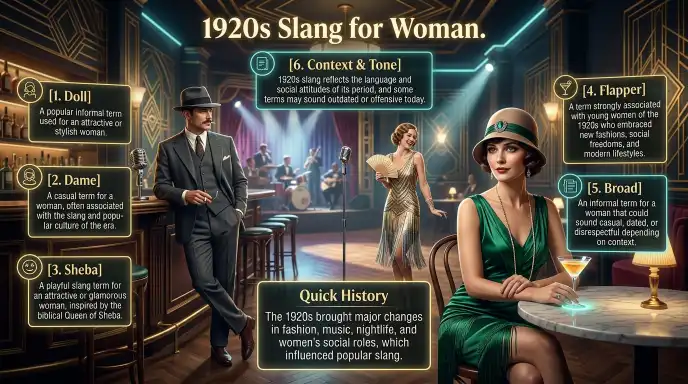
1920s slang for women includes terms such as “flapper,” “dame,” “doll,” “gal,” and “broad.” These words had different meanings and tones, so the right term depended on the woman, setting, and speaker.
If you are searching for 1920s slang for women, you may be reading an old story, studying Jazz Age culture, or writing a character from the period. The 1920s had many informal words for women, but they were not all used in the same way.
Other terms, such as “dame” and “doll,” were older expressions that were also used during the decade.This guide explains the main terms, their meanings, tones, origins, and appropriate contexts.
Quick Answer: What Is 1920s Slang for Women?
1920s slang for women included “flapper,” “dame,” “doll,” “gal,” “broad,” “Sheba,” “bim,” and “tomato.” “Flapper” described a specific type of fashionable young woman, while “dame” was a more general informal word for a woman.
What Does 1920s Slang for Women Mean?
1920s slang for woman refers to informal words used to describe women during or around the Jazz Age. These terms could describe a woman’s age, appearance, lifestyle, social role, or relationship.
The meaning depended heavily on context.
| Slang term | Basic meaning | Typical tone |
| Flapper | Young woman linked with Jazz Age culture | Historical, descriptive |
| Dame | Woman | Informal, sometimes rough |
| Doll | Attractive woman | Affectionate or objectifying |
| Gal | Girl or woman | Casual |
| Broad | Woman | Rough, often disrespectful |
| Sheba | Attractive woman | Flirtatious, dated |
| Bim | Woman | Dated, often negative |
| Tomato | Attractive woman | Objectifying |
| Moll | Woman linked with a criminal | Crime-related |
These terms are not interchangeable.
For example, a “flapper” was not simply another word for every woman. The term described a particular cultural image. In contrast, “dame” could be used more generally.
Full Meaning of Popular 1920s Slang for Women
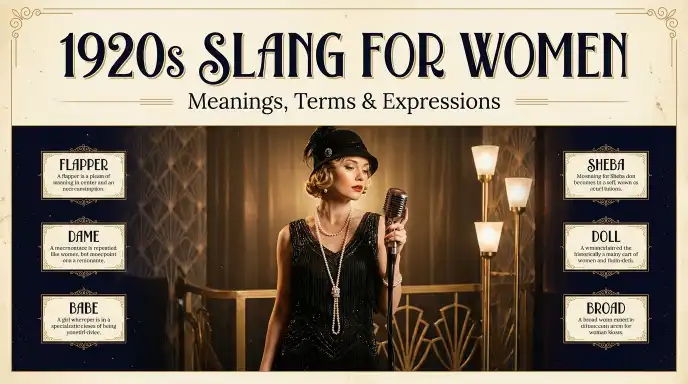
Flapper
“Flapper” is the word most strongly associated with young women of the 1920s.
It described a fashionable young woman linked with the modern culture of the Jazz Age. The popular image included short hair, fashionable clothing, dancing, jazz, and nightlife.
The word does not mean that every young woman in the 1920s was a flapper. It described a particular social and cultural image.
Example:
“She looked like a flapper at the jazz club.”
Today, “flapper” is mainly used in historical discussions, vintage fashion, and writing about the 1920s.
Dame
“Dame” was an informal word for a woman.
It was not created in the 1920s. The word had been used earlier and continued to appear in American informal speech during the decade.
Its tone could be casual or rough depending on the speaker.
Example:
“That dame knows everyone at the club.”
Today, “dame” sounds old-fashioned. It is often used to create a vintage or crime-story feel.
Doll
“Doll” could refer to an attractive woman.
Depending on the situation, it could sound affectionate or flirtatious. It could also reduce a woman to her appearance, so the tone matters.
Example:
“He arrived at the party with his doll.”
The word existed before the 1920s, so it should not be described as a word invented during that decade.
Gal
“Gal” was an informal term for a girl or woman.
It was also older than the 1920s and was not exclusive to that period. Still, it fits the casual American speech associated with the era.
Example:
“That gal can really dance.”
“Gal” is less harsh than some other terms on this list, but it can sound old-fashioned today.
Broad
“Broad” was slang for a woman.
It usually had a rough or disrespectful tone. The word later became strongly associated with tough-guy and crime-story dialogue.
Example:
“That broad was waiting outside the club.”
Because of its negative tone, “broad” is best kept for historical dialogue or discussion of old slang.
Sheba
“Sheba” was used as slang for an attractive or sexually appealing woman.
The expression drew on the image of the biblical Queen of Sheba and suggested beauty and glamour.
Example:
“Everyone noticed Sheba when she entered the room.”
The term is strongly dated today and is mainly useful in historical or vintage-style writing.
Bim
“Bim” was an early 20th-century slang term for a woman.
It often carried a negative or disrespectful tone. The word could suggest a woman who was seen as attractive, fashionable, or sexually available.
Example:
“The old story described her as a city bum.”
Because the term is dated and can be insulting, it is better used when discussing historical language.
Tomato
“Tomato” was slang for an attractive woman.
The word focused strongly on physical appearance, which made it objectifying.
Example:
“He called the singer a tomato.”
Today, “tomato” in this sense is mostly associated with old-fashioned or vintage speech.
Is 1920s Slang for Women Rude or Offensive?
Some terms were casual, while others could be insulting or objectifying.
“Flapper” is generally neutral when used to describe a historical cultural type. “Gal” can also be relatively casual.
Terms such as “broad,” “bim,” and “tomato” are more likely to sound disrespectful. “Doll” and “Sheba” may sound flattering in some contexts, but they still focus strongly on appearance.
For example:
“She was a talented singer.”
This focuses on her skill.
“She was a real tomato.”
This focuses on her appearance and can sound objectifying.
For modern conversation, these older terms are usually unnecessary. For historical writing, however, they can help show a character’s voice and attitude.
Where Was 1920s Slang for Women Used?
These expressions appeared in informal speech and popular culture. Their use varied by region, social group, and setting.
Everyday conversation
Words such as “dame” and “gal” could be used as informal references to women.
The tone depended on the speaker and situation.
Jazz Age nightlife
“Flapper” became closely connected with dancing, jazz, fashion, and nightlife.
It represented a particular image of the modern young woman.
Entertainment
Popular entertainment helped spread many informal expressions. Songs, stage shows, magazines, and films all played a role in shaping the language people encountered.
This does not mean every person used every term. Slang varied across groups and settings.
Crime-related speech
Some expressions became strongly connected with gangster and crime stories.
“Moll” is a good example. It referred to a woman associated with a criminal, often as his girlfriend or companion.
“Broad” could also appear in rough or crime-related dialogue, but it was a broader term for a woman.
Real-Life Examples of 1920s Slang for Woman
Friendly example
“That gal from Chicago sure knows how to dance.”
Here, “gal” sounds casual and informal.
Fashion example
“She looked like a real flapper at the dance.”
This connects the woman with the fashionable image of the Jazz Age.
Romantic example
“He brought his doll to the party.”
Here, “doll” suggests attraction or affection.
Glamorous example
“That Sheba turned every head in the room.”
“Sheba” presents the woman as highly attractive.
Rough example
“That broad never misses a night at the club.”
“Broad” gives the sentence a rough and disrespectful tone.
Crime example
“The gangster’s moll waited outside the club.”
“Moll” connects the woman with a criminal figure.
Singer example
“The canary began singing when the band started playing.”
Here, “canary” refers to a female singer in an entertainment setting.
Origin and Background of 1920s Slang for Woman
The 1920s brought major changes to American popular culture.
Jazz, radio, movies, fashion, nightlife, and new forms of entertainment helped new expressions spread. Young women also became more visible in popular culture and public life.
“Flapper” became one of the strongest symbols of this period. However, the word itself did not suddenly appear in the 1920s. Its history goes back earlier, while its connection with the modern young woman became especially strong during the Jazz Age.
Other words were also older.
“Dame,” “doll,” and “gal” were not invented in the 1920s. They were earlier informal expressions that continued to be used during the decade.
This is an important point when studying historical slang. A word can be popular during a particular period without having originated in that period.
What Did “Moll” Mean in 1920s Slang?
“Moll” had a specific meaning.
It referred to a woman associated with a criminal, often as his girlfriend or companion.
Example:
“The gangster’s moll waited near the car.”
The term is strongly connected with crime and gangster culture.
It should not be used as a general synonym for “woman.” Calling someone a “moll” gives the character a specific connection to criminal life.
Why Was “Flapper” So Important?
“Flapper” became more than a simple slang term.
It became a symbol of a particular kind of young woman during the Jazz Age. The popular image was connected with fashion, dancing, jazz music, nightlife, and changing social expectations.
The typical image included:
- Bobbed hair
- Modern clothing
- Dancing
- Jazz music
- Nightlife
- A more independent social image
However, it is important not to assume that all women in the 1920s were flappers. The term described a specific cultural type, not all women of the decade.
When Should You Avoid Using 1920s Slang for Women?
You should avoid these expressions when a clear and respectful modern word works better. Most of these terms now sound old-fashioned, and some can sound insulting.
Be especially careful with:
- “Broad”
- “Bim”
- “Tomato”
- Some uses of “doll”
- Some uses of “dame”
These words can focus on a woman’s appearance or suggest a dismissive attitude.
Historical slang is more suitable when you are:
- Writing historical fiction
- Creating period dialogue
- Studying 1920s culture
- Researching old books or films
- Writing a historical screenplay
- Discussing Jazz Age language
- Creating vintage-themed content
If you are talking about a woman in modern everyday English, “woman” is usually the clearest choice.
Polite Alternatives to 1920s Slang for Woman
Modern English has simple alternatives that are clear and respectful.
Depending on the situation, you can use:
- Woman
- Young woman
- Lady
- Girl, when appropriate
- Girlfriend
- Female singer
- Female companion
For example, instead of saying:
“She is a tomato.”
You could say:
“She is very attractive.”
Instead of:
“That broad is waiting outside.”
You could simply say:
“That woman is waiting outside.”
The modern alternatives make the meaning clear without the old slang tone.
Why Do People Still Use 1920s Slang for Women?
People usually use these expressions for historical, creative, or educational reasons.
A writer may want a character’s speech to sound like it belongs to the Jazz Age. A student may want to understand an old text. A filmmaker may need dialogue that fits a 1920s setting.
These words can also create a strong sense of time and place.
For example, “flapper” quickly suggests the 1920s. “Moll” can suggest a gangster story. “Canary” can suggest a nightclub or stage setting.
The word can therefore tell readers something about both the character and the world around them.
Impact of 1920s Slang on Communication
Slang can communicate more than a person’s basic identity.
A word such as “flapper” can suggest fashion, youth, nightlife, and Jazz Age culture. “Moll” can suggest a connection with crime. “Canary” can suggest a female singer in an entertainment setting.
This makes historical slang useful in storytelling.
At the same time, some terms reveal the speaker’s attitude toward women. A word focused on appearance may make a character sound flirtatious, dismissive, or disrespectful.
That can be useful in fiction when the tone is intentional. In modern communication, however, it is usually better to choose a neutral term.
Is 1920s Slang for Women Safe for Social Media?
Historical slang can be discussed on social media when the context is clear.
For example:
“Flapper fashion became a major symbol of the 1920s.”
This is a historical statement.
However, calling a real person a “broad” or “tomato” today may sound insulting or objectifying.
If you use these words in a post, video, or discussion, explain that you are referring to historical slang. This helps readers understand the intended meaning.
The same rule applies to online communities, comments, captions, and messages. Historical context can make an old expression understandable, but it does not automatically make the expression polite in modern speech.
Common Misunderstandings About 1920s Slang for Woman
One common mistake is assuming that every slang word on a 1920s list was invented during the decade.
That is not correct.
Many expressions were already in use before the 1920s. They continued to appear during the decade and became part of its popular language.
Another mistake is treating every term as a direct synonym for “woman.”
“Flapper” describes a particular cultural type. “Moll” describes a woman’s connection with a criminal. “Canary” can refer to a female singer.
A third mistake is ignoring tone.
“Doll” can sound affectionate in one situation but objectifying in another. “Broad” generally sounds much rougher.
The safest approach is to look at the whole sentence, the speaker, and the setting before deciding what a slang term means.
How to Choose the Right 1920s Slang Term
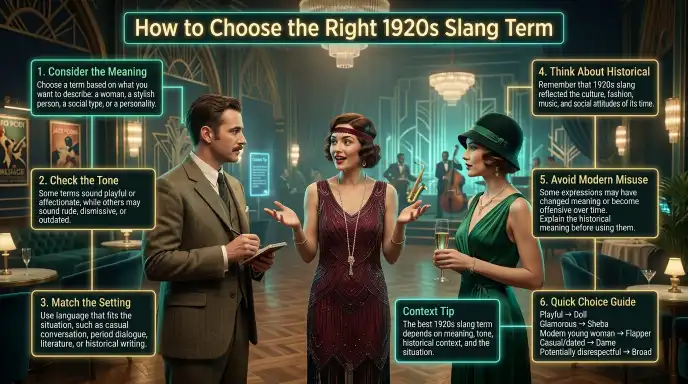
The best term depends on the character and situation.
For a fashionable young woman
Use “flapper” when the character fits the Jazz Age image.
For a general informal reference
“Dame” or “gal” can create a period-style voice.
For an attractive woman
“Doll,” “Sheba,” or “tomato” can create a vintage tone, although these words focus on appearance.
For a rough or disrespectful speaker
“Broad” may fit historical dialogue when the negative tone is intentional.
For a gangster story
“Moll” works when the woman is connected with a criminal.
For a female singer
“Canary” can fit a nightclub or entertainment setting.
A good historical writer does not use old slang simply because it sounds interesting. The word should fit the character, setting, and tone.
Frequently Asked Questions About 1920s Slang for Woman
Q1. What is the most famous 1920s slang word for woman?
“Flapper” is probably the most famous term associated with women in the 1920s. It described a young woman connected with the fashionable and socially modern culture of the Jazz Age.
Q2. What did people call women in the 1920s?
Common informal terms included “dame,” “doll,” “gal,” “broad,” “Sheba,” and “flapper.” Each term had a different meaning and tone.
Q3. What was slang for an attractive woman in the 1920s?
“Doll,” “Sheba,” and “tomato” could describe attractive women. These words focused on appearance and could sound flattering, flirtatious, or objectifying depending on the context.
Q4. What did “dame” mean in the 1920s?
“Dame” was an informal slang word for a woman. It existed before the 1920s but remained part of American informal speech during the decade.
Q5. What did “broad” mean in 1920s slang?
“Broad” meant a woman and usually had a rough or disrespectful tone. Today, it sounds very dated and can be insulting.
Q6. What did “moll” mean in the 1920s?
“Moll” referred to a woman associated with a criminal, often as his girlfriend or companion. The term was strongly connected with gangster and crime-related language.
Q7. What did “Sheba” mean in 1920s slang?
“Sheba” was slang for an attractive or sexually appealing woman. It created a glamorous image and is now strongly dated.
Q8. Can I use 1920s slang for women today?
You can use these terms in historical writing, research, or vintage-themed content. In normal modern conversation, words such as “broad,” “bim,” and “tomato” are better avoided because they may sound disrespectful.
Conclusion: 1920s Slang for Woman
1920s slang for women includes several colorful expressions, but they do not all mean the same thing. “Flapper” is the best-known term and describes a particular young woman associated with Jazz Age culture.
Other words, such as “dame,” “doll,” “gal,” “Sheba,” “broad,” “bim,” “tomato,” and “moll,” had different meanings and tones. Some were casual, some focused on appearance, and others were connected with crime or entertainment.
The best way to understand these expressions is to consider the historical setting and the speaker’s attitude. Some work well in period dialogue but sound strange or disrespectful today.
For modern communication, “woman” is usually the clearest and most respectful choice. For historical writing, carefully chosen period slang can make a character’s voice feel more authentic.