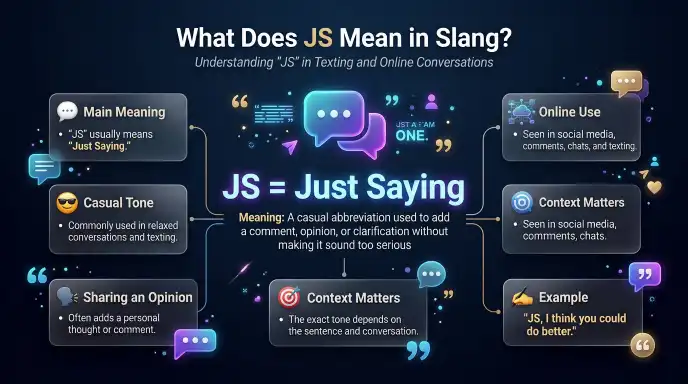
What does JS mean in slang? JS usually means “just saying.” It is a casual abbreviation used in texts, chats, and social media when someone wants to share an opinion, comment, or observation in a relaxed way.
If you see JS in a message, the exact meaning can depend on the conversation. In most casual texting, it means “just saying.” For example, “That movie was better than I expected, js” means “That movie was better than I expected, just saying.”
However, JS can have other meanings in different settings. In some online conversations, it can mean “just,” while in technology, JS commonly refers to JavaScript. Understanding the context helps you choose the right meaning.
Quick Answer: What Does JS Mean in Slang?
JS most commonly means “just saying” in texting and internet slang. People use it to add an opinion, observation, or comment in a casual way without making the statement sound too serious.
For example:
“Your old profile picture was better, js.”
Here, JS means “just saying.”
What Does JS Mean in Slang?
In slang, JS usually stands for “just saying.” It is a shortened form of a phrase people use when they want to give their opinion or point something out.
The phrase can make a comment feel more casual. It can also suggest that the person is not trying to start an argument.
For example:
“You should probably leave earlier next time, js.”
This means:
“You should probably leave earlier next time, just saying.”
The person is giving advice but keeping the tone informal.
What does JS mean at the end of a text?
When JS appears at the end of a message, it usually means “just saying.”
For example:
“That outfit looked better yesterday, js.”
The sender is sharing an opinion. The JS shows that they are casually making the comment rather than presenting it as a serious demand.
What does JS mean at the beginning of a text?
JS can also appear at the beginning of a sentence.
For example:
“JS, I think you should talk to her.”
Here, the person is signaling that what follows is their personal opinion.
The meaning stays the same, but its position can change the flow of the sentence.
What Is the Full Form of JS in Texting?
The most common full form of JS in texting is “just saying.”
It is mainly used in informal conversations where people want to type quickly or keep their message short.
| Abbreviation | Full form | Common use |
| JS | Just saying | Casual opinion or comment |
| IJS | I’m just saying | More direct version |
| Just saying | Full phrase | Informal spoken or written comment |
IJS is closely related to JS. It means “I’m just saying” and can be used when someone wants to make their personal opinion clear.
For example:
“IJS, you could have told me earlier.”
This means:
“I’m just saying, you could have told me earlier.”
Different Meanings of JS
JS can have more than one meaning. The correct definition depends on the conversation.
JS meaning “just saying”
This is the main slang meaning.
People use it after an opinion, criticism, suggestion, or observation.
Example:
“You could have asked me first, js.”
The speaker is saying, “You could have asked me first, just saying.”
This use is common in casual online conversations.
JS meaning “just”
In some newer online writing styles, lowercase “js” can be used as a short form of “just.”
For example:
“I just got home.”
This means:
“I just got home.”
This meaning is less universal than “just saying.” Someone who is not familiar with this newer texting style may read JS as “just saying.”
The surrounding sentence is the best clue.
JS meaning JavaScript
In technology and programming, JS commonly means JavaScript.
For example:
“I need to fix the JS on this page.”
Here, JS does not mean “just saying.” It refers to JavaScript.
The conversation makes the difference clear. In a programming discussion, JavaScript is much more likely. In a casual text between friends, “just saying” is usually the better interpretation.
JS in sneaker conversations
In some sneaker-related conversations, JS can refer to Jordan shoes or Jordans.
For example:
“Did you see the new Js?”
If the conversation is about sneakers, the person may be talking about Jordan shoes.
This meaning is much more dependent on context than “just saying.”
Where Is JS Commonly Used?
JS is mostly used in informal digital communication. You may see it in texting, comments, chats, and online communities.
Text messages
Friends may use JS when sharing an opinion or giving casual advice.
Example:
“You should try the chocolate one, js.”
TikTok
JS can appear in TikTok comments or captions when someone wants to add a quick opinion.
Example:
“The first version was better, js.”
The comment is short and casual.
People may use JS in comments, replies, or direct messages.
Example:
“That was easily the best picture, js.”
Here, the person is simply sharing their view.
Snapchat
Snapchat conversations are often short and informal, so abbreviations such as JS can fit naturally.
Example:
“You should’ve come with us js 😂”
The sender is casually pointing out that the other person missed the outing.
Discord
JS can be used in casual Discord chats.
For example:
“JS, you should have waited for the team.”
The person is giving a quick opinion during a conversation or game.
However, if the Discord channel is about programming, JS may mean JavaScript instead.
JS may appear when someone adds a personal opinion to a discussion.
For example:
“JS, I think the older version was easier to use.”
The meaning is “just saying.”
Gaming
Gamers may use JS when commenting on another player’s decision.
For example:
“You should’ve healed before pushing, js.”
Here, JS keeps the comment casual.
Is JS Rude, Offensive, or Harmless?
JS is generally harmless. It is not a swear word, slur, or offensive expression.
However, the message around JS can still sound rude or passive-aggressive.
For example:
“You’re always late, js.”
The abbreviation itself is not offensive. The problem is the criticism in the sentence.
Compare these two messages:
“Maybe leave earlier next time.”
“You’re always late, js.”
The first sounds like helpful advice. The second can sound more critical.
So, JS is usually safe in casual conversation, but it does not automatically make a blunt statement polite.
Real-Life Examples of JS in Slang
Friendly conversation
“You should watch the second episode, js.”
Meaning: The person casually recommends the second episode.
Text message
“I think you should apologize first, js.”
Meaning: The sender is giving a personal opinion.
TikTok comment
“That was the best part of the whole video, js.”
Meaning: The commenter is sharing an opinion.
“The old design looked better, js.”
Meaning: The person prefers the older design.
Snapchat
“You looked better with the old hairstyle js.”
Meaning: The sender is casually stating a preference.
Gaming chat
“You should’ve waited for us, js.”
Meaning: The player thinks waiting would have been better.
Discord
“JS, I think the old server layout was better.”
Meaning: The speaker is sharing a personal opinion.
School conversation
“JS, you should start the project today.”
Meaning: The speaker is casually giving advice.
Workplace chat
“I think we should check the numbers again, js.”
The meaning is clear, but the tone is informal. In a professional message, it is usually better to write the complete thought without the abbreviation.
Origin and History of JS Slang
The exact starting point of JS meaning “just saying” is not clearly tied to one person or one platform.
The abbreviation developed as part of the broader habit of shortening phrases in online communication and text messaging. “Just saying” was already a familiar spoken phrase, so shortening it to JS made sense in quick digital conversations.
The slang form became established in online communication during the 2000s and continued into social media and messaging culture.
Its use has also changed over time. Some newer online communities use lowercase “js” as a short form of “just.” This can create confusion because older users may immediately understand JS as “just saying.”
There is no need to assign the newer meaning to every use of JS. Context remains the most reliable way to understand the abbreviation.
Is JS Still Used Today?
Yes. JS is still used in casual online communication.
The “just saying” meaning remains easy to find in texts, chats, comments, and social media conversations. At the same time, some users now use “js” differently, especially as a shortened form of “just.”
This means the abbreviation does not have one universal meaning in every online community.
A simple rule can help:
- Opinion or comment → likely “just saying”
- Casual sentence such as “I js left” → likely “just”
- Programming discussion → likely “JavaScript”
- Sneaker discussion → possibly Jordan shoes
Reading the whole sentence is usually enough to identify the intended meaning.
Is JS Appropriate in Professional or School Settings?
JS is mainly an informal abbreviation, so it is best used with friends, classmates, or people you already know well.
In professional communication, it is safer to write “just saying” or, even better, express the idea directly. Workplace messages should be clear and professional, especially when speaking to a manager, client, teacher, or customer.
For example:
Casual:
“JS, I think we should check this again.”
Professional:
“I think we should review this again.”
The second version is clearer and avoids any possible confusion about tone.
When Should You Avoid Using JS?
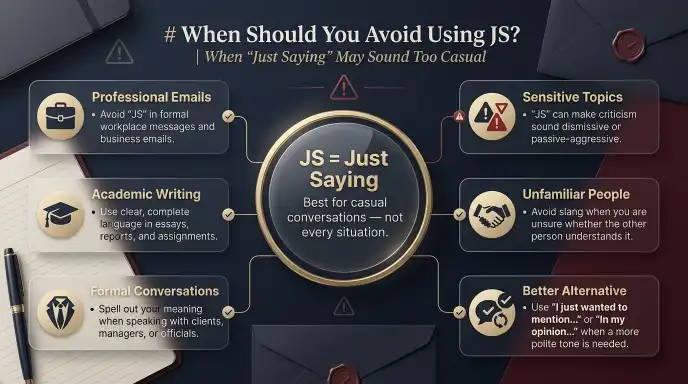
You should avoid JS when the message needs to sound formal, respectful, or very clear.
Consider avoiding it in:
- Job applications
- Business emails
- School assignments
- Formal reports
- Messages to clients
- Official complaints
- Important workplace discussions
- Academic writing
You should also be careful when using JS after criticism. Even though the abbreviation is harmless, it can make a sharp comment sound dismissive.
For example:
“Your idea doesn’t make sense, js.”
This may sound more like an insult than helpful feedback.
A better option is:
“I see it differently. Could we look at another approach?”
The goal is not to avoid JS everywhere. It is to match the wording to the situation.
Polite Alternatives to JS
If you want to share an opinion without sounding too blunt, you have several options.
“Just my opinion”
This is useful when you want to clearly show that you are sharing a personal view.
Example:
“Just my opinion, but I liked the first design better.”
“In my opinion”
This sounds more neutral and works in both casual and semi-formal conversations.
Example:
“In my opinion, the second option is better.”
“I think”
This is one of the simplest alternatives.
Example:
“I think we should leave earlier.”
“For what it’s worth”
This phrase can introduce an opinion without sounding too forceful.
Example:
“For what it’s worth, I liked the original version.”
“Just a thought”
This is useful when offering an idea or suggestion.
Example:
“Just a thought, but maybe we could try another color.”
These alternatives are often better than JS when you want your message to sound clear and respectful.
Why Do People Use JS?
People use JS mainly because it is short, quick, and familiar in casual online conversations.
There are several reasons someone may add it to a message.
To share an opinion
JS lets people add a personal view without making it sound like a formal statement.
Example:
“I think the old logo was better, js.”
To make a comment feel casual
The abbreviation can make a sentence feel less serious.
Example:
“You should probably bring a jacket, js.”
To soften a criticism
Some people use JS after criticism to make it feel less direct.
Example:
“You should have checked the message first, js.”
However, this does not always work. The criticism can still sound harsh.
To keep messages short
Online conversations often favor quick messages. JS is much faster to type than “just saying.”
To show personal opinion
JS can tell the reader that the statement represents the speaker’s view rather than an established fact.
How Does JS Change the Tone of a Message?
JS can make a statement sound casual, but tone depends heavily on the sentence.
Compare:
“You should try the other restaurant.”
“You should try the other restaurant, js.”
The second version can sound more like a personal suggestion.
But consider:
“You were wrong about that, js.”
Here, JS does not make the message friendly. It may even make the comment sound sarcastic.
This is why readers should not treat JS as a guaranteed “politeness word.” It changes the style of a message, but the surrounding words control most of the tone.
JS Meaning on Different Platforms
The meaning of JS can change depending on where you see it.
| Platform or setting | Most likely meaning | Typical context |
| Texting | Just saying | Opinions and comments |
| Snapchat | Just saying | Casual messages |
| Just saying | Comments and replies | |
| TikTok | Just saying | Short opinions |
| Discord | Just saying or JavaScript | Depends on the channel |
| Gaming chat | Just saying | Casual comments |
| Programming chat | JavaScript | Coding discussions |
| Workplace | Usually understood as just saying | Informal chat |
Platform alone does not always determine the meaning. The topic of the conversation is often more important.
For example, JS in a coding Discord server is more likely to mean JavaScript. JS in a friend’s Snapchat message is much more likely to mean “just saying.”
Common Misunderstandings About JS
JS can be confusing because the same abbreviation has several meanings.
JS does not always mean “just saying”
If someone writes:
“I’ve been learning JS for two months.”
They probably mean JavaScript if they are discussing programming.
The sentence does not make sense with “just saying.”
JS is not automatically rude
Some people may see JS after a criticism and assume the abbreviation itself is rude. It is not.
The tone comes from the complete message.
JS and IJS are closely related
JS means “just saying,” while IJS usually means “I’m just saying.”
They serve a similar purpose, but IJS makes the speaker’s meaning more explicit.
Capitalization is not a perfect clue
“JS” and “js” can have different meanings in some communities, but capitalization alone cannot always tell you what the writer means.
Always read the complete sentence.
JS vs. IJS: What’s the Difference?
JS and IJS are similar abbreviations, but there is a small difference.
| Term | Meaning | Example |
| JS | Just saying | “That was a bad idea, js.” |
| IJS | I’m just saying | “IJS, you should ask first.” |
How JS Works as a Short Sentence Tag
IJS sounds more like a direct introduction to the speaker’s opinion.
Both are informal.
How to Reply When Someone Uses JS
You usually do not need a special response to JS. Simply respond to the actual comment.
For example:
Person 1:
“You should have brought an umbrella, js.”
Person 2:
“Yeah, you’re right. I should have checked the weather.”
Or:
Person 2:
“Fair point. I’ll remember next time.”
If the comment sounds critical, you can respond to the criticism rather than focusing on the abbreviation.
For example:
Person 1:
“You should have told me earlier, js.”
Person 2:
“Sorry, I should have let you know.”
This keeps the conversation calm and natural.
How to Know Which Meaning of JS Someone Intended
The easiest way to understand JS is to look at the words around it.
Ask yourself what topic the person is discussing.
If the message is an opinion:
“That song is overrated, js.”
JS probably means “just saying.”
If the message is about something happening recently:
“I just got home.”
JS probably means “just.”
If the conversation is about coding:
“I need to learn JS.”
JS probably means JavaScript.
If the discussion is about sneakers:
“I bought some new Js.”
JS may refer to Jordan shoes.
Context is more useful than the abbreviation by itself.
Is JS Used by Teenagers?

Yes, JS can appear in casual communication among teenagers and younger internet users, especially in texting and social media.
However, it is not limited to one age group. People of different ages may understand or use “just saying” and its abbreviation.
The newer “js” meaning “just” may be more common in some younger online communities, but it should not be treated as a universal rule for all young users.
Online slang changes quickly. A person may understand one meaning while another person understands something completely different.
Can You Use JS With Teachers or Parents?
You can use JS with a teacher or parent if your relationship and communication style are very casual, but it is not the safest choice in formal or respectful messages.
For example, texting a close family member:
“JS, you should try this restaurant.”
That is fine.
But in a formal message to a teacher:
“JS, I think you marked this wrong.”
This could sound too casual or even confrontational.
A better version would be:
“I think there may be an issue with this grade. Could you please check it?”
The second message is more respectful and clear.
Can JS Be Used in a Serious Conversation?
Yes, but it may not be the best choice.
JS can make a serious statement sound casual. That can be helpful in some situations, but it can also make the speaker seem dismissive.
For example:
“I think we need to talk about what happened.”
This sounds serious and direct.
“JS, I think we need to talk about what happened.”
This sounds more casual and may reduce the seriousness of the message.
When a conversation involves an important issue, clear language is usually better than slang.
Frequently Asked Questions About What Does JS Mean in Slang?
Q1. What does JS mean in texting?
JS most commonly means “just saying.” It is used to add a casual opinion, observation, suggestion, or comment to a message.
Q2. What does JS stand for in slang?
In slang, JS usually stands for “just saying.” The phrase shows that the writer is casually sharing their personal view.
Q3. What does JS mean on Snapchat?
On Snapchat, JS usually means “just saying” when it appears in a casual message or comment. The exact meaning still depends on the surrounding conversation.
Q4. What does JS mean on TikTok?
On TikTok, JS can mean “just saying.” Users may add it to a comment when they want to share an opinion without making the statement sound too serious.
Q5. Is JS rude?
JS is not rude or offensive by itself. However, it can appear after criticism or sarcasm, so the full sentence may still sound rude.
Q6. Does JS mean JavaScript?
Yes, JS commonly means JavaScript in programming and technology. If the conversation is about coding, websites, or software, JavaScript is usually the intended meaning.
Q7. What is the difference between JS and IJS?
JS means “just saying,” while IJS usually means “I’m just saying.” Both are informal ways to introduce or add a personal opinion.
Q8. Can I use JS in formal writing?
It is better to avoid JS in formal writing. Use clear phrases such as “I think,” “in my opinion,” or “just a thought” instead.
Conclusion: What Does JS Mean in Slang?
If you are asking what does JS mean in slang, the main answer is “just saying.” It is a short, informal expression used in texts, social media, chats, and other casual conversations.
The meaning can change with context. In some online writing, lowercase “js” can mean “just,” while in programming, JS usually means JavaScript. In sneaker conversations, it may have another context-specific meaning.
The safest way to understand JS is to read the whole message. If it follows an opinion or comment, “just saying” is usually the right interpretation. For formal communication, it is better to write your meaning clearly instead of relying on the abbreviation.

I’m Emily Carter, and I enjoy writing about slang, internet language, and modern English expressions. My goal is to explain word meanings in a simple, clear, and easy-to-understand way so anyone can learn with confidence.