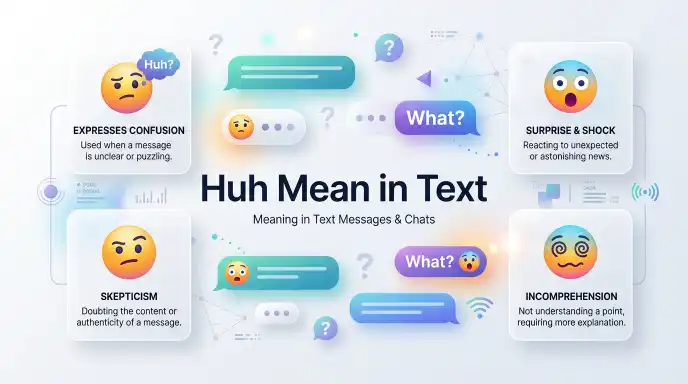
“Huh” in text usually means “What?,” “I don’t understand,” or “Can you repeat that?” People use it when they are confused, surprised, or did not understand something clearly.
You may see huh on TikTok, Snapchat, Instagram, WhatsApp, and in regular text messages. It is especially common in casual conversations between friends and other people who communicate informally.
The meaning can change slightly depending on the situation. “Huh?” may show confusion, while “Huh?!” can express surprise or disbelief.
People often search for huh mean in text because this small word can have several meanings. The context around it usually helps explain what the sender intended.
Huh Meaning in Text
In text messages, huh is generally used to show confusion, surprise, or a request for clarification. Depending on the conversation, it can mean “What?”, “Really?”, “I’m confused,” or “Can you say that again?”
For example:
A: I saw Jake at the airport yesterday.
B: Huh? I thought he was still in London.
Here, huh? shows surprise and confusion. The person wants more information.
Another example is:
A: You already finished the project?
B: Huh?
In this situation, the sender may be asking the other person to repeat what they said.
Is Huh Slang, an Acronym, or an Abbreviation?
Huh is not normally an acronym or abbreviation. It is an informal interjection used in spoken language and online communication.
An interjection is a short word or expression that communicates a reaction. Examples include “wow,” “oh,” “ugh,” and “hey.”
Unlike texting abbreviations such as IDK or BRB, the word huh does not normally represent a longer phrase.
It is better understood as a casual conversational expression.
What Does Huh Mean in Everyday Chat?
The most common meanings of huh include:
- “What did you say?”
- “I don’t understand.”
- “Can you explain?”
- “Really?”
- “Wait, what?”
- “That surprised me.”
The exact meaning depends on the surrounding conversation.
For example:
“Huh? What do you mean?”
shows clear confusion.
Meanwhile:
“Huh. I never thought about it that way.”
shows that the person has noticed or considered something.
Huh vs. Different Punctuation
Small changes in punctuation can affect the tone of huh.
| Version | Possible Meaning |
| Huh? | Confusion or request to repeat |
| Huh | Casual confusion or reaction |
| Huh?! | Strong surprise or disbelief |
| Huh… | Uncertainty, hesitation, or thinking |
| Huh. | Mild surprise or realization |
These are not strict rules. People use punctuation differently in texts, so the context is important.
Where People Use Huh
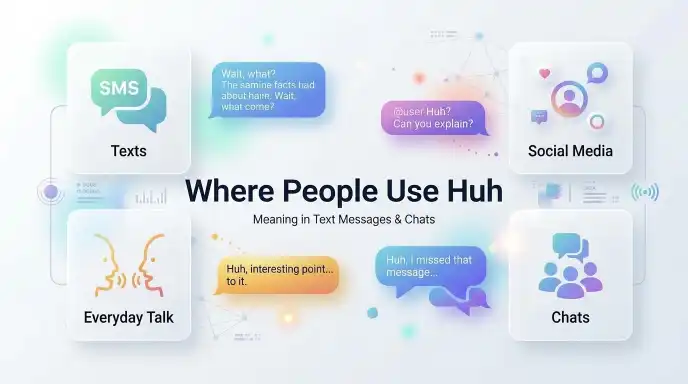
Huh can appear almost anywhere people communicate casually. It is particularly useful when someone wants to give a quick reaction without writing a complete sentence.
Huh on TikTok
On TikTok, people may use “huh” in comments when a video is confusing, unexpected, surprising, or difficult to understand.
For example:
“Huh? What did I just watch?”
Someone might also comment:
“Huh 😭”
The emoji can make the reaction feel more playful or humorous.
People may also use huh when a video has an unexpected ending or unusual joke.
Huh on Snapchat
Snapchat conversations are usually informal, so “huh” can be a natural quick response.
For example:
Friend: I might move next month.
You: Huh? Where?
Here, the sender is surprised and wants more information.
Because Snapchat messages are often short, a single word can sometimes communicate a complete reaction.
Huh on Instagram
On Instagram, “huh” may appear in DMs, comments, replies, or reactions.
Someone might reply:
“Huh? You actually went there?”
This expresses surprise.
In comments, it can also be used as a reaction to an unusual post:
“Huh 😭”
The meaning depends heavily on the post and the conversation around it.
Huh on WhatsApp
WhatsApp users commonly use “huh” when they do not understand another person’s message.
For example:
“Huh? I didn’t get you.”
It can also be used between friends as a quick way to ask for clarification.
Because WhatsApp is used for both casual and serious conversations, tone matters. A short “huh?” from a friend may be harmless, while the same response during a serious conversation could sound impatient.
Huh in SMS
Traditional SMS messages can also contain “huh.”
For example:
“Huh? You said the meeting was tomorrow.”
The sender is questioning information that seems different from what they previously heard.
There is nothing specifically social-media-related about the word. It existed in everyday communication before modern social platforms became popular.
Real Chat Examples
Here are realistic examples showing how people might use huh in different conversations.
Asking Someone to Repeat
A: Did you call Sarah yesterday?
B: Huh?
A: I said, did you call Sarah?
B: Oh, no. I forgot.
Here, “huh?” simply means “Can you repeat that?”
Confusion
A: I’m going to the new place after class.
B: Huh? Which place?
A: The café near the library.
B: Oh, that one.
The word shows that B does not understand which place A means.
Surprise
A: Mark quit his job today.
B: Huh?! Seriously?
A: Yeah, he told everyone this morning.
B: Wow, I didn’t know that.
Here, “huh?!” communicates surprise.
Unexpected News
A: We’re getting a holiday next Monday.
B: Huh? Really?
A: Yep. The school announced it today.
B: Nice!
The sender initially feels surprised by the information.
Confusing Explanation
A: You need to submit it before you submit it.
B: Huh?
A: Sorry, I explained that badly.
B: 😂 I was completely lost.
Here, “huh?” means the explanation was unclear.
Mild Disbelief
A: I finished the entire book last night.
B: Huh. That’s impressive.
A: I couldn’t put it down.
B: I might read it next.
“Huh” here is closer to “Oh, interesting.”
Playful Reaction
A: Guess who I saw at the mall?
B: Huh?
A: Your favorite actor.
B: NO WAY 😭
A: I’m serious.
The first “huh?” asks the speaker to continue.
Confusing Text
A: Meet me at the usual place.
B: Huh? We have three usual places.
A: The coffee shop downtown.
B: Got it.
The word signals that the original message was not specific enough.
Surprise About a Friend
A: Emma bought a new car.
B: Huh?! When?
A: Last weekend.
B: She never told me.
The reaction shows genuine surprise.
Casual Clarification
A: I’ll see you there at eight.
B: Huh, eight?
A: Yeah, eight in the evening.
B: Okay, got it.
The sender uses huh to double-check information.
How to Reply When Someone Says “Huh”
Your response depends on why the other person said huh. If they seem confused, explain yourself. If they are surprised, provide more details.
Funny Replies
If you’re chatting with a close friend, you can respond playfully:
- “Huh yourself 😂”
- “I said what I said.”
- “Welcome to the confusion club.”
- “You heard me the first time 😭”
- “Should I use subtitles?”
These replies work best when both people understand the joke.
Casual Replies
If the person simply wants clarification, keep your answer simple:
- “I said I’m coming later.”
- “I meant tomorrow.”
- “I was talking about the new café.”
- “Sorry, I said we’re meeting at 7.”
- “I mean the blue one.”
Friendly Replies
A friendly response can make the conversation easier:
- “Sorry, let me explain.”
- “I meant that we’re leaving early.”
- “No worries, I’ll explain.”
- “I was saying that the plan changed.”
- “Sorry, I didn’t explain that well.”
Neutral Replies
For someone you do not know well, a straightforward answer is usually appropriate:
- “I meant the meeting is at 10.”
- “I’m referring to the second option.”
- “I was asking if you had finished.”
- “I can explain what I meant.”
- “I meant next Friday.”
The best reply is usually based on context rather than the word itself.
Is Huh Rude or Offensive?
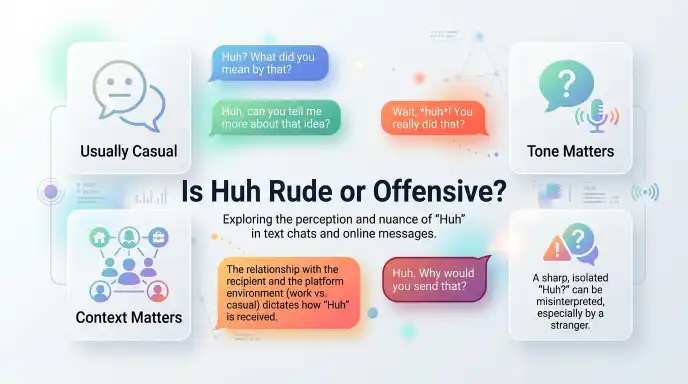
Huh is not inherently rude or offensive. It is a normal conversational expression.
However, tone can make a difference.
For example:
“Huh? What are you talking about?”
may sound irritated or dismissive.
But:
“Huh? Sorry, I didn’t hear you.”
sounds polite and simply asks the person to repeat themselves.
In text, there is no voice tone to help the reader understand your intention. As a result, a short “huh?” can sometimes be interpreted as annoyed even when that was not intended.
Is Huh Safe to Use?
Yes. In ordinary casual conversations, “huh” is generally safe.
It is especially common with friends, family members, classmates, and people you regularly message.
If you want to sound more polite, you can replace it with:
- “Sorry, what did you mean?”
- “Could you repeat that?”
- “I didn’t understand.”
- “Sorry, I didn’t catch that.”
These alternatives make your intention clearer.
Can You Use Huh at School?
In casual communication with classmates, “huh?” is generally fine.
However, when speaking to a teacher, writing an assignment, or communicating formally, a complete sentence is usually more appropriate.
Instead of:
“Huh?”
you could say:
“Sorry, could you explain that again?”
Can You Use Huh at Work?
Among coworkers who communicate casually, “huh?” may be understood without a problem.
Still, professional communication usually benefits from clearer wording.
Instead of:
“Huh? What do you mean?”
you could write:
“Could you clarify what you mean?”
That version sounds more professional and leaves less room for misunderstanding.
Who Uses This Term?
Huh is not limited to one age group. Children, teenagers, adults, and older people can all use it.
It is also not exclusive to Gen Z.
Gen Z Usage
Younger internet users may use huh in creative ways, especially alongside emojis, reaction images, or other internet expressions.
For example:
“Huh 😭”
or:
“Huh???”
The extra punctuation can make the reaction stronger.
However, using “huh” does not automatically indicate that someone belongs to Gen Z.
Common Platforms
The word can appear on:
- TikTok
- Snapchat
- Discord
- Text messages
- Online gaming chats
Its broad use comes from its connection to ordinary conversation rather than from one specific internet community.
How Often Does Huh Appear Online?
Huh is a common conversational expression, although its frequency can vary by platform and context.
People are more likely to use it in informal conversations than in formal writing.
It can also appear as part of longer expressions such as:
“Huh, that’s interesting.”
“Huh? What happened?”
“Huh?! No way.”
So, while it is a short word, it can perform several conversational functions.
Origin of the Term
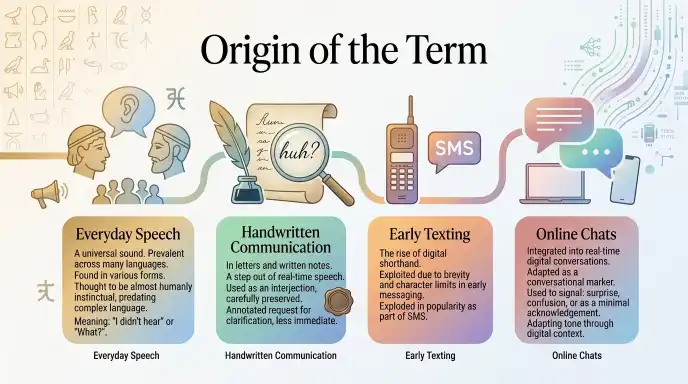
The exact historical origin of huh is difficult to connect to one specific person, website, or internet trend.
Unlike newer abbreviations created by online communities, huh is an older conversational expression associated with asking for repetition, showing confusion, or reacting to something unexpected.
It is commonly treated as an interjection or conversational response. The expression existed in spoken communication long before TikTok, Snapchat, Instagram, or smartphones.
Internet culture did not create the basic word. Instead, texting and social media gave people new ways to write and stylize the reaction.
For example, people can change the tone by using different punctuation or emojis. “Huh?” can show confusion, while “Huh?!” may express stronger surprise. A playful version such as “Huh 😭” can make the reaction feel humorous, whereas “Huh…” may suggest uncertainty or hesitation.
These variations allow written messages to communicate some of the emotion and tone that would normally be conveyed through someone’s voice.
Why Did Huh Become Common in Texting?
Short reactions work particularly well in messaging because people often communicate quickly.
Instead of typing:
“I don’t understand what you’re saying. Could you explain that again?”
someone can simply write “Huh?” The shorter version is convenient and feels natural in casual conversation.
Texting also encourages conversational writing. People often type messages in the same informal way they would speak to a friend.
Huh Compared With Other Text Abbreviations
Huh works differently from common texting abbreviations such as IDK, IDC, IMO, and BRB.
| Term | Meaning | Type | Usage | Popularity |
| Huh | What? / I don’t understand / Really? | Interjection | Confusion, surprise, clarification | Common |
| IDK | I don’t know | Acronym | Showing uncertainty or lack of knowledge | Very common |
| IDC | I don’t care | Acronym | Showing lack of concern or interest | Common |
| IMO | In my opinion | Acronym | Introducing a personal opinion | Common |
| BRB | Be right back | Acronym | Telling someone you will return soon | Common |
The biggest difference is that huh is not normally an acronym.
IDK is made from the first letters of “I don’t know.” BRB comes from “be right back.” IMO represents “in my opinion.”
Huh is already a complete conversational expression.
It also does not communicate the same idea as these abbreviations. Someone saying “huh?” is usually asking for clarification or showing confusion, while someone saying “IDK” is directly stating that they do not know.
Real-World Usage Example
Imagine two friends are talking after school.
One friend says:
“The teacher moved our presentation to Friday.”
The other friend looks surprised and responds:
“Huh? I thought it was Thursday.”
The first friend explains:
“It was Thursday, but she changed the schedule this morning.”
In this situation, “huh?” is not an insult. The friend is simply surprised because the information is different from what they expected.
A similar situation can happen at work.
Imagine a coworker sends:
“The meeting starts at 3 instead of 4.”
You might reply:
“Huh? I had 4 PM in my calendar.”
The coworker can then clarify the change.
This shows why context is important. The same word can express confusion, surprise, or a request for repetition depending on the conversation.
Frequently Asked Questions
Q1. What does huh mean in text messages?
Huh usually means “What?”, “I don’t understand,” or “Can you repeat that?” It can also show surprise or confusion.
Q2. What does huh mean on TikTok?
On TikTok, “huh” is often used as a reaction to something confusing, surprising, strange, or unexpected in a video or comment.
Q3. Is huh slang?
Huh is better described as an informal interjection rather than a texting acronym. People use it in everyday speech as well as online conversations.
Q4. Is huh rude or offensive?
Huh is not normally rude or offensive. However, “huh?” can sound impatient depending on the context, punctuation, and relationship between the people.
Q5. How should you reply huh?
If someone says “huh?” because they are confused, simply explain or repeat your message. For example, say, “I meant we’re meeting at 7.”
When Huh Has Different Meanings
One reason this short word can be confusing is that it does not always communicate the same emotion.
Consider these examples:
“Huh?”
This usually asks for clarification.
“Huh?!”
This often expresses strong surprise.
“Huh…”
This can suggest uncertainty, thought, or hesitation.
“Huh. Interesting.”
This may show that the person has just learned something new.
“Huh, I didn’t know that.”
This generally communicates mild surprise or realization.
The surrounding words provide important clues. If someone sends only “huh,” you may need to consider the previous message before deciding what they mean.
Huh in Online Conversations
Online communication removes many of the signals people normally use in face-to-face conversations.
When someone speaks, you can hear their voice and notice their facial expression. In a text message, those signals are missing.
That is why punctuation, emojis, capitalization, and extra words can change how a message feels.
Compare:
“Huh?”
with:
“Huh 😂”
The first may sound confused or serious. The second may suggest that the sender finds the situation funny.
Similarly:
“HUH?!”
looks much more dramatic than:
“huh”
Capitalization does not create a completely new definition, but it can make the emotional reaction appear stronger.
Common Misunderstandings About Huh
A common mistake is assuming that every “huh?” means the person is annoyed.
That is not necessarily true.
Someone may simply have missed your message or misunderstood what you wrote.
Another misunderstanding is thinking that huh is a modern Gen Z abbreviation. It is not. The expression has been used in spoken communication for a long time.
It is also incorrect to assume that the word always means “I don’t know.”
For example:
“Huh? Did you say Monday?”
means the person wants clarification.
Meanwhile:
“Huh. That’s interesting.”
is more like a reaction to new information.
Context determines the meaning.
When to Avoid Using Huh
Although the expression is harmless in most casual settings, there are situations where clearer wording is better.
Avoid using a very short “huh?” when communicating with someone in a formal or professional setting if there is a risk they will interpret it as dismissive.
Instead, try:
“Could you clarify that?”
or:
“Sorry, could you repeat that?”
In school, work emails, customer service conversations, applications, and formal messages, complete sentences are generally easier to understand.
With close friends, however, a simple “huh?” can be perfectly natural.
Conclusion:
Huh in text usually means “What?”, “I don’t understand,” “Can you repeat that?”, or “Really?” It is an informal interjection rather than an acronym or abbreviation.
You may see it in text messages, WhatsApp, TikTok comments, Snapchat chats, Instagram DMs, and many other online conversations.
The exact meaning depends on context and tone. “Huh?” commonly shows confusion, while “huh?!” can express strong surprise. Adding words or emojis can make the intended reaction clearer.
For casual conversations, using huh is generally fine. In school or professional communication, a clearer phrase such as “Could you explain that?” may be a better choice.