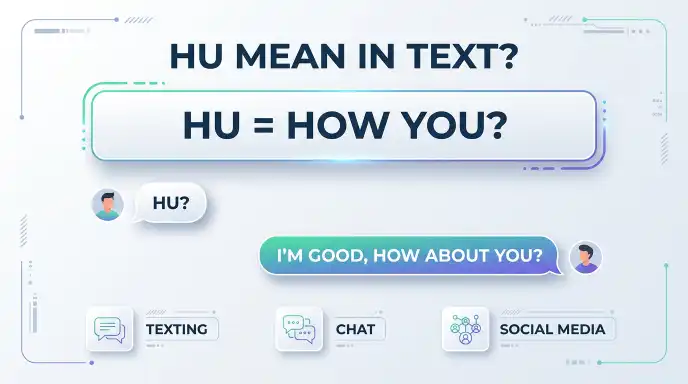
HU in text can have different meanings, but it is commonly used as a short form such as “How are you?”, “How about you?”, or “Hold up,” depending on the conversation.
You may see it in TikTok comments, Snapchat messages, Instagram DMs, WhatsApp chats, and ordinary texts.
People often search for HU meaning in text because two-letter abbreviations can be confusing. Unlike IDK or BRB, HU does not have one universally fixed meaning in casual online communication.
The best way to understand HU is to look at the words around it. For example, “I’m good, HU?” may mean “How about you?” while “HU, wait a second” can mean “Hold up.” Context usually provides the answer.
HU Meaning in Text
HU is an informal texting abbreviation whose meaning depends on how it is used. In casual messages, it can represent “How are you?”, “How about you?”, or “Hold up.” Some people may also use it as a personal shorthand for other phrases.
When HU appears after someone talks about themselves, “How about you?” is a natural interpretation.
For example:
“I’m having a great day. HU?”
Here, the sender is asking, “How about you?”
In another message, HU can suggest that the person wants you to pause.
“HU, what did you just say?”
In this case, it can mean “Hold up.”
There are also casual uses where someone types HU as a very short greeting or check-in. Because of this variation, it is better not to assume that every HU has exactly the same meaning.
Is HU Slang, an Acronym, or an Abbreviation?
HU is best described as an informal abbreviation or texting shorthand.
People use it to make digital conversations faster. It is not normally treated like a standard English word.
The exact expansion can change according to the situation. That is important because two people may use the same letters differently.
For example:
- HU? → How are you?
- I’m fine. HU? → How about you?
- HU, wait! → Hold up.
- HU me later. → Could potentially mean another phrase depending on the sender and context.
So, if you receive a message containing only HU, check the previous message before deciding what it means.
HU vs. HBU
One common source of confusion is HU versus HBU.
HBU is much more clearly associated with “How about you?”
For example:
“I’m staying home tonight. HBU?”
That clearly asks what the other person is doing.
HU can sometimes be used in the same way, but it is more ambiguous because the same two letters can represent other expressions.
Why Do People Use HU?
The main reason is speed.
Texting encourages people to shorten familiar phrases. Instead of writing a complete sentence, someone may use a couple of letters because the meaning is already obvious to the person they are talking to.
It can also make a conversation feel relaxed and informal.
However, very short abbreviations can create confusion when the other person does not know the sender’s preferred shorthand. That is why context matters so much with HU.
Where People Use HU
HU can appear across several messaging and social media platforms. The exact meaning still depends on the conversation rather than the platform alone.
HU on TikTok
On TikTok, HU may appear in comments, replies, direct messages, or private conversations.
A user might write:
“That movie was amazing. HU?”
Depending on the conversation, the sender may be asking for your opinion or returning a question.
Because TikTok comments are often extremely short, abbreviations can be difficult to interpret without reading the surrounding comments.
If someone simply comments “HU?”, it is safer to consider the context before deciding what they mean.
HU on Snapchat
Snapchat encourages quick conversations, so short forms are common.
Someone might send:
“I’m bored lol, HU?”
If the previous conversation was about how someone is feeling, HU could mean “How about you?”
A different conversation could give HU another meaning.
The disappearing-message format also encourages quick replies, which makes abbreviations useful.
HU on Instagram
On Instagram, HU may appear in DMs, comments, story replies, or group chats.
For example:
“I’m going shopping later. HU?”
Here, the person may be asking about your plans.
Instagram conversations are usually informal, so a short abbreviation can feel completely normal between friends.
HU on WhatsApp
WhatsApp users often rely on abbreviations to keep conversations quick.
For example:
A: “I’m finally home.”
B: “Nice! HU?”
If the conversation is about someone’s day, HU may be understood as “How about you?”
Another example is:
“HU, I need to tell you something.”
Here, the intended meaning may be “Hold up.”
The surrounding sentence makes the difference.
HU in SMS Texting
Traditional SMS texting is another place where HU may appear.
Friends or family members may use it when they already understand each other’s texting habits.
For example:
“Morning! HU?”
The sender may simply be checking how you are.
Still, HU is not as clear as a longer phrase. If you are communicating with someone you do not know well, write “How are you?” or “How about you?” avoids unnecessary confusion.
Real Chat Examples
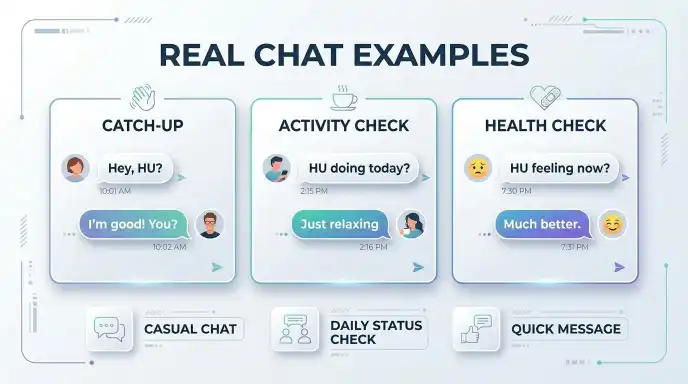
Below are realistic examples showing how HU can work in different conversations.
Checking on a Friend
A: “Hey, how have you been?”
B: “I’ve been pretty good. HU?”
A: “I’m doing great too.”
Here, HU means “How about you?”
A Short Greeting
A: “Heyyy, long time no talk!”
B: “Hey! HU?”
A: “I’m good. Just busy with work.”
Here, HU is being used as a quick way to ask how the other person is doing.
Asking Someone to Pause
A: “I’m going to send the message now.”
B: “HU! Check the name first.”
A: “Oh right, good catch.”
Here, HU can mean “Hold up.”
Talking About Plans
A: “I’m going out with my cousins tonight.”
B: “Nice. HU?”
A: “I might stay home.”
In this context, HU can work like “How about you?”
A Quick Social Media Reply
A: “This song has been stuck in my head all day.”
B: “Same 😂 HU?”
A: “Literally all day.”
The sender is returning the conversation and asking about the other person’s experience.
Asking for Clarification
A: “I think we should leave at 7.”
B: “HU, 7?”
A: “Yeah, because the place closes early.”
Here, HU can suggest “Hold up” or a request to pause and clarify.
Casual WhatsApp Chat
A: “I’m finally done with my homework.”
B: “Lucky 😭 HU?”
A: “I still have two assignments left.”
The short response asks what the other person is doing.
Instagram DM
A: “I watched that new show yesterday.”
B: “Was it good?”
A: “Yeah, I loved it. HU?”
The second HU works as “How about you?”
Snapchat Conversation
A: “Are you coming later?”
B: “HU, let me check.”
A: “Okay 😂”
Here, HU can be read as “Hold up.”
Friendly Text
A: “I’m feeling much better today.”
B: “Glad to hear that. HU?”
A: “I’m good too, just tired.”
Here, HU is a short way of returning the question.
How to Reply When Someone Says “HU”
The right reply depends on what the sender means.
If you believe HU means “How are you?” or “How about you?”, you can simply answer the question.
If it means “Hold up,” you can pause and respond to what they are asking.
Funny Replies
If the conversation is relaxed, a playful answer can work.
“HU? Still surviving 😂”
“HU? Better now that you texted.”
“Doing great. My sleep schedule disagrees.”
These replies fit casual conversations with people you know.
Casual Replies
A simple answer is usually enough.
“I’m good, you?”
“Pretty good! HU?”
“Doing okay. What about you?”
These are natural responses when the sender is checking in.
Friendly Replies
For a warmer conversation, you can add a little more detail.
“I’m doing well! I just finished work. How about you?”
“Pretty good today. What have you been up to?”
This keeps the conversation moving instead of ending it with a one-word answer.
Neutral Replies
If you are unsure about the meaning, clarification is perfectly reasonable.
“What do you mean by HU?”
Or:
“Do you mean how about you?”
A short clarification can prevent a misunderstanding.
If HU means “Hold up,” you could reply:
“Sure, what happened?”
“Okay, I’ll wait.”
“No problem. What’s up?”
Is HU Rude or Offensive?
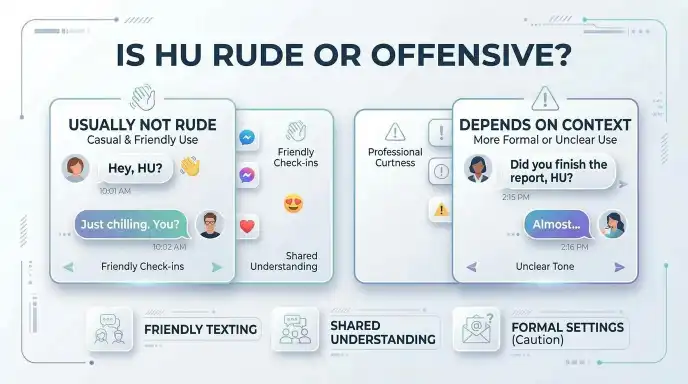
HU is not automatically rude or offensive. Its tone depends on the phrase it represents and the situation in which it is used.
When HU means “How are you?” or “How about you?”, it is generally harmless and casual.
When it means “Hold up,” it can also be completely normal. However, a very short message can sometimes sound abrupt.
For example:
“HU!”
may feel more forceful than:
“Hold up for a second!”
That difference comes from the tone and context rather than the abbreviation itself.
Is HU Safe to Use?
HU is generally fine in casual conversations when the other person understands texting shorthand.
It is less suitable when you need to communicate clearly or formally.
For example, a message to a close friend can be informal:
“HU?”
But an email to a teacher, employer, customer, or official organization should normally use complete words.
Can You Use HU at School?
Among friends, students may use HU in private chats.
For school assignments, essays, presentations, or communication with teachers, it is better to write the full phrase.
Texting shorthand belongs mainly to informal communication.
Can You Use HU at Work?
It depends on the workplace and the person you are messaging.
A casual team chat may allow abbreviations, especially among coworkers who regularly use them. Still, HU can be unclear, so complete wording is safer when the message involves important information.
Instead of:
“HU?”
you could write:
“How about you?”
Instead of:
“HU, wait.”
you could write:
“Hold on for a second.”
Clear language reduces the chance of misunderstanding.
Who Uses This Term?
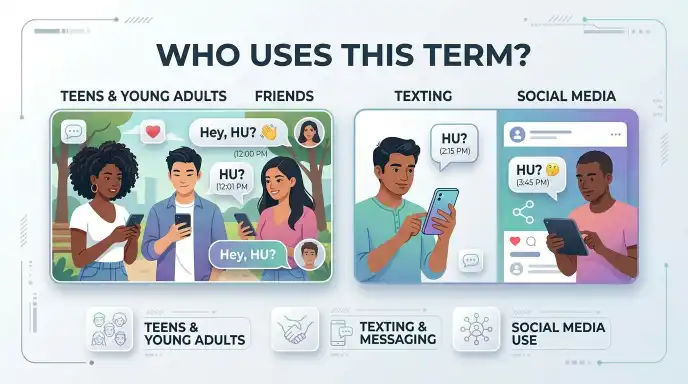
HU is mainly associated with informal digital communication.
People who spend a lot of time texting or using social media may recognize short abbreviations quickly. Younger internet users, including Gen Z, may encounter these forms in DMs, group chats, comments, and casual conversations.
However, it would be inaccurate to say that every Gen Z user regularly uses HU. Online slang varies from person to person, region to region, and platform to platform.
Gen Z Usage
Gen Z commonly communicates through fast-moving digital platforms, so abbreviations and shortened expressions are familiar parts of online communication.
That does not mean every abbreviation becomes equally popular.
Some terms such as IDK, BRB, and IMO have much clearer and more established meanings. HU is more dependent on context.
Common Platforms
You may encounter HU in:
- TikTok
- Snapchat
- SMS
- Group chats
- Online communities
- Direct messages
The meaning can change even on the same platform.
How Often Does HU Appear Online?
There is no single reliable frequency that can establish HU as one universally dominant slang term. Different communities use the abbreviation differently.
That is another reason to avoid treating HU as though it has only one official definition.
If the message seems unclear, read the conversation before interpreting it.
Origin of the Term
There is no single, clearly documented origin for every casual use of HU.
The abbreviation fits into the broader history of digital shorthand. As texting and online chat became popular, people began shortening common expressions to save time and typing effort.
Early SMS messaging encouraged compact communication. Internet chatrooms and instant messaging later made short forms even more common.
Over time, users created their own abbreviations based on familiar phrases. That helps explain why HU can have multiple interpretations today.
It is also important not to claim that one specific platform invented HU without strong evidence.
Different meanings may have developed independently because the letters can represent several common two-word phrases.
For example:
- Hold Up
- How About You is more commonly HBU, showing why abbreviation patterns vary
- How Are You is also often shortened differently, such as HRU
Because HU is so short, different communities can assign different meanings to it.
In other words, its history is better understood as part of internet and texting shorthand than as a slang term with one confirmed creator or launch date.
HU Compared With Other Texting Abbreviations
| Term | Meaning | Type | Usage | Popularity |
| HU | Context-dependent, such as “How are you?”, “How about you?”, or “Hold up” | Abbreviation | Casual texts and chats | Less standardized |
| IDK | I don’t know | Acronym | Texts, DMs, social media | Very common |
| IDC | I don’t care | Acronym | Casual online conversations | Very common |
| IMO | In my opinion | Acronym | Discussions, texts, comments | Very common |
| BRB | Be right back | Acronym | Chats and messages | Well established |
This comparison shows why HU requires more context than several familiar texting abbreviations.
If someone sends “IDK”, the meaning is usually obvious.
If someone sends “BRB”, you can normally understand that they are temporarily leaving the conversation.
With HU, you may need to read the previous message before deciding what the sender means.
Real-World Usage Example
Imagine two friends are messaging after school.
One friend writes:
“I’m going home to finish my project.”
The other replies:
“I’m going to the gym. HU?”
In this situation, the most natural interpretation is “How about you?” The second person has shared their own plan and is asking about the first person’s plan.
Now imagine a different situation.
One friend writes:
“I’m going to send the address.”
The other replies:
“HU, check if it’s the right one first.”
Here, HU is more likely being used as “Hold up.”
The same two letters appear in both conversations, but the surrounding words change the meaning.
This is the most important thing to remember about HU: context comes first.
If the sender uses HU in an unusual way, you do not need to guess. Simply asking what they mean is often the easiest solution.
Frequently Asked Questions
Q1. What does HU mean in text messages?
HU can mean different things in text messages, including “How are you?”, “How about you?”, or “Hold up.” The surrounding conversation determines the intended meaning.
Q2. What does HU mean on TikTok?
On TikTok, HU is context-dependent. It may be used as a casual abbreviation or shorthand, so check the comment, reply, or previous message to understand it correctly.
Q3. Is HU slang?
Yes. HU can be used as informal texting slang or shorthand, but it is not a single standardized slang term with one fixed meaning.
Q4. Is HU rude or offensive?
Usually, HU is not rude or offensive. It is an informal abbreviation, although a very short message can sound abrupt depending on the context and tone.
Q5. How should you reply to HU?
First, determine what the sender means. If HU means “How are you?”, you can answer with “I’m good, thanks!” If you are unsure, ask, “What do you mean by HU?”
Conclusion:
HU is a short, informal abbreviation that can have several meanings in online conversations. Depending on the context, it may mean “How are you?”, “How about you?”, or “Hold up.”
You may see it in TikTok comments, Snapchat messages, Instagram DMs, WhatsApp chats, and SMS texts. The important thing is not to assume that every HU means the same thing.
If someone says “I’m good, HU?”, they are likely asking “How about you?” If they write “HU, wait!”, they may mean “Hold up.”
For casual conversations, HU can be perfectly fine when everyone understands the shorthand. In schoolwork, professional messages, or situations where clarity matters, writing the full phrase is usually better.
When you are unsure, simply check the surrounding conversation or ask the sender. With a two-letter abbreviation like HU, context is the key to getting the meaning right.