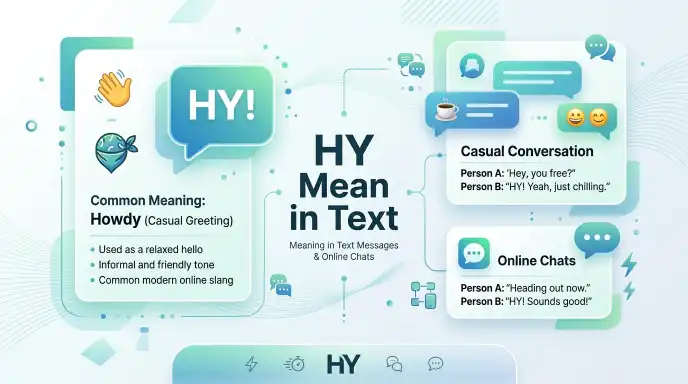
HY in text usually means “Hey” or “Hi” when used as a quick greeting. In some conversations, HY can also mean “Hell Yeah” or “Hell Yes,” showing strong agreement or excitement. The context tells you which meaning is intended.
You may see HY in TikTok comments, Snapchat messages, Instagram DMs, WhatsApp chats, and regular text messages. Because it has more than one possible meaning, a short message like “HY” can sometimes be confusing.
People often search for HY mean in text because abbreviations can change meaning depending on how they are used. If HY starts a conversation, it is usually a casual greeting. If someone sends it as an answer to a question, it may express an enthusiastic “Hell Yeah.”
HY Meaning in Text
The most common uses of HY in casual online communication are “Hey,” “Hi,” “Hell Yeah,” or “Hell Yes.” The intended meaning depends on the surrounding conversation.
When someone writes:
“HY, what are you doing?”
they are most likely using HY as a shortened, informal greeting.
But if someone asks:
“Do you want to come with us?”
and the reply is:
“HY!”
the meaning may be “Hell Yeah!” In this case, the sender is showing excitement or strong agreement.
So, HY is best understood through context rather than by the two letters alone.
HY as “Hey” or “Hi”
One common use of HY is as a very short greeting.
Someone may type:
“HY, what’s up?”
instead of:
“Hey, what’s up?”
This style is especially suited to quick and casual conversations. It can be used when someone wants to start a chat without typing a longer greeting.
For example:
A: HY
B: Hey! What’s up?
Here, HY clearly works as a greeting.
HY as “Hell Yeah” or “Hell Yes”
Another use of HY is as an enthusiastic response.
For example:
A: Want to go to the concert tonight?
B: HY!
Here, HY can mean “Hell Yeah!”
This use gives the message more energy than a simple “yes.” It can show excitement, approval, or strong agreement. Several current slang references describe this interpretation as a common use in casual online conversations.
Is HY an acronym or abbreviation?
HY is better described as texting shorthand or an abbreviation, although people may casually call it an acronym.
Unlike a standard acronym such as BRB, which has a widely established expansion, HY can have different interpretations. Its meaning depends heavily on the conversation.
That is why reading the complete message is important.
Why does context matter?
Imagine receiving:
“HY, long time no talk!”
The greeting’s meaning makes sense.
Now imagine receiving:
“Are you coming to the party?”
“HY!”
The enthusiastic meaning makes much more sense.
The same two letters can therefore communicate different things without changing their spelling.
Where People Use HY
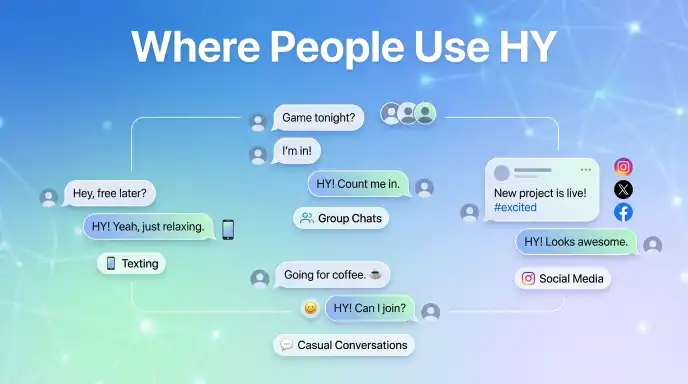
HY can appear in many casual digital conversations. Its meaning usually stays connected to the surrounding message rather than changing completely from one app to another.
You may see it in TikTok, Snapchat, Instagram, WhatsApp, and SMS.
HY on TikTok
On TikTok, people may use HY in comments or direct messages.
For example:
“HY I’m watching this 😂”
could use HY as a casual greeting.
In a different conversation:
“You really did that?”
“HY 😂”
could express an enthusiastic “Hell Yeah.”
Because TikTok comments are often short and informal, abbreviations can fit naturally into quick conversations.
HY on Snapchat
On Snapchat, messages are usually casual and fast.
Someone might send:
“hy”
as a quick way to say “hey.”
A friend could also use HY as an excited response:
“Are you coming over?”
“HY!”
The surrounding message makes the intended meaning easier to understand.
HY on Instagram
On Instagram, you may see HY in DMs, comments, or replies to Stories.
For example:
“HY, where have you been?”
uses it as a greeting.
A reply such as:
“Want to grab food later?”
“HY 😂”
can express strong agreement.
HY on WhatsApp
WhatsApp conversations often include many informal abbreviations.
Friends and family members may use HY when starting a casual chat or responding quickly.
For example:
“HY bro, you free?”
Here, it works as a greeting.
If someone asks:
“Are we still going tomorrow?”
“HY, definitely.”
the context can make the enthusiastic meaning clear.
HY in SMS
In regular SMS texting, HY may also appear as casual shorthand.
However, not everyone uses it in the same way. Some people may understand it as “Hey,” while others may read it as “Hell Yeah.”
If the meaning is unclear, looking at the rest of the message is the easiest solution.
Real Chat Examples
The following examples show how HY can work naturally in different situations.
Casual Greeting
A: HY
B: Hey! How are you?
A: I’m good. What are you doing?
Here, HY simply means “Hey” or “Hi.”
Starting a Conversation
A: HY, you still awake?
B: Yeah 😂
A: I wanted to ask you something.
The sender uses HY as a quick opener.
Strong Agreement
A: Do you want pizza tonight?
B: HY!
A: I knew you’d say yes 😂
Here, HY means something like “Hell Yeah!”
Making Plans
A: We’re going to the mall tomorrow.
B: HY, I’m coming.
A: Great, meet us at 2.
In this context, the abbreviation expresses enthusiasm.
Friendly Greeting
A: Hy, long time no see!
B: Hey! It’s been forever.
A: How have you been?
Here, HY is simply being used as a casual greeting.
Excited Reply
A: Did you hear our team won?
B: HY 😭
A: Finally!
The response shows strong excitement.
Casual Question
A: HY, are you free later?
B: Maybe. What’s up?
A: I need some help with homework.
In this example, HY functions like “Hey.”
Agreeing With a Plan
A: Movie at 8?
B: HY!
A: Perfect. I’ll get the tickets.
Here, the meaning is clearly enthusiastic agreement.
Instagram DM
A: HY 😂
B: Heyyy
A: Did you see that new post?
This is a relaxed social-media greeting.
Group Chat
A: Anyone coming to the game?
B: HY, I’m in.
A: Nice, see you there.
Here, HY is being used to express a strong yes.
How to Reply When Someone Says “HY”
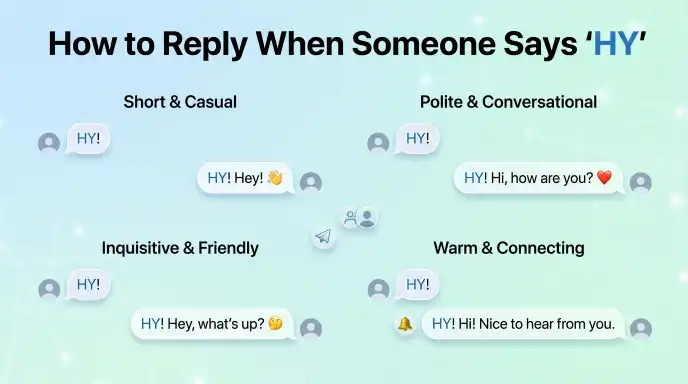
Your response depends on what HY means in the conversation.
If someone uses it as “Hey,” a normal greeting is enough. If they mean “Hell Yeah,” you can respond to the idea they are agreeing with.
Funny Replies
If the conversation is playful, you can reply with:
- “HY 😂 what’s up?”
- “Look who finally appeared!”
- “Well hello there 😂”
- “That was a very energetic HY.”
These work best with friends who understand your sense of humor.
Casual Replies
For a simple conversation, try:
- “Hey!”
- “Hey, what’s up?”
- “Hi! How are you?”
- “What’s going on?”
These are easy responses when HY is being used as a greeting.
Friendly Replies
If you want to sound warm and welcoming, you can say:
- “Hey! Good to hear from you.”
- “Hi! How have you been?”
- “Hey, what are you up to?”
- “Hey! Is everything good?”
These responses naturally keep the conversation moving.
Neutral Replies
If you are not sure what the sender means, you can keep your answer simple:
- “Hey.”
- “Hi.”
- “What’s up?”
- “Yes?”
If the meaning is still unclear, you can simply ask:
“What do you mean by HY?”
There is nothing wrong with asking. Short forms can have different meanings, so context matters.
Is HY Rude or Offensive?
HY is generally not considered rude or offensive when it is used as casual texting shorthand.
If someone uses HY to mean “Hey” or “Hi,” it is simply an informal greeting.
When HY means “Hell Yeah” or “Hell Yes,” the word “hell” makes the expression more informal and mildly profane. That does not necessarily make the message offensive, but it may not fit every situation.
Is HY safe to use?
For casual conversations with friends, HY is generally fine.
It can work well in:
- Friendly texts
- Group chats
- Social media DMs
- Casual conversations
- Informal online communities
However, abbreviations are not always appropriate in professional communication.
Can you use HY at school?
It is usually better to use complete words when messaging a teacher, professor, or school administrator.
Instead of:
“HY, I wanted to ask about the assignment.”
you could write:
“Hi, I wanted to ask about the assignment.”
The second version is clearer and more respectful in a school setting.
Can you use HY at work?
For workplace communication, it is safer to avoid ambiguous slang.
A coworker you know well may understand it, but a manager, client, or new professional contact might not.
For example, instead of:
“HY, are we meeting at 3?”
use:
“Hi, are we meeting at 3?”
Clear language reduces the chance of misunderstanding.
Who Uses This Term?
HY is mostly associated with casual digital communication, particularly short messages and social-media conversations.
You may encounter it among younger users, including Gen Z, but age alone does not determine who uses it.
Gen Z and younger users
Younger internet users often communicate through short messages, abbreviations, emojis, and informal expressions.
That makes short forms such as HY suitable for quick conversations.
Still, there is no rule saying that only Gen Z can use it.
Common platforms
The abbreviation can appear in:
- TikTok
- Snapchat
- Text messages
- Group chats
- Online communities
Its frequency can vary significantly between users and communities.
Some people use short forms constantly, while others prefer complete words.
How often does HY appear online?
HY is not as universally standardized as abbreviations such as IDK, BRB, or IMO.
That is important to remember.
Because HY has multiple possible interpretations, you should not automatically assume one meaning every time you see it.
The sentence around it is usually the best clue.
Origin of the Term
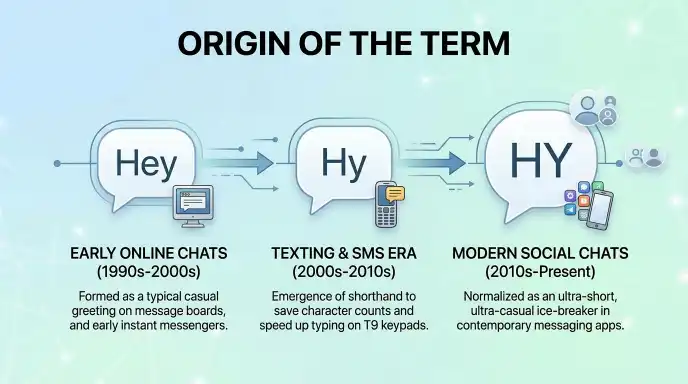
There is no single, clearly documented origin for HY as a modern texting expression.
Its use appears to come from the broader culture of shortened online communication, where people reduce words to make messages faster and more casual.
The greeting interpretation can work as a shortened form of “Hey” or “Hi,” while the enthusiastic interpretation uses the initials of “Hell Yeah” or “Hell Yes.” Current slang references consistently describe these as context-dependent uses rather than pointing to one specific creator or launch date.
Internet culture and short messages
Online conversations encourage people to communicate quickly.
That is why many expressions have developed shortened versions. Instead of writing a complete phrase, people may use two or three letters when the meaning is already understood by the people involved.
HY fits this style.
Its short form can make a message feel relaxed, quick, and conversational.
Why the origin is uncertain
Unlike some famous internet abbreviations, HY does not have one universally accepted origin story.
Different communities can also create their own meanings for the same letters.
Therefore, it is better to focus on how HY is used today rather than claiming a specific person or platform invented it.
HY Compared With Other Text Abbreviations
The following table compares HY with several familiar texting abbreviations.
| Term | Meaning | Type | Usage | Popularity |
| HY | Hey/Hi or Hell Yeah/Hell Yes | Abbreviation | Casual greetings and enthusiastic replies | Common in some online chats |
| IDK | I Don’t Know | Abbreviation | Showing uncertainty or lack of knowledge | Very common |
| IDC | I Don’t Care | Abbreviation | Showing indifference | Very common |
| IMO | In My Opinion | Abbreviation | Introducing a personal opinion | Common |
| BRB | Be Right Back | Abbreviation | Telling someone you will return soon | Common |
One key difference is that HY has more than one common interpretation, while abbreviations such as IDK and BRB are generally easier to interpret.
For example:
“IDK what happened.”
almost always means “I don’t know what happened.”
But:
“HY”
requires more context.
That is why the message before or after HY can be especially useful.
Real-World Usage Example
Imagine two friends are making plans for the weekend.
One friend sends:
“HY, are you free Saturday?”
The other responds:
“Yeah, why?”
Here, HY works as a casual “Hey.”
The first friend then says:
“Want to go to the movies?”
The second friend replies:
“HY! I’ve been wanting to see that new one.”
In the second message, HY can mean “Hell Yeah!” because it expresses strong excitement.
This example shows why context is so important. The same abbreviation can appear twice in the same conversation while carrying slightly different meanings.
If you receive HY and are unsure, look at what comes immediately before and after it. Usually, the intended meaning becomes clear.
Frequently Asked Questions
Q1. What does HY mean in text messages?
HY usually means “Hey” or “Hi” as a casual greeting. In some contexts, it means “Hell Yeah” or “Hell Yes” to show strong agreement or excitement.
Q2. What does HY mean on TikTok?
On TikTok, HY can mean “Hey” as a greeting or “Hell Yeah” as an enthusiastic response. The surrounding comment or conversation provides the clue.
Q3. Is HY slang?
Yes, HY can be considered casual texting slang or shorthand. It is mainly used in informal digital conversations rather than formal writing.
Q4. Is HY rude or offensive?
Usually, HY is not rude or offensive. However, when it means “Hell Yeah” or “Hell Yes,” it contains informal language that may not be suitable for formal school or workplace communication.
Q5. How should you reply to HY?
If HY means “Hey,” you can reply with “Hey!”, “Hi!”, or “What’s up?” If it means “Hell Yeah,” respond naturally to the question or statement being discussed.
Conclusion:
HY in text can have more than one meaning, but the two common interpretations are “Hey/Hi” and “Hell Yeah/Hell Yes.” The surrounding conversation usually tells you which meaning the sender intended.
You may see HY in TikTok comments, Snapchat, Instagram DMs, WhatsApp messages, and regular texts. It works best in relaxed conversations where short forms and slang are already common.
For formal school, workplace, or professional messages, complete words are usually clearer. If you receive HY and cannot tell what the person means, simply check the context or ask them.
In short, HY is a small abbreviation with a meaning that depends heavily on how it is used.