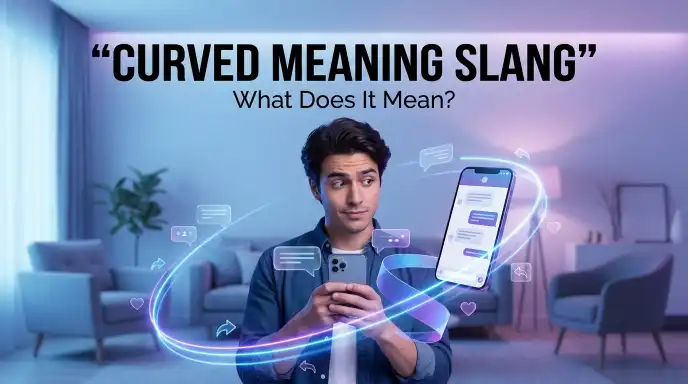
If someone told you they “got curved” and you had no idea what that meant, you’re not alone. Curved meaning slang is one of those terms that shows up constantly in texts and comments but rarely gets explained clearly.
In simple terms, to be curved means to be rejected, ignored, or turned down, usually in a romantic or flirty situation, without the other person ever saying a plain “no.”
People search for curved meaning slang because they either got curved themselves and want to know what just happened, or they saw the word used online and felt lost. This guide breaks down exactly what curved means, where it comes from, how it’s used on different apps, and when you should avoid saying it yourself.
Quick Answer: What Does Curved Mean in Slang?
Curved means being rejected or ignored, usually in a dating or flirting situation, without a direct “no.” Instead of saying they’re not interested, the other person avoids, dodges, or gives vague responses. If someone says “I got curved,” it means their romantic interest was quietly turned down.
What Does the Slang Word “Curved” Actually Mean?
The word “curved” comes from the regular English word curve, which describes a bending or turning line instead of a straight one. In slang, that idea gets applied to people: instead of moving straight toward someone’s romantic interest, the other person “curves away” from it.
So when someone gets curved, they don’t get an honest rejection. They get avoided instead. That could look like:
- Getting left on read after a flirty text
- Being met with one-word replies that go nowhere
- Watching someone change the subject every time things get personal
- Being introduced to “just be friends” out of nowhere
The core idea stays the same across all of these: someone is being turned down without hearing the word “no.”
Does “Curved” Have More Than One Meaning?
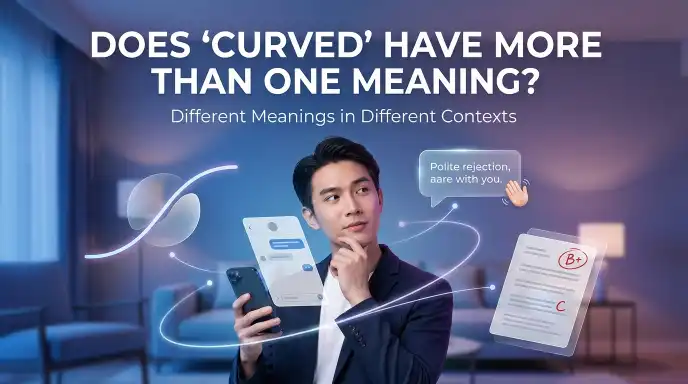
Yes, and it’s worth separating these clearly so there’s no confusion.
Meaning 1: Romantic or dating rejection (the common slang use)
This is the meaning almost everyone means when they use curved meaning slang online. It describes being indirectly rejected by someone you were interested in.
Meaning 2: General dictionary use for “to reject emphatically”
Standard American dictionaries also list a broader use of “curve” as a verb meaning to reject a person firmly. This overlaps with the slang meaning but isn’t limited to romance; it can describe any situation where someone is turned down.
Meaning 3: Unrelated technical uses
Outside of slang, “curve” also shows up in completely different contexts, like grading a test “on a curve,” a “learning curve,” or a curved object or shape. These have nothing to do with rejection, and readers searching for slang meaning should know the two are unrelated so there’s no mix-up.
This article focuses on Meaning 1, since that’s the one behind curved meaning slang searches.
Where Is “Curved” Commonly Used?
Curved is mostly a texting and social media word. It shows up wherever people talk about dating, DMs, and modern romance.
| Platform | How “Curved” Is Used |
| Texting | Describing slow replies or vague answers after showing interest |
| TikTok | Storytime videos and comment sections about being turned down |
| Comments on flirty posts, or DM screenshots shared as jokes | |
| Discord | Casual chat between friends recapping a dating situation |
| Relationship or dating advice threads asking “was I curved?” | |
| Workplace chat | Almost never used; it reads as too casual and personal for work |
Curved lives comfortably in casual, personal spaces. It doesn’t really belong in formal writing or professional messaging.
Is “Curved” Rude, Offensive, or Harmless?
Curved isn’t offensive, and it isn’t a slur or an insult aimed at a group. It’s a casual, everyday word that describes a social situation, similar to saying someone was “ghosted.”
That said, tone matters. Saying “I got curved” about yourself is usually lighthearted, even self-deprecating. Saying “she curved him so hard” about someone else can feel a little mocking, especially if it’s said publicly or to embarrass someone. The word itself is harmless; how it’s used toward another person is what can come across as unkind.
Real-Life Examples of “Curved” in Use
Texting:
“I asked him if he wanted to hang out this weekend and he just said ‘maybe, we’ll see.’ I think I got curved.”
TikTok comment:
“The way she left him on read for three days after that compliment… he got curved and doesn’t even know it yet.”
Discord chat between friends:
“bro I tried shooting my shot in the group chat and she just changed the subject lol. curved.”
Reddit dating thread:
“Is this a curve or is she just busy? He texted me twice this week but never asked to actually meet up.”
Notice that none of these examples involve someone being told “no” directly. That indirectness is the whole point of the word.
Where Does “Curved” Come From?
Curved meaning slang has roots in Black and hip-hop culture rather than being generic, unattached internet slang, and it deserves to be credited that way instead of treated as if it appeared out of nowhere.
Early slang use of “curve” traces back to Black vernacular speech, where it was used around the 2000s to mean leaving or getting away from someone or something, similar to saying “peace out.” By around 2009, that usage had shifted toward describing the act of avoiding or getting away from a person specifically. From there, as dating moved heavily onto texting and dating apps in the mid-2010s, “curve” narrowed further into the dating-rejection meaning that’s common today.
It’s worth being honest here: exact dates and the very first recorded use are hard to pin down precisely, and different sources describe the timeline slightly differently. What’s consistent across sources is the general path: general slang for leaving or dodging someone, narrowing over time into a dating-specific term for indirect rejection.
Is “Curved” Fading or Still Popular?
Curved is still active and widely understood as of now, especially among Gen Z and younger millennials. It hasn’t reached “cringe” or outdated status the way some older slang has. It sits comfortably alongside newer dating terms like ghosting, breadcrumbing, and benching, and people continue using it in everyday texting and social media without it sounding dated.
Similar Slang or Related Terms
Curved isn’t the only word people use to describe messy modern dating situations. A few related terms:
- Ghosted – Someone disappears completely and stops replying altogether
- Breadcrumbing – Someone gives just enough attention to keep you interested, without real commitment
- Benched – Someone keeps you as a backup option while pursuing others
- Left on read – A message is seen but never answered
- Friendzoned – Romantic interest is redirected into a platonic friendship
Curved overlaps with all of these, but its defining feature is the avoidance. The other person doesn’t vanish (that’s ghosting) or string you along for weeks (that’s breadcrumbing); they simply steer things away from where you wanted them to go.
When Should You Avoid Using “Curved”?
Curved works fine in casual conversation, but there are situations where it doesn’t fit:
- At work or in professional messages – It’s too informal and personal for workplace chat or emails.
- With teachers or in school assignments – It reads as slang, not appropriate for formal writing.
- When talking to parents who may not know the term – It might just cause confusion rather than clear communication.
- When the situation is more serious than a casual dating dodge – If someone was actually treated badly (manipulated, lied to, or hurt), softer slang like “curved” can undersell what really happened.
If clarity matters more than sounding casual, it’s better to just describe the situation plainly.
Polite or Clearer Alternatives
If curved feels too slangy for the setting, these work as clearer substitutes:
- “They weren’t interested, but didn’t say it directly.”
- “I got turned down without a clear answer.”
- “They avoided giving me a straight response.”
- “It didn’t work out; they kept dodging the topic.”
Why Do People Use “Curved” Instead of Saying “Rejected”?
Part of the appeal of curved meaning slang is that it softens an awkward experience. Saying “I got rejected” can feel blunt and a little painful to admit. Saying “I got curved” carries the same meaning but with a lighter, almost joking tone that makes it easier to talk about, especially with friends or online.
It also fits the way modern dating actually works. Direct rejection is rare online; people usually just fade out or go quiet instead of saying “no.” Curved gives that specific, common experience its own name.
Common Misunderstandings About “Curved”
Misunderstanding 1: Curved always means someone was ignored completely.
Not quite. Curving can include continued, low-effort contact, not just silence. Someone can still text back occasionally while clearly avoiding commitment. That’s still considered curving.
Misunderstanding 2: Curved only applies to texting.
While texting is the most common setting, curving can happen in person too, for example, someone giving vague, distracted answers on a date instead of texts.
Misunderstanding 3:Being curved always means the person dislikes you.
Not necessarily true. Someone might curve another person simply because the timing is wrong, not because of dislike. The word describes the behavior (avoidant rejection), not the exact reason behind it.
Misunderstanding 4:Curving and a hard “no” are the same thing.
They’re not. A hard “no” is direct and clear, even if it stings. Curving is deliberately unclear. That’s actually why people find it more frustrating than a plain rejection: there’s no closure, just a slow fade that leaves you guessing.
Curving vs. a Direct Rejection: What’s the Real Difference?
It helps to see the two side by side, since people sometimes use them interchangeably even though they describe different experiences.
| Situation | Direct Rejection | Curving |
| Clarity | Clear “no” is stated | No clear answer is given |
| Communication | Usually still responsive | Responses become vague or slow |
| Emotional impact | Can sting but gives closure | Often more confusing and drawn out |
| Common phrasing | “I’m not interested” | “Maybe,” “we’ll see,” or no reply |
A direct rejection, even a blunt one, at least ends the guessing. Curving stretches it out, which is part of why so many people find it more annoying than an honest “no.”
Frequently Asked Questions
Q1: What does “I got curved” mean?
It means someone was rejected or ignored, usually after showing romantic interest, without hearing a direct “no.”
Q2: Is “curved” the same as being ghosted?
No. Ghosting means someone disappears and stops responding entirely. Curving usually still involves some contact, just vague, avoidant, or non-committal responses.
Q3: Is it rude to say someone “curved” you?
No, describing your own experience as being curved is generally seen as casual and harmless. It can feel a bit mocking if used publicly about someone else, so tone matters.
Q4: Can I use “curved” at work or with teachers?
It’s best avoided in professional or academic settings since it’s informal slang, not appropriate for formal communication.
Q5: Where did the word “curved” come from?
It developed from Black slang usage around the 2000s meaning to leave or get away from someone, later narrowing into a dating-specific term for indirect rejection by the mid-2010s.
Q6: Is “curved” only used for romantic rejection?
In everyday slang, yes, that’s the common meaning. Outside of slang, “curve” also appears in unrelated contexts like grading, but those uses aren’t connected to the dating meaning.
Conclusion:
Curved meaning slang describes a very specific, very common modern experience: being turned down without ever hearing a direct “no.” Instead, the rejection comes through vague replies, sudden distance, or a quiet redirect away from romance.
It’s not an offensive term, just a casual way people describe the awkward, indirect side of dating and texting today.
Whether you’re figuring out if you got curved or just trying to keep up with how people talk online, the meaning comes down to one simple idea: someone steered away from you instead of saying no.

I’m Emily Carter, and I enjoy writing about slang, internet language, and modern English expressions. My goal is to explain word meanings in a simple, clear, and easy-to-understand way so anyone can learn with confidence.