If a friend cancelled on you at the last minute again, you might have heard someone call them a “flake.” Flake meaning slang describes a person who backs out of plans, cancels commitments, or just doesn’t show up, usually without a good reason. It can also describe the action itself, as in “he flaked on me.”
People search for flake meaning slang after being let down by someone, after seeing the word used online, or because they want to know if it’s an insult before using it themselves. This guide explains exactly what flake means, where the word comes from, its other meanings, and how to use it (or avoid it) the right way.
Quick Answer: What Does “Flake” Mean in Slang?
Flake (slang) describes someone who is unreliable and often cancels plans at the last minute, or fails to show up at all. As a verb, “to flake” or “flake out” means to back out of a commitment without following through. It’s commonly used to describe both a person’s personality and a specific action.
What Does “Flake” Actually Mean?
At its core, flake meaning slang comes from the idea of something breaking off and detaching, like a flake of paint peeling away from a wall. Applied to people, it captures the same feeling: someone detaches themselves from a plan they already agreed to.
Two related forms show up constantly:
- “He’s such a flake” – describes someone’s personality as unreliable
- “She flaked on me” or “She flaked out” – describes the specific act of cancelling or bailing
Both point to the same core idea: saying yes to something and then not following through, often at the last possible moment.
Does “Flake” Have More Than One Meaning?
Yes, and it’s important to separate these clearly, since mixing them up causes real confusion.
Meaning 1: Unreliable person who cancels plans (the most common slang use today)
This is what almost everyone means by flake meaning slang in everyday conversation. It describes someone who agrees to plans and then backs out, often repeatedly.
Meaning 2: An eccentric or “odd” person (older slang)
Before it meant “unreliable,” flake was used, particularly in American baseball slang from the mid-20th century, to describe someone quirky, unpredictable, or a little strange, without necessarily meaning dishonest. This meaning still exists but is far less common now than the “cancels plans” meaning.
Meaning 3: Slang for cocaine (older, separate, and much less common)
Flake has also been used historically as street slang for cocaine, dating back roughly to the 1920s. This meaning is unrelated to cancelling plans or being eccentric, and it’s largely dated and regional rather than something people commonly say today. It’s worth knowing this meaning exists so context isn’t misread, but it isn’t the meaning behind most modern flake meaning slang searches.
This guide focuses mainly on Meaning 1, since that’s what almost everyone is asking about.
Where Is “Flake” Commonly Used?
Flake is an everyday, casual word. It shows up in texting, friend groups, dating conversations, and social media whenever someone talks about unreliable people or last-minute cancellations.
| Platform | How “Flake” Is Used |
| Texting | “Sorry, I have to flake tonight, something came up.” |
| TikTok | Storytime or rant videos about friends who always cancel |
| Captions or comments joking about being “a certified flake” | |
| Discord | Friend groups calling out someone who keeps skipping calls |
| Advice threads asking how to deal with a friend who flakes often | |
| Workplace chat | Rare, but can appear informally between coworkers about social plans, not formal work tasks |
Flake fits naturally into casual conversation about plans, friendships, and dating, but it’s not a word used to describe someone missing a work deadline or failing a job responsibility.
Is “Flake” Rude, Offensive, or Harmless?
Flake is not offensive in the sense of being a slur, but it is a criticism. Calling someone a flake points directly at their reliability and character, so it can sting if said seriously or repeatedly.
Used lightly among friends, it’s often more teasing than harsh, for example, joking “don’t be a flake” to someone who’s late replying
. Used with real frustration, especially about someone who repeatedly cancels or lets people down, it reads as a genuine complaint about their behavior. The tone depends heavily on the relationship and the situation, not the word itself.
Real-Life Examples of “Flake” in Use
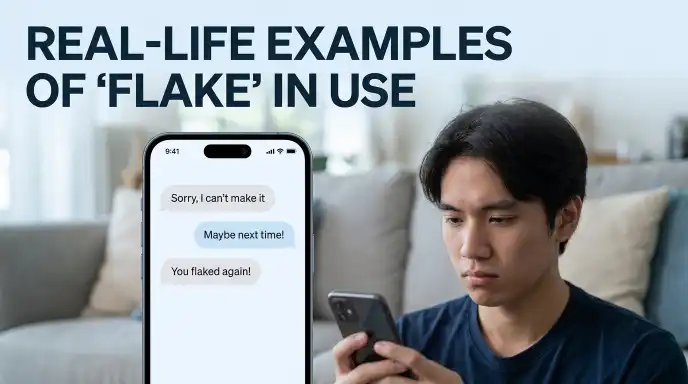
Texting:
“I know we said 7pm, but I’m exhausted. Can we push it? Sorry to flake like this.”
TikTok comment:
“POV: your friend flakes on plans for the third time this month and says ‘something came up’ again.”
Discord chat between friends:
“bro keeps saying he’ll join the game night and then just goes offline. certified flake behavior.”
Reddit advice thread:
“My roommate flaked on splitting rent plans for the trip and now I’m stuck covering it. How do you deal with a flaky friend without cutting them off completely?”
Workplace-adjacent, casual context:
“A few of us were going to grab lunch, but half the team flaked once it started raining.”
Notice that in almost every example, the word is tied to a specific broken plan, not a permanent judgment about someone’s whole character, even though repeated flaking can shape that reputation over time.
Where Does “Flake” Come From?
Flake meaning slang has a longer and more layered history than most modern internet slang. The base word “flake” is old, dating back centuries as a term for a small, thin piece that breaks off something larger, like a snowflake or a flake of paint.
The slang jump to describing people came in stages. Around the late 1950s, “flaky” was used in American baseball slang to describe an eccentric or unpredictable player, and “flake” as a noun for that kind of person followed shortly after. Separately, “flake” was also used earlier, around the 1920s, as street slang for cocaine, a meaning that exists on its own track and isn’t connected to personality or reliability.
The specific meaning most people search for today, someone who cancels plans or fails to follow through, became the dominant everyday use later, especially from the 1990s onward, and it’s the meaning that has stuck as the word spread through texting and social media. Sources describe this evolution slightly differently in terms of exact dates, so it’s fair to say the general path is clearer than the precise year the “cancels plans” meaning took over.
Is “Flake” Fading or Still Popular?
Flake meaning slang is still very much active and widely understood today. Unlike some slang that fades after a few years, “flake” and “flaky” have stayed consistent in casual English for decades, and they show no signs of sounding dated. If anything, the word has become more visible recently through relationship and friendship content on TikTok and Instagram, where “flaky friends” and “flaky texting” are common discussion topics.
Similar Slang or Related Terms
A few other words describe similar unreliable behavior, though each has its own shade of meaning:
- Ghosted – Someone disappears completely and stops responding, rather than cancelling a specific plan
- Bailed – Very close to flaking; means backing out of plans, often used interchangeably
- Left on read – A message is seen but not answered, which can be a sign someone is about to flake
- Canceled last minute – The plain, non-slang way of describing the same behavior
- Unreliable – The straightforward personality description behind the word “flaky”
Flake and “bailed” overlap the most closely, though “flake” more often implies a pattern of behavior, not just a one-time cancellation.
When Should You Avoid Using “Flake”?
Flake works fine casually, but a few situations call for more care:
- Formal work communication – Calling a coworker a “flake” in an email or meeting sounds unprofessional; describe the specific issue instead (missed deadlines, no-shows).
- With teachers or in schoolwork – It’s slang, not suited for formal writing or academic contexts.
- Serious relationship or trust issues – If someone’s cancellations reflect a deeper problem, like disrespect or unreliability that’s genuinely hurting you, a joking word like “flake” can undersell how serious the pattern actually is.
- As a permanent label after one mistake – Calling someone a flake after a single cancellation, especially for a real reason, can feel unfair and overly harsh.
Polite or Clearer Alternatives
If flake feels too casual or blunt for the setting, these phrases work as clearer substitutes:
- “They’ve cancelled on me a few times without much notice.”
- “I can’t always count on them to follow through on plans.”
- “They tend to back out at the last minute.”
- “Our plans keep falling through.”
Why Do People Use “Flake” Instead of Just Saying “Unreliable”?
Flake meaning slang packs a lot into one short word. Instead of explaining “this person agrees to things and then cancels, often at the last minute, without much explanation,” people can just say “flake” and be instantly understood. It’s short, familiar, and slightly informal, which fits the casual tone of texting and social media much better than a longer, more formal description would.
It also carries a bit of personality. Calling someone “unreliable” sounds clinical. Calling them “a flake” feels more like something you’d actually say to a friend while venting about your weekend plans falling apart.
Common Misunderstandings About “Flake”
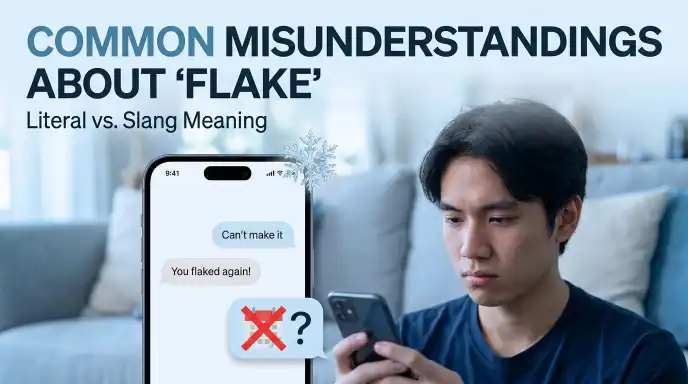
Flaking always means someone doesn’t care about you.
Not necessarily. Sometimes flaking comes from anxiety, overcommitting, or genuine last-minute problems, not a lack of care. Repeated flaking is a stronger signal than a single instance.
“Flake” always refers to cancelling in-person plans.
While that’s the most common use, people also use it for skipped calls, missed online meetups, or backing out of group projects, not just face-to-face hangouts.
Being called a flake once means you’re labeled forever.
One cancellation for a legitimate reason doesn’t usually earn someone that label. The word tends to apply once a pattern shows up, not after a single missed plan.
All meanings of “flake” are related.
As covered earlier, the “cancels plans” meaning, the “eccentric person” meaning, and the older drug-slang meaning developed separately. Hearing the word doesn’t automatically point to one specific meaning without context.
“Flake” vs. “Bailed”: What’s the Real Difference?
These two get used almost interchangeably, but there’s a subtle difference worth knowing.
| Situation | Flake | Bailed |
| Pattern | Often implies repeated behavior | Can describe a single event |
| Personality label | Yes, “a flake” describes a person | No common noun form (“a bailer” isn’t standard) |
| Common phrasing | “He’s such a flake” | “He bailed on me last night” |
| Tone | Slightly more judgmental over time | More neutral, situational |
In short, “bailed” usually describes what happened once. “Flake” more often describes a person’s ongoing habit.
Frequently Asked Questions
Q1: What does it mean when someone says you’re “flaking”?
It means you’re backing out of plans or failing to follow through on something you agreed to, usually at the last minute.
Q2: Is calling someone a “flake” rude?
It can be, depending on tone. Said jokingly among friends it’s usually light. Said seriously and repeatedly, it reads as a real criticism of someone’s reliability.
Q3: Is “flake” the same as ghosting?
No. Ghosting means someone disappears completely and stops responding. Flaking usually involves cancelling a specific plan, even if the person is still reachable afterward.
Q4: Can I use “flake” at work?
It’s best avoided in formal work communication. Describing the specific issue (missed deadlines, no-shows) sounds more professional than calling someone “a flake.”
Q5: Where did the word “flake” come from?
The base word is centuries old, describing a small piece that breaks off something larger. The “unreliable person” slang meaning developed later, building on earlier 20th-century American slang uses like “flaky” for eccentric and, separately, “flake” as old slang for cocaine.
Q6: Does “flake” always mean the same thing?
No. It can describe someone who cancels plans, an eccentric personality (older use), or, in a much older and unrelated slang sense, cocaine. Context makes clear which meaning applies.
Conclusion:
Flake meaning slang mostly comes down to one everyday frustration: someone agrees to something and then backs out, often at the last minute. Whether it’s used as “he’s a flake” or “she flaked on me,” the word captures that specific feeling of plans falling apart because someone didn’t follow through.
It’s not a harsh insult by default, but it does say something real about reliability, so it’s worth using with the same care you’d want if someone used it about you.