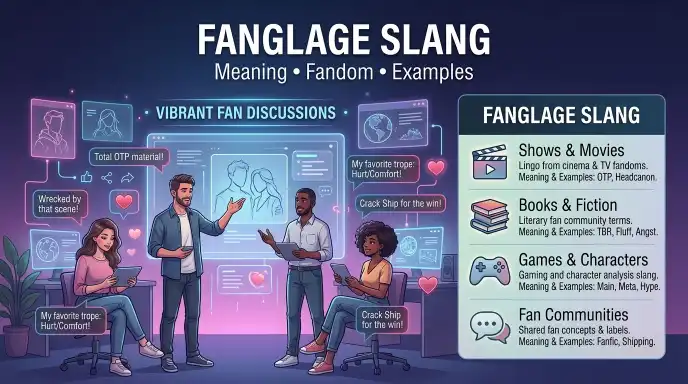
Fanglage slang refers to the special language, words, and expressions used by fans when discussing their favorite shows, movies, books, games, characters, or fictional worlds. It is closely related to fanspeak, fandom slang, and fandom jargon.
These terms can help fans communicate ideas quickly and understand shared references. However, they may seem confusing to people outside the community. In this article, you’ll learn what language means, how it is used, common examples, and how it differs from other types of fandom language.
Fanglage slang means the special language fans use when communicating within a fandom. It can include slang, jargon, abbreviations, inside jokes, and terms such as canon, headcanon, ship, OTP, and AU. Fanglage is closely related to fanspeak and fandom language.
Quick Answer: What Does Fanglage Slang Mean?
Fanglage slang means the special language fans use when talking with others in a fandom. It can include slang, abbreviations, jargon, and expressions that are easy for fans to understand but may confuse people outside the community.
Terms such as “canon,” “headcanon,” “ship,” “OTP,” and “AU” are common examples of fandom vocabulary. Fanglage is closely related to the term “fanspeak,” which describes the specialized language used within fan communities.
The exact words can vary from one fandom to another, depending on its characters, stories, and community culture.
What Does Fanglage Mean?
Fanglage is a term for the language used by people who belong to a fan community. It can include special words, short forms, slang, and expressions that fans understand through shared interests.
For example, fans of a TV show may use words related to its characters, storylines, relationships, or fictional world. A book fandom may have its own terms for characters, theories, and fan-created stories. These words make conversations easier because fans already understand the context.
Fanglage is not limited to one type of fandom. It can appear in communities built around movies, television, books, anime, music, video games, and other forms of popular culture. The vocabulary can also change from one fandom to another.
In simple terms, fanglage is the shared language that helps fans communicate with other fans.
Fanglage in Simple Words
Fanglage is simply the special way fans talk about the things they love. Fans may use certain words or phrases that have a clear meaning inside their community but may not make sense to someone unfamiliar with the fandom.
For example, fans might talk about a “ship” when discussing a relationship between two characters. They may use “headcanon” for a personal idea about a character or story. These terms make fan conversations shorter and easier.
Fanglage can also include abbreviations, jokes, references, and community-specific expressions. Some words are common across many fandoms, while others develop within one particular fan community.
So, when you see the word “fanglage,” think of it as the shared language of fans.
Is Fanglage a Slang Word?
Fanglage is best understood as a niche fandom term rather than common everyday slang. It describes the special words, phrases, and expressions that fans use when communicating within a fandom. These expressions can include slang, abbreviations, jargon, and other community-specific vocabulary.
The word itself may not be familiar to most people. However, the type of language it describes is common in many online fan communities. Fans often create or adopt terms that make it easier to discuss characters, relationships, stories, theories, and fan-created works.
Fanglage is also closely connected with “fanspeak,” a term used for specialized language and vocabulary found in fandom. Some of these terms are widely used across different fan communities, while others are meaningful only within a specific fandom.
So, calling fanglage “slang” is useful for a simple explanation, but fanglage is broader than slang alone.
What Is Fanspeak?
Fanspeak is the specialized language used by fans when they communicate within a fandom. It can include words, abbreviations, phrases, and expressions that have a particular meaning among fans. The term is closely related to phalange and is often used to describe the vocabulary of fan communities.
Fanspeak can make conversations easier because people who share the same interest already understand the terms. For example, fans may use words such as “canon,” “headcanon,” “ship,” or “AU” without explaining them each time.
Not all fanspeak is the same. Some terms are common across many fandoms, while others are created or used mainly within one community. A term may also develop a special meaning because of a particular show, book, game, character, or fan community.
In this way, fanspeak works as a shared vocabulary that helps fans discuss stories, characters, relationships, theories, and fan-created content.
Fanglage vs Fanspeak
Fanglage and fanspeak are closely related terms. Both describe the special language and vocabulary used by people within fan communities. This language can include slang, abbreviations, jargon, and expressions that make sense to fans who share the same interests.
The main difference is the word being used to describe the idea. “Fanspeak” is a more familiar term for specialized language used in fandom, while “fanglage” is a less common term for the same general concept.
For example, words such as “canon,” “headcanon,” “ship,” and “OTP” can be part of fanspeak. They can also be considered examples of the broader language that language describes.
In simple terms, fanglage and fanspeak can refer to the shared language of a fandom. The specific vocabulary can change depending on the community, topic, and type of fan culture involved.
Fanglage vs Fandom Jargon
Fanglage and fandom jargon are closely connected because both describe specialized language used by fan communities. Fandom jargon includes words and expressions that fans understand because they share knowledge about a particular show, book, game, artist, or fictional world.
Fanglage is a broader way to describe the language fans use with one another. It can include jargon, but it may also contain slang, abbreviations, inside jokes, and community-specific expressions.
For example, “canon” is a fandom term used to describe information that is officially part of a story. “Headcanon” describes a fan’s personal idea or interpretation that may not be officially confirmed. Both can appear in fandom conversations as part of the language fans share.
The key point is that not every part of finagle is necessarily slang. Some terms are descriptive or technical, while others are informal. Their meaning often depends on the fandom and the context in which they are used.
Fanglage vs Fandom Slang
Fanglage and fandom slang overlap, but they are not exactly the same thing. Fandom slang refers to informal words and expressions that fans use within a particular community. Fanglage is a broader term for the language fans use to communicate with other fans.
This means fanglage can include fandom slang, but it can also include abbreviations, jargon, technical terms, inside jokes, and shared references. For example, “ship” is an informal fandom term used when fans discuss a relationship they support between characters.
Some fandom slang is understood across many communities, while other expressions may only make sense to fans of one specific series or game. The meaning can also change depending on the community.
In simple terms, fandom slang is one part of fanglage. Fanglage covers the wider collection of language that helps fans communicate, understand each other, and discuss their shared interests.
What Types of Words Are Part of Fanglage?
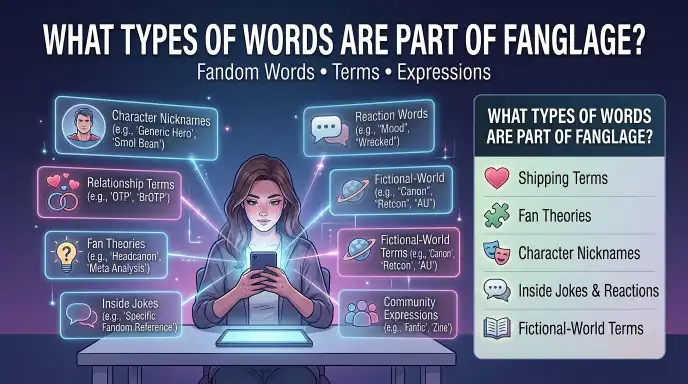
Fanglage can include many different types of words and expressions. Some are simple slang terms, while others are abbreviations, fandom jargon, or phrases created by a specific fan community.
Fandom Slang
These are informal words that fans use when discussing characters, stories, relationships, or other fandom topics. Their meaning may be easy for experienced fans to understand but unclear to outsiders.
Fandom Abbreviations
Fans often shorten long phrases to make online conversations faster. These abbreviations are especially common in posts, comments, chats, and fan forums.
Fandom Jargon
Jargon consists of specialized terms connected to fandom culture. Words such as “canon” and “headcanon” can help fans describe story details or personal interpretations without lengthy explanations.
Shipping Terms
Fans use specific vocabulary when discussing relationships between characters. Terms such as “ship” and “OTP” can quickly communicate a fan’s preferred pairing.
Fanfiction Terms
Fanfiction communities have their own vocabulary for describing stories, characters, settings, and alternative versions of existing fictional worlds.
Fanart Terms
Fan artists and their audiences may also use specialized expressions when discussing characters, pairings, styles, and fan-created artwork.
Community-Specific Expressions
Some fanflage develops inside one particular fandom. These expressions may refer to a character, event, running joke, popular theory, or memorable moment that fans of another community would not immediately understand.
Overall, language is not limited to one type of vocabulary. It can bring together many forms of language that help fans communicate about their shared interests.
Common Examples of Fanglage
Fanglage includes many words that help fans discuss fictional stories, characters, relationships, and fan-created content. Some terms are used across many fandoms, while others may be more common in certain communities.
| Term | Meaning |
| Canon | Information that is officially part of a story or fictional universe |
| Fanon | Ideas or details that become popular among fans but are not officially confirmed |
| Headcanon | A personal idea or interpretation a fan has about a character or story |
| Ship | A character pairing that fans support or enjoy |
| OTP | A fan’s favorite romantic or relationship pairing |
| AU | An alternate universe or version of the original story |
| Fanfic | A story written by fans using existing characters or fictional worlds |
| Fanart | Artwork created by fans based on existing characters or fictional worlds |
| OC | An original character created by a fan |
| Crossover | A fan work that combines characters or worlds from different fictional works |
These terms show how broad language can be. Some describe story details, some describe fan-created works, and others help fans talk about characters and relationships. A reader who knows these terms can often understand a fandom conversation much faster.
How Is Fanglage Used?
Fanglage is used when fans communicate with others who share the same interest. Instead of explaining every detail in ordinary language, fans can use familiar terms that quickly express an idea. This makes conversations easier, especially when discussing complex stories, characters, or relationships.
Fans may use fanflage in posts, comments, private messages, forums, and group chats. It can also appear in fanfiction discussions, fanart communities, and conversations about theories or fictional worlds.
For example, a fan might say, “That scene became part of my headcanon.” Another fan who knows the term can understand that the person has formed a personal interpretation of the story.
The same term may not have the same level of recognition everywhere. A word that is common in one fandom may be unfamiliar in another. This is why context is important when understanding language.
Fanglage in Social Media Posts
Social media is one of the places where fans can use language most naturally. Fans often discuss characters, storylines, relationships, theories, and fan-created content in short posts and comments. Shared fandom terms help them express these ideas without explaining every detail.
A fan might use words such as “canon,” “ship,” “headcanon,” or “AU” when posting about a favorite fictional world. Other fans who know the same vocabulary can understand the message quickly.
Fanglage can also appear in hashtags, replies, memes, captions, and group discussions. Some expressions may become popular within a specific online fandom and later spread to other communities.
However, not every social media user will understand niche fandom language. When writing for a general audience, it can help to explain unusual terms or provide enough context for readers to understand them.
Fanglage in Online Forums
Online forums give fans more space to discuss their favorite topics in detail. Members may use language when talking about characters, storylines, relationships, theories, or fan-created works. Because forum members often share the same interests, they may use specialized terms without explaining them every time.
For example, fans can use terms such as “canon,” “fanon,” “headcanon,” or “ship” when discussing a fictional story. Regular members may understand these terms immediately, while a new visitor may need to look up their meanings.
Fanglage can also help forum members organize conversations around specific topics. Over time, individual communities may develop expressions, abbreviations, and inside references that become familiar to their members.
However, forum discussions can bring together fans with different levels of experience. Using clear language and explaining highly specific terms can make conversations easier for newcomers to follow.
Fanglage in Discord Communities
Discord is another place where fans can use language during fast, informal conversations. Fans may gather in servers dedicated to a particular show, game, book, artist, or fictional universe. Because members often share the same interests, they can use fandom terms without explaining them each time.
A Discord conversation may include words such as “ship,” “canon,” “headcanon,” “AU,” or other community-specific expressions. Members may also create their own abbreviations, jokes, and references that become familiar within the server.
Fanglage can make these conversations quicker and more natural. However, new members may not understand every term immediately. A short explanation can help newcomers join the discussion without feeling lost.
The exact language used on Discord depends on the fandom and the community. Some servers use widely known fandom terms, while others develop vocabulary that is unique to their own members.
Fanglage in Fanfiction Communities
Fanfiction communities use language to discuss stories based on existing characters, fictional worlds, and storylines. Writers and readers may use shared terms to describe relationships, characters, settings, and changes to the original story.
Terms such as “AU,” “OC,” “canon,” “headcanon,” and “crossover” can make fanfiction discussions easier to understand. For example, “AU” tells readers that a story uses an alternate version of the original world, while “OC” can refer to a character created by the writer.
Fanfiction communities may also develop their own shorthand and expressions. Experienced members often understand these terms quickly because they see them regularly in story descriptions, comments, tags, and discussions.
For new readers or writers, this vocabulary can take some time to learn. Understanding the basic terms can make it much easier to follow fanfiction conversations and discover stories that match their interests.
Fanglage in Fan Art Communities
Fan art communities use language to discuss characters, relationships, scenes, styles, and other creative ideas connected to a fandom. Artists and fans may use familiar fandom terms because both groups already understand the fictional world being discussed.
For example, a fan artist might describe artwork featuring their favorite “ship” or create an “AU” version of a character. Fans may also discuss “canon” designs, “OC” characters, or different interpretations of a fictional character.
Community-specific expressions can appear in captions, comments, art challenges, and discussions. Some terms may be widely understood across fandoms, while others may come from a particular community.
For new members, learning common fandom vocabulary can make fan art discussions easier to follow. It also helps them understand what an artist means when describing the characters, relationships, or ideas behind their work.
Why Do Fans Use Fanglage?
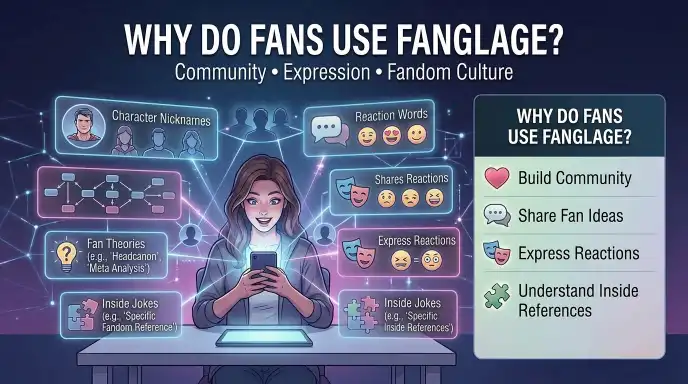
Fans use language because shared vocabulary makes it easier to communicate with people who already understand the same fandom. A single term can sometimes express an idea that would otherwise require a longer explanation.
Fanglage can also make fandom conversations feel more natural. Fans can quickly discuss characters, relationships, story events, theories, and fan-created content without repeatedly explaining common concepts.
Another reason is community connection. Using familiar fandom terms can show that someone understands the culture and conversations of that community. It can also make discussions more fun through inside jokes, references, and creative expressions.
However, finagling is not always easy for everyone. New fans and people outside the fandom may not know the terminology. Clear explanations can help make the community more welcoming and easier to understand.
How Does Fanglage Develop?
Fanglage develops naturally as fans communicate, share ideas, and create content around the same fandom. When a group of people discusses the same characters, stories, or fictional world for a long time, certain words and expressions can become familiar within that community.
Fans may shorten common phrases, give new meanings to existing words, or create expressions for ideas that are especially important to their fandom. Popular jokes, characters, relationships, story events, and fan theories can all contribute to this vocabulary.
Social media and online communities can help these terms spread quickly. A word that starts in one group may become familiar to fans in other communities. Some terms remain specific to one fandom, while others become common across many fandoms.
This is why fanglage is not a fixed list of words. It can grow and change as fan communities create new ways to talk about the things they enjoy.
Can One Fandom Have Its Own Fanglage?
Yes, a fandom can develop its own fanglage. Fans who spend a lot of time discussing the same show, book, game, artist, or fictional universe may create words and expressions that are especially meaningful to their community.
These terms can refer to specific characters, relationships, story events, jokes, theories, or fan-created ideas. A term that seems confusing to an outsider may be completely clear to experienced members of that fandom.
For example, fans may use a character’s name as part of an inside joke or create a short expression for a popular theory. Over time, other members may start using the same expression, turning it into part of the community’s shared vocabulary.
This makes language different from one universal dictionary. Some terms are common across many fandoms, while others are closely connected to one particular fan community.
Can Fanglage Spread Between Fandoms?
Yes, some forms of ganglage can spread from one fandom to another. Fans often participate in more than one online community, so familiar words and expressions can move between different groups.
For example, terms such as “canon,” “headcanon,” “ship,” and “AU” are understood by fans in many different communities. A person who already knows these terms may use them when joining a new fandom.
Social media can also help fandom vocabulary spread. A popular post, meme, fan theory, or expression can reach people outside its original community and become familiar to a wider audience.
However, not every fandom term spreads widely. Some expressions depend on a specific character, storyline, joke, or community tradition. These terms may remain meaningful only to fans of that particular fandom.
How Does Fanglage Change Across Different Fandoms?
Fanglage can look different from one fandom to another because every community has its own characters, stories, traditions, and interests. Some terms are widely understood, while others only make sense when you know the specific fandom.
TV and Movie Fandoms
Fans may use terms related to characters, relationships, episodes, storylines, and fan theories. Discussions can also include words connected to canon and alternative interpretations.
Book Fandoms
Readers may use language when discussing characters, fictional worlds, favorite pairings, theories, and fanfiction based on a book or series.
Anime and Manga Fandoms
These communities can have vocabulary connected to characters, story arcs, relationships, genres, and fan-created content. Some terms may also come from Japanese language or community traditions.
Gaming Fandoms
Gaming communities may use specialized terms related to characters, lore, gameplay, updates, strategies, and fictional worlds. Some vocabulary can overlap with general gaming slang.
Music Fandoms
Music fan communities can develop expressions related to artists, songs, albums, performances, fan events, and community traditions.
The important point is that language is flexible. A term that feels obvious in one fandom may need an explanation in another.
Fanglage and Online Fandom Culture
Fanglage is closely connected to online fandom culture because fans often communicate through communities built around shared interests. These communities can form around movies, television shows, books, anime, games, music, or fictional characters.
Shared vocabulary helps fans understand one another. A person who knows the common terms of a fandom can follow discussions about characters, relationships, theories, and story events without needing every idea explained.
Fanglage can also become part of a community’s identity. Fans may use inside jokes, abbreviations, references, and specialized expressions that feel familiar to other members. These shared terms can make online conversations more engaging and help fans feel connected.
At the same time, this language can create a barrier for newcomers. Someone who has just joined a fandom may see several unfamiliar terms in one conversation. Learning the basic vocabulary can make it easier to understand discussions and participate confidently.
Why Can Fanglage Be Hard for New Fans?
Fanglage can be difficult for new fans because experienced community members often use familiar terms without explaining them. A short comment may contain several words that only make sense when you already know the fandom and its culture.
Abbreviations can make this even harder. New fans may also encounter character nicknames, inside jokes, shipping terms, story references, or community-specific expressions that are unfamiliar.
Another challenge is that the same word can have different meanings in different communities. A term that is common in one fandom may be rare or completely unknown in another.
The good news is that language becomes easier with context. Reading community discussions, checking fandom glossaries, and asking other fans for explanations can help new members learn the vocabulary naturally.
Common Misunderstandings About Fanglage
Fanglage can be misunderstood because the term is not widely known outside fandom communities. Some readers may think it refers only to slang, but it can cover a wider range of language used by fans.
Another common misunderstanding is that every fandom uses the same language. In reality, different communities can develop their own words, abbreviations, references, and expressions. Some terms may be common across many fandoms, while others are meaningful only to one group.
It is also easy to confuse fanglage with general internet slang. Although the two can overlap, language focuses more on language connected to fan communities and their shared interests.
Finally, not every fandom term is necessarily slang. Some words are jargon, abbreviations, technical terms, or simple community vocabulary. The meaning and purpose of a term depend on how fans use it.
Is Fanglage Used Outside Fandom Communities?
Fanglage is mainly connected with fan communities, but some fandom terms can become familiar outside their original communities. When a word becomes widely used online, people who are not active fans may start using it without knowing where it came from.
For example, terms such as “ship,” “canon,” and “headcanon” can appear in general internet conversations. Their meanings may still depend on the context, but they are no longer limited to one small fandom.
The word “fanglage” itself is much more niche. Most people are more likely to describe this type of language as “fandom slang,” “fanspeak,” or “fandom jargon.”
So, it is useful to separate the term from the language it describes. Fanglage mainly refers to fan-community language, while individual fandom terms can sometimes spread into wider online culture.
Is Fanglage Still Used Today?
Fanglage is best viewed as a niche term for the language used within fan communities. The specific word may not appear often in everyday online conversations, but the type of language it describes remains common across fandom spaces.
Fans continue to use specialized vocabulary when discussing characters, relationships, storylines, theories, fanfiction, fanart, and fictional worlds. Some of these terms are widely recognized, while others remain limited to particular communities.
It is also important to distinguish the word “fanglage” from the broader concept of fandom language. People may be more likely to say “fandom slang,” “fanspeak,” or “fandom jargon” when describing these expressions.
So, while “fanglage” is a relatively uncommon term, the shared language of fandom communities remains an important part of online fan culture.
How to Use Fanglage Correctly
Using fanglage correctly mainly depends on understanding the fandom and the people you are talking to. A term may be clear to experienced fans but confusing to someone who has never joined the community.
Before using a specialized expression, make sure you understand its meaning and context. This is especially important when a word has a different meaning outside fandom.
When talking with other fans, familiar terms can make conversations shorter and more natural. However, when speaking to a general audience, it is better to explain uncommon terms instead of assuming everyone knows them.
You should also remember that fandom vocabulary can differ between communities. A term that is common in one fandom may have little meaning in another. Using language with the right context helps keep conversations clear and respectful.
When Should You Avoid Using Fanglage?
Fanglage can be useful when talking with people who understand the same fandom, but it may not work well in every situation. Specialized terms can confuse readers who do not know the community or its vocabulary.
You may want to avoid using unfamiliar language in formal writing, school assignments, professional communication, or content written for a general audience. In these situations, clear and standard language is usually easier to understand.
It is also better to explain a niche fandom term when speaking with a new fan. This keeps the conversation welcoming and prevents misunderstandings.
You do not need to avoid finagling completely. The key is to consider your audience and the context. When everyone understands the terminology, using it can make a fandom conversation quick, natural, and enjoyable.
Fanglage in a Real Fandom Conversation
Fanglage becomes easier to understand when you see how fans use it in a normal conversation. Fans may combine several familiar terms when discussing characters, relationships, or story events.
For example:
Fan A: “That ship is still my OTP. I also have a headcanon that they knew each other before the main story.”
Fan B: “I like that idea, even though it is not canon.”
In this conversation, “ship” refers to a relationship that fans support, “OTP” means a favorite pairing, and “headcanon” refers to a personal idea about a character or story. “Canon” refers to information officially established within the fictional work.
To someone outside the fandom, these terms may sound confusing. To experienced fans, they provide a quick way to communicate detailed ideas without lengthy explanations.
Benefits and Problems of Fanglage
Fanglage can make communication easier for people who share the same fandom. Fans can use familiar terms to discuss characters, relationships, stories, and theories without explaining every detail. Shared vocabulary can also create a stronger sense of community.
Another benefit is speed. Short terms and abbreviations can express complex ideas in only a few words. Fanglage can also make conversations more playful through inside jokes and community references.
However, finagle can create problems for people who are new to a fandom. Too many unfamiliar terms can make conversations difficult to follow. Some expressions may also have different meanings in different communities.
For this reason, language works best when the audience understands the terminology. When speaking to newcomers or a general audience, adding a short explanation can make the conversation much clearer.
Fanglage and Community Identity
Fanglage can become an important part of how fans communicate and connect with one another. Shared words and expressions give members of a fandom a common way to discuss characters, stories, relationships, and ideas.
Using familiar fandom terms can also show that someone understands the community. Inside jokes, nicknames, abbreviations, and references may become meaningful to members who spend a lot of time in the same fandom.
This shared language can create a feeling of belonging. Fans may feel more comfortable when others understand the same terms and references without needing long explanations.
At the same time, community language should not be used to exclude new members. Explaining unfamiliar terms can help newcomers understand conversations and become part of the community more easily.
How to Understand an Unfamiliar Fanglage Term
If you come across a language term that you do not understand, the surrounding conversation can often provide useful clues. Start by identifying the fandom and looking at how other fans use the word.
You can also check a fandom glossary or a trusted reference source. If the term is community-specific, experienced fans may be able to explain it more clearly than a general dictionary.
It also helps to consider the context. Ask yourself if the word relates to a character, relationship, story event, fanfiction, fanart, or an inside joke.
If you are still unsure, asking for clarification is perfectly reasonable. Fandom communities can contain many specialized terms, and learning them gradually is often easier than trying to memorize everything at once.
Related Terms to Know
Understanding related fandom terms can make fanglage much easier to recognize. These words appear often in fan discussions and help people describe stories, characters, relationships, and fan-created content.
- Fandom: A community of people who share an interest in a particular work, creator, character, or subject.
- Fanspeak: Specialized language and vocabulary used within fandom communities.
- Fandom slang: Informal words and expressions commonly used by fans.
- Fandom jargon: Specialized terms that may require knowledge of a particular fandom.
- Canon: Information officially established within a fictional work.
- Fanon: Ideas that become popular among fans without being officially confirmed.
- Headcanon: A personal interpretation or idea a fan has about a character or story.
- Ship: A relationship or pairing that fans support or enjoy.
- OTP: A fan’s favorite pairing or relationship.
- AU: An alternate universe or version of the original fictional setting.
- OC: An original character created by a fan.
- Fanfiction: Fiction written by fans using existing characters or fictional worlds.
- Fanart: Artwork created by fans based on an existing work or character.
- Crossover: A fan work that combines characters or elements from different fictional worlds.
- Lore: The background information, history, and details connected to a fictional world.
These terms do not all mean the same thing, but they can form part of the broader language fans use to communicate. Knowing them also helps readers understand how fanglage works across different fandom communities.
What Are Some Common Fanglage Expressions?
Fanglage can include short expressions that help fans communicate ideas quickly. These expressions may describe characters, relationships, story events, or personal interpretations. Their meaning is often clear to people who already know the fandom.
For example, a fan may say that a character is “in character” when their actions match the established personality. A fan might call a favorite pairing their “OTP,” or describe an idea as their “headcanon.” Someone discussing an alternate version of a story may use “AU.”
Other expressions can be created within a specific fandom. These may come from memorable scenes, character names, popular theories, memes, or inside jokes. Because of this, there is no single fixed list of fanglage expressions used by every fandom.
The best way to understand these expressions is to look at how fans use them in context.
Final Takeaway
Fanglage slang refers to the shared language fans use when communicating within fandom communities. It can include slang, jargon, abbreviations, inside jokes, and specialized terms related to characters, stories, relationships, and fan-created works.
The term is closely connected with fanspeak, fandom slang, and fandom jargon. Some vocabulary is common across many fandoms, while other expressions develop within a specific community.
Understanding fanflage can make online fan discussions easier to follow. If a term is unfamiliar, checking the context or asking another fan can usually help. The key is to use fandom language according to the community and audience.
Frequently Asked Questions About Fanglage Slang
Q1. What does fanglage slang mean?
Fanglage slang refers to the special language used by fans when communicating within a fandom. It can include slang, jargon, abbreviations, inside jokes, and community-specific expressions.
Q2. What does fanglage mean in fandom?
In fandom, fanglage means the shared vocabulary and expressions fans use to discuss their favorite shows, movies, books, games, characters, and fictional worlds.
Q3. Is fanglage a real slang word?
Fanglage is a niche term associated with fandom language. It is not common everyday slang, but it is used to describe specialized language found in fan communities.
Q4. Is fanglage the same as fanspeak?
Fanglage and fanspeak are closely related terms. Both can describe specialized language used by fans. Fanspeak is generally the more familiar term for this type of fandom vocabulary.
Q5. What is fandom slang?
Fandom slang is informal language used by fans within a particular community. It can include words and expressions about characters, relationships, stories, theories, and fan-created content.
Q6. What is the difference between fanglage and fandom slang?
Fanglage is broader than fandom slang. It can include slang, abbreviations, jargon, technical terms, inside jokes, and other shared expressions used by fans.
Q7. What are some examples of finagle?
Common examples include terms such as canon, fanon, headcanon, ship, OTP, AU, OC, fanfiction, fanart, and crossover. Some terms are used across many fandoms, while others are specific to certain communities.
Q8. Where is finflag used?
Fanglage can appear on social media, online forums, Discord communities, fanfiction platforms, fan art communities, and other spaces where fans communicate.
Conclusion:
Fanglage slang is the shared language fans use to talk about their favorite shows, movies, books, games, characters, and fictional worlds. It can include slang jargon, abbreviations, inside jokes, and common fandom terms such as canon, headcanon, ship, OTP, and AU.
Although “fanglage” is a niche term, the idea behind it is common across online fandoms. Different communities can create their own expressions and meanings, while some terms spread across many fandoms.
Understanding fanflage makes fan discussions easier to follow and helps new fans feel more comfortable in online communities. When a term seems unfamiliar, checking its context or asking other fans can quickly make its meaning clear.